



What if your medical career didn’t have to be defined by the intense competition for a handful of seats in India? You’ve likely felt the weight of the NEET rankings and the anxiety of searching for a global alternative that doesn’t compromise on quality or clinical exposure. It’s a common struggle, and the fear of high attrition rates or the complexity of European faculty systems often adds to the stress of planning your future.
We understand that you’re looking for more than just a degree; you’re seeking a secure path to becoming a globally recognized physician. This guide provides everything you need to study medicine in Czech Republic in 2026. You’ll discover the specific entry requirements for prestigious institutions like Charles University, Palacký University, and Masaryk University, alongside a clear breakdown of tuition fees and living expenses.
By the end of this article, you’ll know exactly how to navigate the admission process and ensure your qualifications are valid for NExT or FMGE in India. We’ll also outline the roadmap for securing your residency in the EU or the USA, turning your medical ambitions into a manageable, step-by-step reality.
Key Takeaways
- Understand why a degree from the Czech Republic meets all National Medical Commission (NMC) requirements, ensuring you can return to practice in India seamlessly.
- Compare the prestigious faculties of Charles University and the high-tech simulation centers at Masaryk University to find your ideal academic fit.
- Learn the specific entrance exam strategies and NEET score requirements needed to successfully study medicine in Czech Republic in 2026.
- Get a detailed breakdown of 2026 tuition fees and living costs to plan your budget effectively for cities like Prague, Olomouc, or Brno.
- Access a step-by-step application timeline and document checklist to ensure a hassle-free transition to your medical studies this September.
Why Study Medicine in the Czech Republic in 2026?
The 2026 outlook for international medical graduates in the European Union is exceptionally bright. As healthcare systems across Europe adapt to an aging population, the demand for high-caliber physicians has never been greater. Choosing to study medicine in Czech Republic places you at the heart of this demand. The country’s medical faculties are not just historic institutions; they are modern powerhouses of research and clinical excellence. You’ll find yourself studying in an environment that values transparency and academic integrity above all else, ensuring that your investment in education pays dividends for decades.
Global recognition remains a cornerstone of the Czech medical degree. Every major faculty is listed by the World Health Organization (WHO) and holds World Federation for Medical Education (WFME) accreditation. This isn’t just a badge of honor. It’s a functional asset that allows graduates to pursue residency in the UK, USA, and beyond. The Czech education system is built on a rigorous “Golden Standard” that emphasizes deep theoretical knowledge followed by intensive clinical application. English-medium programs are specifically structured to support international cohorts. These programs offer a multicultural environment where you can build a global network of peers while receiving a world-class education.
NMC Recognition and the NExT Exam
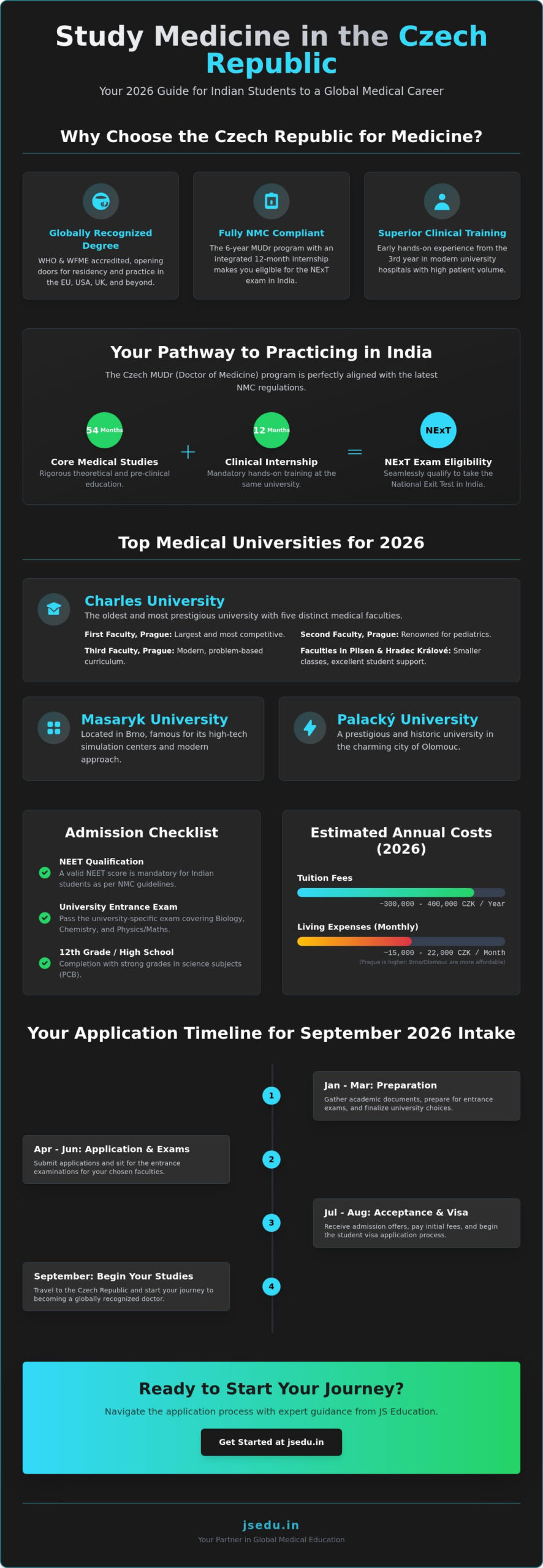
For Indian students, the most critical factor is compliance with the National Medical Commission (NMC). When you choose to study medicine in Czech Republic, you’re investing in a degree that is fully recognized back home. The 6-year MUDr (Doctor of Medicine) program is perfectly aligned with the latest FMGL (Foreign Medical Graduate Licentiate) regulations. It provides the mandatory 54 months of study followed by a comprehensive 12-month clinical internship within the same institution. This seamless structure ensures you’re fully eligible for the National Exit Test (NExT) upon your return to India. You won’t have to worry about the “duration” or “internship” traps that often affect students in other countries.
The Clinical Edge: Hospital Training in Central Europe
Czech medical schools offer a distinct clinical advantage over destinations like Georgia or Italy. While some countries focus heavily on classroom learning in the early years, the Czech system introduces clinical exposure by the third year. You’ll train in university-affiliated teaching hospitals equipped with the latest robotic surgery suites and diagnostic imaging technology. The sheer volume of clinical hours is a major differentiator. Students often log significantly more bedside time here than in other popular European hubs. This hands-on experience is vital for building the confidence needed for future residency placements. It’s this practical mastery that makes Czech graduates so competitive in the global job market.
Top Medical Universities in the Czech Republic: 2026 Roundup
Selecting the right institution is the most critical decision in your journey to study medicine in Czech Republic. While every medical faculty in the country maintains high standards, each offers a unique environment, curriculum focus, and clinical exposure. All medical programs are strictly regulated and accredited by the Czech Ministry of Education, which ensures that the quality of your degree remains consistent regardless of the city you choose. However, understanding the nuances between these universities will help you align your education with your long-term career goals in India or abroad.
Navigating the Five Faculties of Charles University
Charles University isn’t a single entity but a network of five distinct medical faculties, each with its own entrance exam and campus culture. The First Faculty of Medicine, located in the heart of Prague, is the oldest and largest. It offers the most competitive environment and a massive clinical base at the General University Hospital. If you’re looking for a more specialized approach, the Second Faculty is renowned for its pediatric focus at Motol University Hospital, while the Third Faculty utilizes an integrated, problem-based curriculum that emphasizes preventive medicine.
Many Indian students find the regional faculties in Pilsen and Hradec Králové to be excellent alternatives. These campuses offer a more intimate setting with smaller class sizes, which often translates to higher levels of individual student support. The Faculty of Medicine in Hradec Králové, in particular, has a long-standing reputation for welcoming international cohorts and providing a seamless transition for those coming from non-EU backgrounds. If you’re unsure which faculty aligns best with your academic profile, you can consult with our experts for personalized guidance on faculty selection.
Masaryk and Palacký: High-Tech Alternatives
Outside of Prague, Masaryk University in Brno has become a primary destination for those who value modern technology. Its Simulation Centre (SIMU) is a game-changer for medical education. Spanning 8,000 square meters, it allows students to practice complex procedures in a risk-free, high-fidelity environment before they ever step into a real ward. This focus on simulation helps bridge the gap between theory and practice, making it a favorite for students who prefer hands-on learning from day one.
Palacký University in Olomouc offers a different kind of charm. It’s one of the oldest universities in Central Europe and is highly regarded for its dentistry program and clinical research output. Olomouc itself is a quintessential “student city” where nearly one-fifth of the population is enrolled in the university. This creates a supportive, community-driven atmosphere that can be less overwhelming than the bustling streets of Prague. For students seeking a more affordable entry point, the University of Ostrava is a growing destination that offers quality English-taught programs with a focus on practical clinical skills and lower local living costs. Indian students who want to explore other NMC-compliant options in the region may also want to review the Medical University of Lublin Poland admission guide for 2026 as a comparable European alternative.
Admission Requirements and the ‘Difficulty’ Factor
If you’re planning to study medicine in Czech Republic, you’ve likely encountered forum posts on Reddit or Quora warning about the “difficulty” of the first year. Some students even label these institutions as “weed-out” schools. This is a significant misunderstanding of the European academic philosophy. Unlike the competitive entry model in India, where the hardest part is getting in, Czech universities focus on high exit standards. They don’t set traps for students; they simply demand consistent, high-level performance from day one. Success isn’t about luck; it’s about bridging the gap between Indian secondary education and European medical standards early in the process.
The formal eligibility criteria are straightforward. Indian students must have completed their 12th grade with a strong focus on Physics, Chemistry, and Biology (PCB). Crucially, a valid NEET scorecard is mandatory for Indian applicants to remain eligible for practice back home. You’ll also need to navigate the “Nostrification” process, which is the official recognition of your Indian high school diploma by the Czech authorities. Resources like Study in the Czech Republic provide extensive details on how these administrative steps fit into the broader academic landscape. While the paperwork might seem daunting, it’s a procedural hurdle that we help you clear with precision.
The Entrance Exam Blueprint
The entrance examination is the real gateway to your medical career. Unlike NEET, where Biology carries 50% of the weightage, Czech exams typically divide focus equally between Biology, Chemistry, and Physics. This shift often catches Indian students off guard, particularly in Physics. Many exams use a multiple-choice format that includes negative marking, meaning a “guess” can actively lower your score. Beyond the written papers, several faculties include an interview stage. This isn’t a test of your science knowledge but a deep dive into your motivation, ethical reasoning, and ability to communicate in a high-pressure medical environment.
Foundation Programs: Your Secret to 100% Success
To study medicine in Czech Republic successfully, JS Education often recommends a pre-medical foundation year, especially for students coming from CBSE or ICSE backgrounds. The jump from Indian board exams to the rigors of a 6-year MUDr program is steep. A foundation year doesn’t just help you clear the entrance exam; it builds the stamina you’ll need for the first year of medical school. These programs focus on:
- Advanced Science: Aligning your Chemistry and Physics knowledge with European university standards.
- Medical English: Mastering the specific terminology used in clinical settings.
- Czech Language Basics: While your degree is in English, you’ll need basic Czech to communicate with patients during hospital rotations in your third year.
Taking this extra step transforms a daunting challenge into a manageable, structured journey toward your degree.
Costs of Studying Medicine in the Czech Republic (2026)
Planning your finances is a vital step toward a successful medical career. For the 2026 intake, tuition fees for English-taught General Medicine programs vary significantly between the capital and regional cities. At the prestigious Charles University First Faculty of Medicine in Prague, the annual tuition is €24,250. If you look toward the Faculty of Medicine in Hradec Králové, the cost is approximately $19,000 per year. For students seeking a more mid-range budget, Palacký University in Olomouc offers General Medicine at €12,500 per year, while Masaryk University in Brno sets its fee at 380,000 CZK. These figures reflect the high standard of clinical training and global prestige you receive in return.
You should also account for essential administrative costs that often go overlooked. Health insurance for international students is mandatory and must meet specific Czech regulatory standards. Additionally, you’ll need to budget for annual visa renewals and approximately 124,500 CZK in demonstratable funds to satisfy residency requirements. While scholarships for international students are competitive, high achievers can often apply for merit-based grants after their first year of successful study. When you study medicine in Czech Republic, these costs are an investment in a degree that opens doors across the European Union and beyond.
Monthly Living Expenses for Indian Students
Your lifestyle choices will largely dictate your monthly budget. Student dormitories are the most economical option, typically costing between 5,000 and 9,000 CZK per month. Private shared apartments in Prague can easily exceed 15,000 CZK, so many students prefer the community atmosphere of university housing. Indian students often find that cooking at home is both a comfort and a major cost-saver. Local supermarkets are affordable, though you’ll find a wider range of Indian spices in Prague or Brno. Don’t forget to use your ISIC card; it provides substantial discounts on public transport, books, and even meals at university canteens.
Financial Comparison: Czech Republic vs. Other EU Destinations
It’s natural to compare these costs with other popular hubs. For example, many students explore an MBBS in Georgia for Indian students because of the lower tuition and living expenses. Students considering neighboring Central European countries should also review the detailed MBBS in Poland fees for 2026, which typically range between EUR 7,000 and EUR 15,000 annually and offer a useful benchmark when weighing the overall cost of an EU medical degree. However, the Czech Republic offers a different value proposition. While the initial investment is higher, the long-term ROI is exceptional due to the country’s integration into the EU labor market and its reputation in the USA. Graduates often transition directly into high-paying residencies in Germany or the UK. If you’re ready to map out your specific financial plan, contact our team for a personalized cost-of-study breakdown.
How to Start Your Application with JS Education
Securing your seat to study medicine in Czech Republic for the September 2026 intake requires a disciplined approach to deadlines and documentation. Most faculties at Charles University close their applications between April 15 and May 7, 2026. However, Palacký University Olomouc and Masaryk University offer slightly more flexibility, with deadlines extending to June 30 and July 31 respectively. We recommend starting your process at least six to eight months before these dates to ensure all paperwork is immaculate. A rushed application is the most common reason for avoidable delays or rejections.
The document checklist is precise and non-negotiable. You’ll need your 10th and 12th-grade transcripts, a valid NEET scorecard, and a comprehensive medical certificate. Crucially, your Indian educational documents must undergo the “apostille” process to be recognized by Czech authorities. This legal verification confirms the authenticity of your certificates for international use. We manage this entire administrative burden for you, ensuring that every transcript and certificate meets the exact standards of the Czech Ministry of Foreign Affairs.
Visa processing is often the most stressful phase for Indian families. You’ll apply for a long-stay study visa at the Czech Embassy in Delhi or the Consulate in Mumbai. This process requires proof of accommodation, health insurance, and a criminal record extract. Since visa appointments can be scarce and processing takes at least 60 days, we coordinate your submission to align perfectly with your university acceptance. Our support doesn’t end at the border; we arrange airport pickups and help you settle into your first apartment or dormitory so you can focus entirely on your studies from day one.
Why Choose JS Education for the Czech Republic?
With over 20 years of experience in European medical admissions, we’ve built the deep local knowledge necessary to navigate the nuances of the Czech system. We aren’t just consultants; we’re strategic partners with direct ties to top faculties and foundation program providers. Our fee structure is completely transparent. You’ll never encounter hidden “consultancy traps” or unexpected surcharges. We take pride in our role as bridge-builders, connecting your current academic reality in India with a world-class professional future in Europe.
Beyond the Admission: Support Throughout Your Degree
Success in medical school depends on your support network. We connect you with senior Indian students already thriving in Prague, Brno, and Olomouc to provide peer-to-peer mentorship. If your long-term goal is to practice in the USA or the UK, we provide early guidance for the USMLE and PLAB exams. This ensures you’re preparing for global licensing while simultaneously mastering your university curriculum. For those still weighing their options in Central Europe, you might also consider comparing these programs with the Medical University of Warsaw to see which clinical environment best suits your personal learning style.
Secure Your Medical Future for the 2026 Intake
Choosing to study medicine in Czech Republic is a definitive step toward a prestigious global career. You now understand that while the academic standards are high, they’re entirely manageable with the right preparation and a strategic “foundation-first” approach. By aligning your goals with NMC-compliant universities and planning your budget with transparency, you’re not just earning a degree; you’re gaining entry into the world’s most respected medical communities.
JS Education serves as your trusted advisor throughout this high-stakes transition. As an official representative of top European medical faculties, we only work with NMC and WHO recognized universities. With 2000+ students successfully placed, our team possesses the local expertise and international connections to make your application seamless. We’re invested in your long-term outcome, from the first entrance exam to your eventual residency placement.
Don’t leave your medical ambitions to chance. Book a Free 2026 Admission Counseling Session with JS Education and let us help you build a clear, reliable path to your white coat. Your journey to becoming a world-class physician starts with a single, informed decision.
Frequently Asked Questions
Is the NEET exam mandatory to study medicine in the Czech Republic?
Yes, a valid NEET scorecard is mandatory for Indian students who wish to study medicine in Czech Republic and return to practice in India. The National Medical Commission (NMC) requires this qualification for your degree to be valid for the NExT exam. Even if a university doesn’t ask for it during the initial application, you must possess it to secure your future eligibility in the Indian healthcare system.
Can I practice in India after completing my MD from a Czech university?
You’re fully eligible to practice in India after completing your MD, provided you clear the mandatory National Exit Test (NExT). Since top Czech institutions are recognized by the NMC and WHO, your 6-year degree meets all the legal requirements for “Foreign Medical Graduates.” We ensure that every university we represent adheres to these critical compliance standards for your peace of mind.
What is the passing percentage for entrance exams in Charles University?
Admission is based on a competitive ranking system rather than a fixed passing percentage. Each faculty at Charles University has a limited number of seats for the English program; they accept the top-scoring candidates from the entrance exam. While the exams are rigorous, students who prepare through specialized foundation programs often find themselves in the top percentiles of the merit list.
Is the Czech language mandatory for medical students?
Learning basic Czech is mandatory for your clinical years, even though the curriculum is entirely in English. You’ll need to communicate with local patients during hospital rotations starting in your third year. Most universities integrate Czech language classes into the first two years of the program to ensure you’re comfortable and confident by the time you reach the wards.
Are there any scholarships for Indian students in the Czech Republic?
Merit-based scholarships are available for international students who demonstrate exceptional academic performance during their studies. These are usually awarded from the second year onward based on your GPA. While full-ride entrance scholarships are rare, some regional faculties offer smaller grants or housing subsidies to high-achieving Indian students to help offset the cost of living.
What happens if I fail the entrance exam on the first attempt?
You can apply to multiple faculties in the same year to increase your chances of success. If you don’t clear the exam for your first-choice faculty, you might still secure a seat at another. Alternatively, many students choose to enroll in a pre-medical foundation year to strengthen their science knowledge and guarantee a successful attempt during the next admission cycle.
How much is the total budget for a 6-year medical degree in Prague?
A 6-year medical degree in Prague requires a total budget of approximately €180,000 to €210,000. This estimate includes the tuition fees for the First Faculty of Medicine and average living expenses in the capital. If you choose regional cities like Hradec Králové or Olomouc, this total can be significantly lower. It’s vital to plan for the entire duration to ensure a hassle-free academic journey.
Can I work part-time while studying medicine in the Czech Republic?
You can legally work up to 20 hours per week on a Czech study visa, but it’s rarely recommended for medical students. The workload to study medicine in Czech Republic is intense, especially during the first two years of pre-clinical studies. While some students take on light part-time roles during the summer, focusing on your grades is usually the best strategy for long-term success.