


Did you know that over 5,000 Indian students are currently carving out their medical careers in Georgia, with leading institutions achieving FMGE pass rates as high as 35.95%? Choosing to study MBBS in Georgia for Indian students is no longer just a backup plan; it’s a strategic move for those who want global standards without the ambiguity of shifting regulations. You probably feel the weight of this decision, especially with the strict NMC FMGL 2021 requirements and the upcoming NEXT exam. It’s common to feel overwhelmed by the choice between private and government universities or the fear of hidden consultancy traps.
We understand that your goal isn’t just a degree, but a successful career in medicine. This guide promises to show you how to secure a world-class, NMC-compliant education with the transparent support and expert mentorship you need. We’ll provide a definitive roadmap for 2026, covering the mandatory 5.5-year study and internship cycle, safety in Tbilisi, and how to ensure your degree opens doors for practice in India or global mobility across the US and Europe.
Key Takeaways
- Identify which Georgian universities fully comply with the latest NMC FMGL 2021 regulations, including mandatory internship and English-medium instruction requirements.
- Compare the clinical advantages of prestigious government institutions against the modern infrastructure of private medical universities to make an informed choice.
- Discover why an MBBS in Georgia for Indian students serves as a powerful springboard for clearing the NEXT exam and accessing global pathways like USMLE or PLAB.
- Gain a transparent breakdown of living expenses and safety protocols in Tbilisi to ensure a secure and budget-friendly educational journey.
- Learn how to navigate the 2026 admission cycle without hidden fees by leveraging a structured, mentor-led approach to international enrollment.
Why Choose MBBS in Georgia in 2026? (The Strategic Advantage)
The landscape for medical education is shifting rapidly. In 2026, Georgia has emerged as a premier clinical hub, currently hosting over 5,000 Indian students. This surge isn’t accidental. It’s the result of a deliberate alignment between Georgian medical standards and global licensing requirements. Why do so many families now look toward the Caucasus? The answer lies in the “Global Gateway” effect. A Georgian medical degree doesn’t just prepare you for India; it’s a launchpad for the USMLE in the United States and PLAB in the United Kingdom. Choosing to pursue an MBBS in Georgia for Indian students means investing in a degree that carries weight across borders.
The cost-to-quality ratio remains a primary driver for this preference. You’ll find high-end European infrastructure, including advanced simulation labs and modern research facilities, at a fraction of the cost of Indian private medical colleges. This financial transparency, combined with English-medium excellence, ensures that your focus stays on your studies rather than language barriers or hidden fees. The strengthening of Georgia-India relations has further solidified this path, making the transition smoother for students and providing a stable diplomatic foundation for their stay. It’s a seamless bridge between your current aspirations and a professional future in global healthcare.
Georgia vs. Other MBBS Abroad Destinations
When you compare Georgia to Central Asian destinations like Kazakhstan or Kyrgyzstan, the clinical standards often stand apart. Georgia’s universities emphasize practical, bedside training that mirrors European protocols, ensuring students aren’t just memorizing textbooks but practicing real-world medicine. Safety is another deciding factor. Georgia consistently ranks as one of the top 10 safest countries globally, which provides immense peace of mind for parents. You aren’t just moving to a campus; you’re integrating into a welcoming, multicultural European lifestyle that respects Indian traditions while offering a broad, global perspective.
Career Prospects After Graduation
What happens after you earn your degree? The path is clear and well-defined. Georgian medical programs are designed to be fully eligible for the National Exit Test (NEXT) in India, which is mandatory for licensure. Because the curriculum follows international benchmarks, students often find themselves well-prepared for the rigors of global licensing exams. Whether your goal is to return home to practice in a top-tier Indian hospital or pursue a specialized residency in the UK or USA, the Georgian MD degree holds significant value. It’s a credential that signals both academic depth and clinical competence in an increasingly competitive market.
Understanding the NMC FMGL Regulations (Recognition & Eligibility)
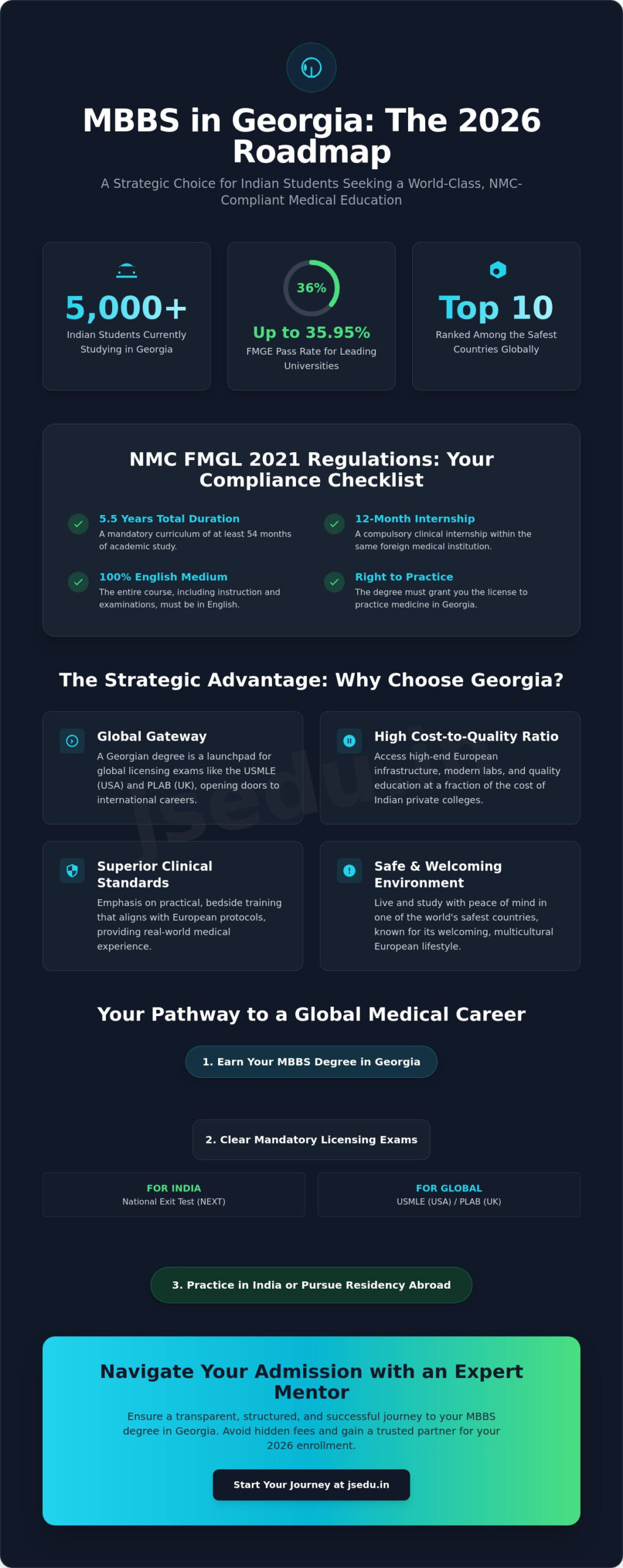
For those planning an MBBS in Georgia for Indian students, the legal framework is just as important as the academic one. The National Medical Commission (NMC) issued the Foreign Medical Graduate Licentiate (FMGL) Regulations in November 2021, and these standards remain the benchmark for 2026 admissions. You must ensure your chosen university provides a minimum of 54 months of academic study. This isn’t just a suggestion; it’s a hard requirement for your degree to be recognized back home.
Clinical exposure is the next critical pillar. The NMC mandates a 12-month internship completed within the same foreign medical institution where you earned your degree. In Georgia, this means your clinical rotation is integrated into the 5.5-year total duration. Additionally, the entire curriculum must be delivered in English. If any part of your instruction or examination is conducted in a local language, you risk disqualification during the Indian licensure process. The rules are clear. There’s no room for ambiguity when your career is on the line.
One of the most frequently overlooked rules is the “Right to Practice” clause. To be eligible for the NEXT exam in India, your Georgian degree must legally entitle you to register and practice medicine in Georgia. This requirement ensures that the quality of your education meets the host country’s national standards. If you’re feeling uncertain about these technicalities, reaching out to an experienced admission mentor can help you verify university-specific compliance before you commit. It’s about building your future on a solid legal foundation. Working with trusted MBBS in Europe consultants who are well-versed in NMC compliance is one of the most effective ways to avoid costly mistakes during this process.
Eligibility Criteria for Indian Students
Entry requirements for 2026 are straightforward but strict. You must qualify for the NEET-UG exam; without a valid NEET scorecard, you cannot practice in India regardless of your international success. Academically, you need a minimum of 50% in Physics, Chemistry, and Biology (PCB) for the General category, or 40% if you belong to a Reserved category. Finally, you must be at least 17 years old by December 31st of your admission year. These benchmarks ensure you have the academic readiness for a rigorous medical curriculum.
Checklist for NMC Compliance
The FMGL 2021 regulations are the legal guidelines that define which foreign medical degrees are valid for practice in India. To stay compliant, follow this verification path:
- Confirm the university is recognized by the relevant Georgian authorities and listed in global directories.
- Verify the course duration is at least 5.5 years, including the integrated internship.
- Ensure the degree is equivalent to an MBBS in India, granting you full registration rights in Georgia.
Selecting the Best Medical University in Georgia (Government vs Private)
Deciding on the right institution is the most critical step once you’ve committed to the path of an MBBS in Georgia for Indian students. Georgia’s educational landscape is split between venerable government universities and agile, innovative private institutions. Government universities, such as Tbilisi State Medical University and Batumi Shota Rustaveli State University, are synonymous with prestige. They offer a historical clinical heritage and deep-rooted connections with state-run hospitals. This often translates to a high volume of patients and diverse clinical cases during your rotations, which is vital for developing diagnostic skills.
Private universities like Alte University and David Tvildiani Medical University represent the modern face of Georgian medical education. These institutions often prioritize small class sizes and a highly personalized approach to mentorship. They frequently align their curricula with international benchmarks, making them excellent choices for students who have their sights set on residency in the United States or Europe. The innovation in these schools often includes advanced simulation centers that allow for risk-free clinical practice before you ever step into a hospital ward.
The 2026 academic calendar offers two distinct entry points. The primary intake begins in September, with applications typically opening as early as May. A secondary intake in February provides flexibility for students who need more time to finalize their documents or NEET results. When reviewing fee structures, look beyond the annual tuition. A truly transparent plan includes hostel costs, health insurance, and visa renewal fees. We advise students to demand a comprehensive breakdown to ensure no hidden administrative charges surface mid-semester. This clarity is essential for long-term financial planning and peace of mind.
Top-Ranked Universities for 2026
Tbilisi State Medical University remains the most popular choice for Indian families due to its massive alumni network and established reputation. For those focused on a Western career path, Georgian American University offers a curriculum specifically designed to aid in USMLE preparation. Meanwhile, New Vision University has gained traction for its research-heavy approach and strong clinical partnerships. Each of these institutions provides a unique environment, so your choice should reflect your specific career goals and learning preferences.
Government vs. Private: Which is right for you?
The choice often comes down to the learning environment you prefer. Private universities generally boast lower student-to-teacher ratios, which can be beneficial if you prefer direct interaction and frequent feedback from professors. In contrast, government universities offer the grandeur of historical campus life and extensive clinical bedside teaching in large public hospitals. While infrastructure in private schools is often more modern, the clinical depth of government institutions is hard to match. High-achieving Indian students should also inquire about merit-based scholarships, which are increasingly available in both sectors to attract top talent.
Life in Georgia for Indian Students (Safety, Costs & Culture)
Moving to a new country is a significant milestone. While the academic standards for an MBBS in Georgia for Indian students are a major draw, the daily experience of living in Tbilisi or Batumi is what truly shapes a student’s success. You’ll find a culture that’s deeply welcoming and increasingly attuned to the needs of the international medical community. It’s a place where tradition meets a modern, European outlook, creating a balanced environment for high-stakes study.
Let’s look at the numbers. A realistic monthly budget for an Indian student in Georgia typically ranges between ₹12,000 and ₹15,000. This estimate covers your basic accommodation, food, local transportation, and utilities. It’s remarkably affordable when compared to other European destinations. Most students find they can maintain a comfortable lifestyle without financial strain. This allows you to focus entirely on your clinical rotations and exam preparation rather than worrying about rising costs. For a detailed, itemized breakdown of every expense category, refer to this comprehensive guide on the cost of living in Georgia for Indian students in 2026.
Safety is often the top concern for families, especially for female students. Georgia consistently earns its reputation as a secure environment. You can walk the streets of Tbilisi late at night with a sense of peace that’s rare in many global capitals. The local police are visible and helpful, and the community is protective of its international guests. This security isn’t just a statistic; it’s a daily reality that makes the country feel like a second home.
You won’t feel isolated here. The Indian community in Georgia is vibrant and growing. From celebrating Diwali and Holi on campus to the widespread availability of Indian mess facilities, the support system is already in place. You’ll find student unions that help newcomers settle in, ensuring a smooth transition from your home in India to your new life abroad. Prepare for the seasons, though. Georgia experiences beautiful, warm summers, but the winters require high-quality gear for the snowy months. Well-heated university buildings make this change very manageable.
Accommodation Options
Most first-year students choose university hostels for their proximity to classes and built-in security. These shared living spaces are cost-effective and foster a strong sense of community. As you become more familiar with the city, you might consider private apartments. Renting in Tbilisi is generally more expensive than in Batumi, but sharing with classmates keeps costs low. The “Indian Mess” system is a lifesaver. It provides nutritious, familiar meals so you don’t have to worry about cooking during intense exam seasons.
Connectivity and Travel
Staying connected is simple and affordable. Upon arrival, you can easily pick up a local SIM card with high-speed data for a very low cost. Local transport, including the efficient Tbilisi Metro and a network of buses, is incredibly cheap and reliable. For travel back home, flights from major Indian hubs are frequent, with total travel time usually under 10 to 12 hours. If you’re ready to start this journey, you can apply for MBBS in Georgia today and begin your transition with expert guidance.
Seamless Admission with JS Education (Your Trusted Mentor)
Success in international medical education requires more than just an acceptance letter. It demands a strategic partnership with an expert who understands the nuances of the Georgian system. JS Education brings over 20 years of specialized expertise to the table, acting as a reliable bridge between your medical ambitions and the reality of practicing in India. We prioritize transparency above all else. When you plan your MBBS in Georgia for Indian students with us, you receive a clear and honest breakdown of the entire process. There are no hidden administrative costs or inflated promises. Our role is to ensure your transition is as smooth as it is legally sound.
Our commitment doesn’t end with your enrollment. We recognize that the ultimate goal for most Indian families is clearing the NEXT exam. That’s why our mentorship includes guidance on preparing for the Indian licensure exam right from your first year. We help you align your Georgian clinical training with the specific requirements of the National Medical Commission. This long-term focus transforms a simple admission service into a comprehensive career strategy. You aren’t just a student to us; you’re a future doctor whose success we’re invested in for the long haul.
Our Step-by-Step Guidance
The journey begins with personalized counseling. We analyze your NEET-UG scores and academic background to match you with a university that fits both your budget and your clinical interests. Once the selection is made, we handle the complex documentation, including necessary apostille services and official translations. Our team also provides preparation for visa interviews and assists with the logistics of your travel arrangements. We take the technical burden off your shoulders so you can focus on your upcoming academic challenges.
Post-Arrival Mentorship
Landing in Tbilisi is just the start of our local support. We provide airport pickup and assist with your initial hostel registration to ensure you feel settled from day one. Our local guardianship service remains active throughout your six-year journey, offering a reliable point of contact for any challenges you might face abroad. If you’re ready to take the first step toward a global medical career, you can Book a Free Counseling Session with JS Education and begin your journey with a partner you can trust.
Your Path to a Global Medical Career Starts Here
Navigating the 2026 admission cycle requires a firm grasp of NMC FMGL regulations and a clear understanding of the Georgian educational landscape. Whether you choose the historical prestige of a government university or the modern innovation of a private institution, your degree serves as a gateway to both the NEXT exam in India and international practice. Life in Georgia offers the safety and community support necessary to maintain your focus during these intensive years of study.
Securing an MBBS in Georgia for Indian students is a transformative decision that aligns academic excellence with long-term professional security. With 20 years of excellence and a 100% visa success rate, we leverage our direct university partnerships to guide you through every step of this journey. We ensure your documentation is flawless and your transition is seamless.
Start Your Medical Journey Today – Get a Free 2026 Georgia Admission Brochure
Your ambition to become a doctor deserves a foundation built on transparency and expert mentorship. We’re here to help you turn that vision into a reality.
Frequently Asked Questions
Is the MBBS degree from Georgia valid in India for the 2026 batch?
Yes, the degree is fully valid provided the university complies with the NMC FMGL Regulations 2021. This includes a minimum course duration of 54 months and a mandatory 12-month internship at the same institution. Since the medium of instruction is English and the curriculum aligns with international standards, students from the 2026 batch can confidently return to India to appear for the National Exit Test (NEXT).
Do I need to clear NEET to study MBBS in Georgia?
Yes, qualifying for the NEET-UG exam is a mandatory requirement for any Indian student pursuing a medical degree abroad. While some Georgian universities may offer admission without a high NEET score, the National Medical Commission requires a qualification certificate to grant you eligibility to practice in India. Without this, you won’t be able to sit for the licensure exams or register as a medical practitioner upon your return.
What is the total cost of MBBS in Georgia including hostel and food?
The total cost varies based on the university, but it remains significantly more affordable than private medical education in India. Tuition fees across Georgian institutions typically range from USD 4,000 to USD 8,000 per year. For living expenses, students should budget approximately ₹12,000 to ₹15,000 per month. This amount generally covers comfortable accommodation, nutritious food, local transport, and other essential utilities in cities like Tbilisi or Batumi.
Is IELTS or TOEFL required for admission to Georgian medical universities?
Most Georgian medical universities don’t require formal IELTS or TOEFL scores for admission. Instead, institutions often conduct their own internal English proficiency interviews or entrance tests to ensure students can handle the medical curriculum. Since the entire course is taught in English, having a strong grasp of the language is essential for success in both academic examinations and clinical rotations during your MBBS in Georgia for Indian students.
Can I work in Georgia after completing my MD degree?
Yes, you’re eligible to work in Georgia after completing your MD degree, provided you meet the local licensing requirements. In fact, the NMC mandates that your foreign degree must grant you the right to practice medicine in the host country. This ensures that the quality of education meets national healthcare standards. Many students choose to stay for specialized training or use their degree as a stepping stone to practice in the UK or USA.
How difficult is the NEXT exam for students returning from Georgia?
The difficulty of the NEXT exam depends on your clinical foundation and early preparation. Students returning from Georgia often perform well because the curriculum emphasizes practical training and bedside teaching. For instance, European University reported an FMGE pass rate of 35.95% in 2025, which was notably higher than the national average of 23.9%. Starting your preparation in the first year and focusing on clinical concepts will make the transition much smoother.
Are there Indian teachers in Georgian medical universities?
While the majority of the faculty members are Georgian and European experts, several universities do employ international professors, including those from India. These educators often assist with clinical subjects and help bridge the gap between Georgian teaching methods and the requirements of Indian licensure exams. Regardless of the faculty’s nationality, the focus remains on delivering a globally recognized medical education that meets the high standards expected for an MBBS in Georgia for Indian students.
Is Georgia safe for female Indian students?
Georgia is widely recognized as one of the safest countries in the world for international students. It consistently ranks in the top 10 of global safety indices due to its low crime rates and respectful culture. Female students find the environment in Tbilisi and other university towns to be very secure, even when traveling alone. The presence of a large, supportive Indian student community and active local police further ensures a protected and welcoming atmosphere.