



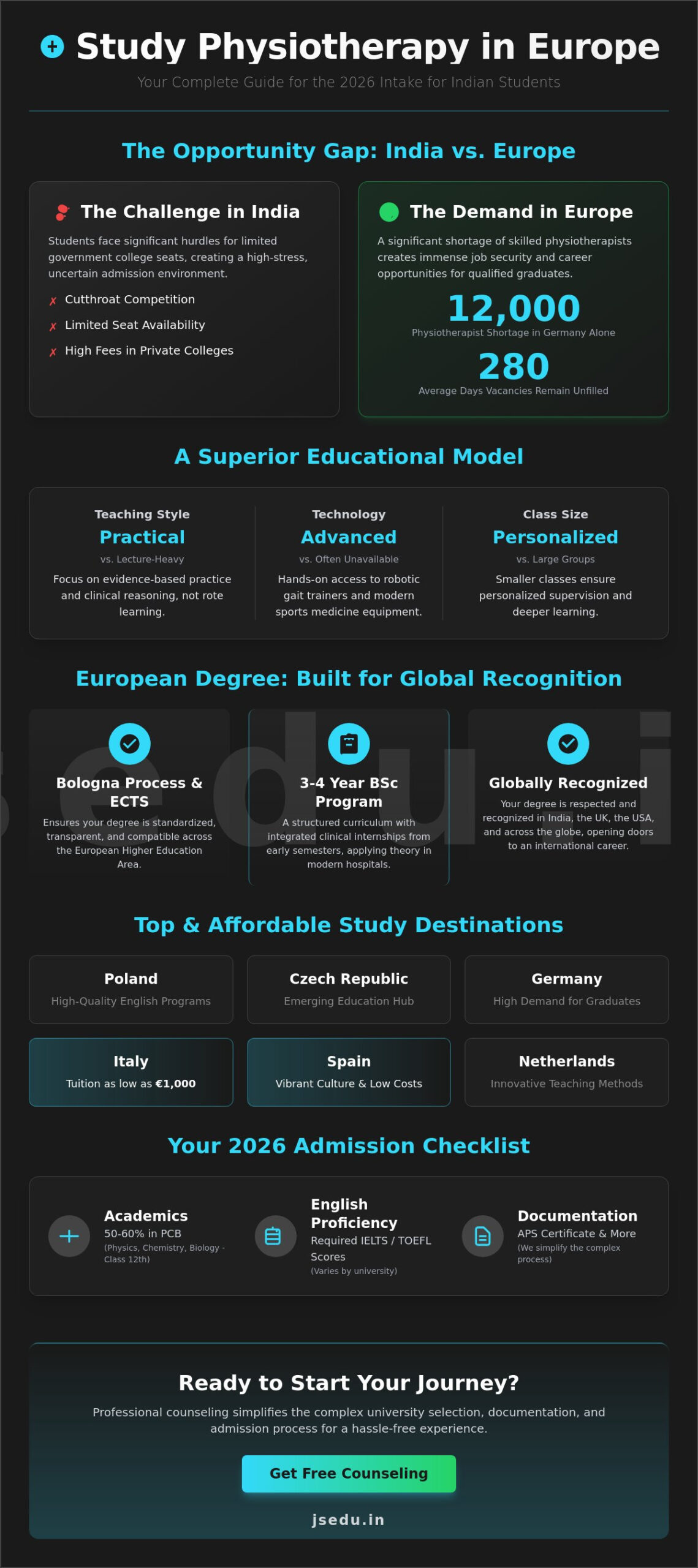
Did you know that Germany currently faces a shortage of approximately 12,000 physiotherapists, with vacancies remaining unfilled for an average of 280 days? While thousands of Indian students struggle against the cutthroat competition and limited seats in local government medical colleges, a world-class physiotherapy course in Europe offers a direct path to a stable, global career. It’s understandable to feel overwhelmed by confusing accreditation rules or the fear of language barriers during hospital internships. You aren’t alone in wanting a degree that’s recognized in India, the UK, and the USA without the stress of an uncertain admission process.
This guide simplifies your journey by breaking down everything you need for the 2026 intake. We’ll show you how to secure admission into top-ranked, English-taught programs where clinical exposure in modern hospitals is the standard, not a luxury. You’ll find specific details on tuition fees, which can be as low as €1,000 in Italy or Spain, alongside critical application deadlines for the Netherlands and Germany. From navigating the APS certificate requirements to understanding post-study work visas, we’re here to ensure your transition to becoming a global healthcare professional is seamless and successful.
Key Takeaways
- Learn why European healthcare standards and evidence-based practice provide a superior foundation for a global career in rehabilitation and sports medicine.
- Understand how the Bologna Process and ECTS system ensure your degree is transparent and recognized across the European Higher Education Area.
- Identify the most cost-effective destinations for a physiotherapy course in Europe, including hubs like Poland and the Czech Republic that offer high-quality English-medium programs.
- Review the 2026 academic prerequisites, including the 50-60% PCB requirement and necessary IELTS or TOEFL scores for Indian applicants.
- Discover how professional counseling simplifies the complex university selection and documentation process for a hassle-free admission journey.
Why Pursue a Physiotherapy Course in Europe in 2026?
Choosing a physiotherapy course in Europe is a strategic investment in a career that transcends borders. While Indian students often face extreme competition for limited seats in government colleges, European universities provide a clear, merit-based alternative with world-class standards. These programs emphasize evidence-based practice, ensuring you graduate not just with a degree, but with the clinical skills required by international healthcare providers. It is a path that prioritizes professional competence over rote learning.
European institutions are pioneers in medical technology. You’ll gain hands-on experience with advanced rehabilitation tools, such as robotic-assisted gait training and specialized sports medicine equipment, which are often unavailable in standard Indian private colleges. The financial burden is also frequently lighter abroad. Many public universities in Europe offer tuition fees that are significantly lower than the high premiums charged by private medical institutions in India. This makes a global education surprisingly accessible for families who value quality and transparency. The European Physiotherapy Degree Structure is specifically designed to integrate theory with heavy clinical exposure. You’ll participate in rotations across multi-specialty hospitals, working alongside experts in neurology, orthopedics, and cardiopulmonary care.
The Global Demand for Skilled Physiotherapists
The need for rehabilitation experts is at an all-time high. Europe’s aging population requires specialized geriatric care to maintain mobility and independence. Similarly, the post-pandemic landscape has shifted focus toward respiratory rehabilitation, creating new roles for skilled therapists. Beyond hospitals, you’ll find diverse opportunities in professional sports clubs, pediatric clinics, and private wellness centers. Germany alone reports a shortage of nearly 12,000 physiotherapists, which highlights the immense job security and career stability awaiting qualified graduates in the 2026 cycle.
Europe vs. India: Comparing the Educational Experience
The primary difference lies in the patient-centered care model. While Indian education is often lecture-heavy, European programs prioritize practical research and clinical reasoning. Smaller class sizes are a hallmark of the European system. Instead of being one among a hundred students, you’ll receive personalized supervision from clinical instructors. This environment fosters deeper learning and professional confidence. You’ll also build a global network, interacting with peers and mentors from various cultural backgrounds. This exposure is essential for anyone aiming to practice in the UK, USA, or international health organizations. Indian students exploring broader healthcare education options abroad may also find it valuable to review nursing programs abroad for Indian students, which covers similar English-medium destinations and global career pathways in the 2026 cycle.
Understanding the European Physiotherapy Degree Structure
The framework of a physiotherapy course in Europe is primarily defined by the Bologna Process. This international agreement ensures that higher education systems across the European Higher Education Area are compatible, consistent, and transparent. For an Indian student, this means your degree follows a standardized quality assurance protocol, making it much easier to verify your credentials globally. Most Bachelor of Science (BSc) programs in this field last between three and four years. A standout feature of these programs is the integrated clinical internship. You won’t just study anatomy in a classroom; you’ll apply your knowledge in modern hospital settings starting from your early semesters.
Transparency is the core of this system. Every student receives a Diploma Supplement, which describes the nature, level, and content of the studies performed. Understanding EU professional qualification recognition is vital if you plan to move between different European countries or return to India. This structure ensures that your hard work translates into a qualification that healthcare boards actually respect. If you feel uncertain about how these academic stages fit your specific career goals, you can speak with a dedicated counselor to clarify your options.
BSc Physiotherapy vs. BPT: Understanding the Nomenclature
In India, the standard degree is the Bachelor of Physiotherapy (BPT). In Europe, it’s typically a Bachelor of Science (BSc). Despite the different names, these degrees align closely in terms of clinical hours and core subjects like biomechanics, kinesiology, and exercise therapy. Most top-tier European universities ensure their curricula meet the standards set by the World Physiotherapy organization. This alignment is what allows you to apply for licensing in the UK, USA, or Australia after graduation. The Diploma Supplement acts as your bridge, providing a detailed breakdown of your clinical competencies for international boards.
The Role of ECTS in Global Mobility
The European Credit Transfer and Accumulation System (ECTS) is a tool that helps Indian students understand their workload. One academic year typically equates to 60 ECTS credits. A standard three-year degree totals 180 ECTS, while a four-year program reaches 240 ECTS. These credits represent more than just time in a chair; they quantify your lectures, seminars, and hospital hours. This system simplifies the process of transferring to a Master’s program in countries like Canada or the USA. It also helps the Indian Association of Physiotherapists (IAP) evaluate your degree equivalence, ensuring a smoother registration process if you choose to practice back home.
Best European Countries for Affordable Physiotherapy Degrees
Selecting the right destination for a physiotherapy course in Europe involves balancing academic prestige with financial feasibility. While many students initially look toward the UK or Ireland, the high tuition and living costs often make those options unreachable for many Indian families. Instead, Central and Southern Europe have emerged as strategic hubs that offer world-class standards without the prohibitive price tag. These countries provide degrees fully taught in English, ensuring you don’t face language barriers during your core medical studies.
Poland is a prime example of this balance. It has become a major destination for medical education, with several top-tier medical universities offering specialized physiotherapy tracks. These programs are designed to meet the rigorous standards set by the Europe Region of World Physiotherapy, which ensures your qualification is respected across the continent. The cost of living in Polish cities like Lublin or Poznan remains significantly lower than in Western European capitals, allowing you to focus on your clinical rotations without constant financial stress.
Physiotherapy in Poland and the Czech Republic
The Czech Republic is another heavyweight in the field of rehabilitation. Known for its traditional approach to spa medicine combined with modern kinesiology, it offers a unique educational environment. Universities here emphasize hands-on techniques from the very first year. For a deep dive into specific entry requirements and application timelines, you should refer to our Physiotherapy in Czech Republic for Indians: 2026 Admission Guide. Both Poland and the Czech Republic offer a high quality of life and a safe environment for international students, making the transition from India much smoother.
Strategic Alternatives: Italy and Georgia
Italy offers a different but equally compelling advantage. Public universities in Italy are world-renowned, and many provide regional tuition waivers or scholarships based on family income. This can bring your education costs down to almost zero in some cases. However, admission is often competitive and may require specific entrance examinations similar to the IMAT used for medical programs. It is a path for students who are confident in their academic standing and want a degree from one of the world’s oldest and most respected medical systems.
Georgia is rapidly becoming a favorite for Indian students due to its streamlined admission process and lack of complex entrance exams. The healthcare infrastructure in Georgia is expanding, providing ample clinical practice opportunities in modern facilities. The success of MBBS in Georgia for Indian students has paved the way for other healthcare courses, including physiotherapy. It’s a pragmatic choice for those who want a direct, hassle-free route into the European healthcare sector without compromising on the quality of clinical exposure.
Eligibility Criteria and Admission Requirements for 2026
Securing a seat in a physiotherapy course in Europe requires meeting specific academic and administrative standards. Academic prerequisites for Indian students typically include completing the 12th grade with a focus on Physics, Chemistry, and Biology (PCB). Most universities look for a minimum aggregate of 50% to 60% in these subjects. While the NEET exam is mandatory for medical studies within India, it is generally not a prerequisite for physiotherapy programs in Europe. Having a qualifying NEET score can still be beneficial; it serves as additional proof of your science background and commitment to the healthcare field.
Language proficiency is equally vital because you’ll be studying in English. Most institutions require an IELTS score between 6.0 and 6.5, or an equivalent TOEFL score. University-specific entrance examinations are also common, especially in countries like Poland or Italy. These tests usually focus on Biology and Chemistry to ensure you have the foundational knowledge required for rigorous clinical training. If you find these requirements confusing, you can consult with our admission experts to identify which university fits your academic profile best.
Step-by-Step Application Timeline for 2026
Planning is the key to a stress-free admission journey. For the September 2026 intake, follow this structured timeline to stay ahead of deadlines:
- Phase 1 (October 2025 to January 2026): Begin your research into specific countries and universities. Use this time to prepare your documents and take your IELTS or TOEFL exams.
- Phase 2 (February 2026 to May 2026): Submit your applications. Keep in mind that Saxion University in the Netherlands has a deadline of March 15, 2026, while Sapienza University in Italy typically closes applications by May 15, 2026.
- Phase 3 (June 2026 to August 2026): Once you receive your admission letter, start the visa process. For Germany, you’ll need to obtain an APS certificate to verify your academic documents. This phase also includes attending pre-departure orientations.
Document Checklist for Indian Applicants
Your application’s success depends on the accuracy and completeness of your documentation. Ensure you have the following ready:
- Apostilled 10th and 12th-grade mark sheets and passing certificates.
- A valid passport with at least 18 months of validity remaining.
- Updated medical fitness certificates and vaccination records as required by the host country.
- A professional Statement of Purpose (SOP) and at least two Letters of Recommendation (LOR) from your science teachers.
How JS Education Simplifies Your European Physiotherapy Admission
Applying for a physiotherapy course in Europe involves more than just filling out a form. It’s a high-stakes life decision that requires precision, local knowledge, and strategic planning. How do you ensure your chosen university aligns with your long-term career goals? JS Education acts as your authoritative mentor and bridge-builder, providing expert counseling that matches your academic profile with the right European institution. We don’t just provide a list of colleges; we create a roadmap to your professional success.
Our team handles the heavy lifting of the admission process. We offer end-to-end support for documentation, including the apostille process and professional translations required by European authorities. If your chosen university requires specific entrance exams in Biology or Chemistry, we provide the guidance necessary to navigate these tests with confidence. This meticulous approach eliminates the stress of administrative errors that often lead to application rejections. Our goal is to make the entire transition feel manageable and safe for both you and your family.
We maintain strong connections with official bodies to ensure a seamless visa processing experience. Our support extends far beyond the admission letter. We provide comprehensive pre-departure orientations and post-arrival assistance to ensure student safety and comfort. Whether it’s finding secure accommodation or understanding the local healthcare system in countries like Poland or Georgia, we remain your trusted advisor until you are fully settled in your new environment.
Why Choose JS Education for Your Healthcare Career?
With over two decades of experience in international medical education consultancy, we’ve navigated the complexities of global admissions for thousands of students. Our reputation is built on transparency and procedural integrity. We offer:
- A proven track record of placing students in institutions recognized by the Indian Association of Physiotherapists (IAP).
- Clear and transparent fee structures with absolutely no hidden charges.
- Deep local knowledge of European healthcare standards and university requirements for the 2026 intake.
- A protective and paternalistic approach that prioritizes your long-term well-being and career stability.
Start Your Journey to Europe Today
Your ambition to become a global healthcare professional deserves the best possible start. Don’t let confusing accreditation rules or documentation hurdles hold you back. You can learn more about selecting the right partner by Choosing the Best MBBS in Europe Consultants in India for your healthcare path. Book a free consultation with our senior advisors today to discuss your profile and join our 2026 batch of successful students pursuing a physiotherapy course in Europe. It’s time to turn your dream into a definitive plan of action.
Launch Your International Physiotherapy Career in 2026
A world-class medical education is within your reach. By choosing a physiotherapy course in Europe, you’re investing in a degree that offers global mobility and high-tech clinical exposure. You’ve learned how strategic destinations like Poland and the Czech Republic provide affordable, English-taught programs that bypass the intense competition of Indian government colleges. With a standardized credit system and a clear admission timeline, the path to becoming a licensed professional in India, the UK, or the USA is more transparent than ever before.
Navigating this journey requires a partner who understands the complexities of international healthcare standards. JS Education brings over 20 years of expertise to your application, offering NMC and IAP compliant guidance. We provide dedicated support for every step; from choosing the right university to securing your visa. Don’t let administrative hurdles stand between you and your professional ambitions. Apply for Your European Physiotherapy Degree with JS Education and take the first step toward a rewarding global career. Your future in healthcare starts today.
Frequently Asked Questions
Is a physiotherapy degree from Europe recognized in India?
Yes, a physiotherapy degree from Europe is recognized in India provided the university is accredited and the curriculum meets the standards of the Indian Association of Physiotherapists (IAP). The Bologna Process ensures that your education includes the necessary clinical hours and core subjects. Upon returning, you’ll need to submit your transcripts to the IAP for registration. This process is generally straightforward because European medical standards are highly respected worldwide.
Do I need to clear NEET to study physiotherapy in Europe?
No, you don’t need to clear NEET to enroll in a physiotherapy course in Europe for the 2026 academic cycle. While NEET is a mandatory requirement for medical programs within India, European universities primarily evaluate your 12th-grade PCB scores and English language proficiency. However, a qualifying NEET score can still serve as a valuable addition to your profile, demonstrating your commitment to a healthcare career during the admission process.
What is the average cost of a physiotherapy course in Europe for Indian students?
The tuition fees vary significantly depending on the country. Public universities in Italy and Spain are quite affordable, with annual fees ranging from €1,000 to €2,500. In the Netherlands, tuition at specialized institutions like THIM University is approximately €10,400 per year. Poland and the Czech Republic offer a balanced middle ground with moderate tuition and lower living costs, making them more cost-effective than many private medical colleges in India.
Can I work in Europe after completing my physiotherapy degree?
Yes, you can work in Europe after graduation. Most European countries, including Germany, the Netherlands, and Sweden, offer post-study work visas for one to two years. This allows you to seek employment in modern hospitals or specialized clinics. With Germany currently reporting a shortage of nearly 12,000 physiotherapists, the demand for skilled professionals is high, providing excellent opportunities for career stability and growth.
Are there scholarships available for Indian students for physiotherapy in Europe?
Yes, there are several scholarship opportunities available from both governments and individual universities. Italy is particularly well-known for offering regional scholarships that can cover a large portion of tuition and living expenses based on family income. Many universities in Poland and the Czech Republic also provide merit-based financial aid. It’s important to research these options early, as scholarship deadlines often fall several months before the start of the semester.
Is the medium of instruction entirely in English for physiotherapy in Poland or the Czech Republic?
Yes, many top-tier medical universities in Poland and the Czech Republic offer physiotherapy programs that are taught entirely in English. These courses are specifically designed for international students, ensuring that all lectures, study materials, and examinations are in English. While you may learn the local language for daily interactions, your clinical training and academic curriculum will adhere to global English-medium standards.
How long does it take to get a student visa for European countries like Poland or Italy?
The processing time for a National Long-Stay Student Visa (Type D) is usually between 15 and 30 working days. However, you should begin the application process at least two to four months before your course starts. This allows enough time for document apostille, medical checkups, and specific requirements like the APS certificate for Germany. Starting early ensures a seamless and hassle-free transition to your university.
Can I pursue a Master’s in Physiotherapy (MPT) in India after a European Bachelor’s?
Yes, you can pursue an MPT in India after completing your Bachelor’s in Europe. The ECTS credit system used across European universities makes it easier for Indian institutions to verify your academic workload and degree equivalence. As long as your degree is from a recognized institution and you meet the specific entrance requirements of the Indian university, your international clinical exposure will be viewed as a significant professional asset. Students who wish to explore other healthcare pathways alongside physiotherapy can also review the complete guide to nursing programs abroad for Indian students to understand the full range of internationally recognized options available for the 2026 intake.