



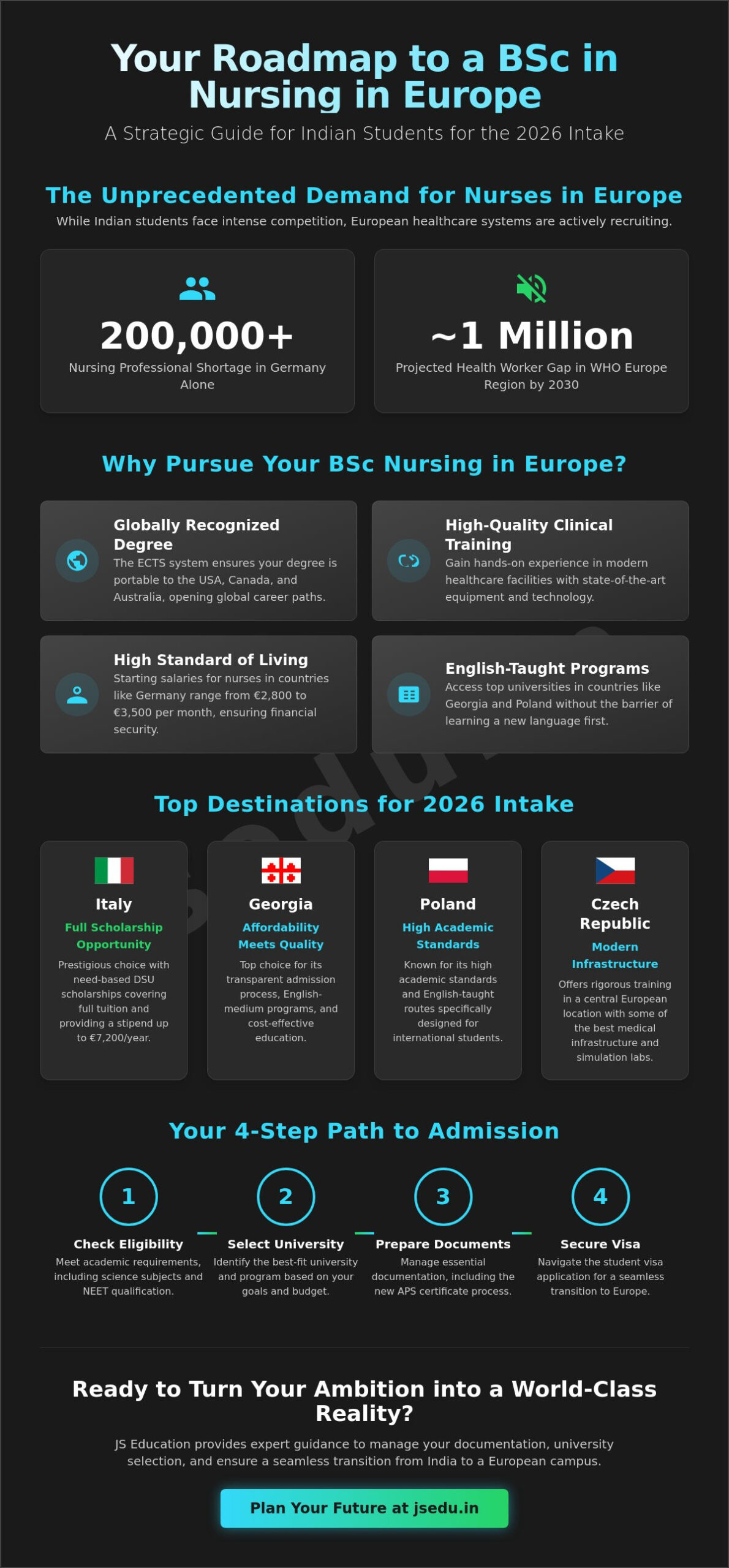
Did you know that Germany alone is currently facing a shortage of over 200,000 nursing professionals? While thousands of qualified Indian students struggle with limited seats and high cut-offs at home, European healthcare systems are actively looking for your skills. You’ve probably felt the stress of intense competition in India or feared that an international degree might not be recognized by global employers. It’s a high-stakes decision, and the complex documentation for visas can often feel overwhelming for students and their families alike.
This guide is designed to simplify that journey and build your confidence. You’ll discover how to access affordable, English-taught programs and secure your admission for the 2026 academic year. We’ll explore the best destinations for a BSc nursing in Europe, including tuition-free options in Germany and full scholarship opportunities in Italy. We’ll also break down the essential steps for a seamless transition. This includes mastering the new APS certificate process and obtaining your student visa without the usual headaches. By the end of this article, you’ll have a clear, professional roadmap to turn your clinical ambitions into a world-class reality.
Key Takeaways
- Understand how the European Credit Transfer System (ECTS) ensures your degree is globally recognized and simplifies your future career mobility.
- Identify the most cost-effective destinations for your BSc nursing in Europe, specifically focusing on the high academic standards in Georgia and Poland.
- Clarify the 2026 admission requirements, including the role of NEET and the specific academic subjects needed to secure your seat.
- Compare annual tuition fees and monthly living costs across different countries to build a sustainable financial plan for your international education.
- Discover how professional guidance can manage your documentation and university selection for a seamless transition from India to a European campus.
Why Pursue BSc Nursing in Europe in 2026?
Choosing to pursue a BSc nursing in Europe is a strategic move for any Indian student aiming for a high-impact global career. European universities provide a Bachelor of Science in Nursing (BScN) that is recognized across the globe. This recognition isn’t just about prestige; it’s about the European Credit Transfer System (ECTS). This system ensures that your academic credits are standardized, making it significantly easier to migrate or pursue further specialization in countries like Canada, Australia, or the United States. When you study here, you’re not just getting a degree. You’re gaining a portable professional identity that opens doors in almost any healthcare system.
The quality of clinical training is another decisive factor. Students have access to modern healthcare facilities and state-of-the-art equipment that often exceeds what’s available in private Indian colleges. You can explore the extensive list of European nursing schools to see the sheer scale of the academic infrastructure available across the continent. This hands-on experience in diverse clinical settings prepares you to handle complex medical scenarios with confidence. It also ensures you’re ready for the high standards of patient care expected in international hospitals.
The Global Nursing Shortage and Your Career Scope
The world is currently facing a critical shortage of healthcare professionals. The WHO European Region projects a gap of nearly 1 million health workers by 2030. This creates an unprecedented opportunity for Indian graduates. Once you complete your BSc nursing in Europe, the path to becoming a Registered Nurse (RN) is well-defined and supported by local governments. In Germany, for example, starting salaries for registered nurses range between €2,800 and €3,500 per month. As you gain experience, these figures can rise above €4,000. This provides a standard of living and financial security that is difficult to match early in a career back home.
English-Taught Programs: Breaking the Language Barrier
A common concern for many students is the language of instruction. It’s a relief to know that many universities in Eastern and Central Europe offer programs taught entirely in English. These pathways are specifically designed for international students. They ensure that you don’t lose time learning a new language before you start your medical education. While you’ll eventually learn the local language for patient interactions during clinical rotations, the core academic curriculum remains accessible. At JS Education, we focus on identifying these English-taught routes in countries like Georgia and Poland. Our goal is to ensure your transition is seamless so you can focus entirely on your professional growth.
Top Destinations for BSc Nursing in Europe for Indian Students
Selecting the right country is the first major milestone in your journey. While Western Europe is often the first thought, the 2026 academic landscape shows a significant shift toward Eastern and Central Europe. These regions offer a unique balance of high-quality education and manageable costs. When you look for a BSc nursing in Europe, you’ll find that countries like Georgia, Poland, and Italy have become strategic hubs for Indian students. Each destination offers distinct advantages, from scholarship availability to streamlined residency pathways.
Italy remains a prestigious choice for those seeking a blend of tradition and modern healthcare. The primary draw for many Indian families is the DSU scholarship. This need-based award can provide a full tuition waiver and a yearly stipend of up to €7,200, making a world-class degree remarkably affordable. Meanwhile, the Czech Republic offers a central location with some of the best medical infrastructure in the region. Its universities are known for rigorous training and modern simulation labs that mirror real-world hospital environments. If you’re unsure which destination fits your budget, our team at JS Education can help you compare these options side-by-side.
Nursing in Georgia: Affordability Meets Quality
Georgia has emerged as a top choice for the 2026 intake due to its transparent admission process. It’s an ideal destination for students who want to avoid the high competition and hidden costs of Indian private colleges. Programs here are entirely English-medium, ensuring you can focus on your clinical skills without a language barrier. For a deeper look at what follows graduation, you should explore the Nursing Degree in Georgia: Career Prospects. The focus on practical training in Georgian hospitals ensures that students are prepared for international licensing exams from day one. Georgia’s welcoming academic environment also makes it a popular choice for Indian students pursuing dental education, and if you’re considering that path, the BDS in Georgia for Indian students guide offers a comprehensive breakdown of admission requirements and career outcomes.
Poland and Czech Republic: The EU Standard
Studying in Poland or the Czech Republic places you directly within the Schengen area. This is a massive advantage for your future professional mobility across the continent. Polish universities emphasize hands-on clinical rotations, ensuring every student meets the strict criteria for EU recognition of nursing qualifications. This automatic recognition is vital if you plan to work in Germany, France, or Scandinavia later. If you’re also considering related healthcare fields, you might find that a Physiotherapy Course in Europe offers similar benefits in terms of global demand and salary potential.
Eligibility and Admission Requirements for 2026
Securing a seat for a BSc nursing in Europe requires careful preparation and an understanding of specific academic standards. Most universities across Georgia, Poland, and Italy require Indian applicants to have completed their 10+2 education with a focus on Physics, Chemistry, and Biology (PCB). Typically, a minimum aggregate of 50% in these subjects is the benchmark for eligibility. While the competitive nature of Indian admissions often leaves students discouraged, European institutions prioritize your foundational knowledge and genuine interest in the healthcare profession. It’s also essential to provide a valid health certificate to prove you’re fit for clinical practice, alongside meeting the minimum age requirement of 17 years by the time of admission.
One of the most frequent questions we receive concerns the NEET exam. It’s vital to clarify that while NEET is mandatory for Indian students pursuing an MBBS abroad, it’s often not a strict requirement for nursing programs in Europe. This opens a significant door for dedicated students who may not have secured a high NEET score but possess the academic background to excel in nursing. However, ensuring your chosen program aligns with international standards is crucial. This is why the EU system for automatic recognition of nursing qualifications is so valuable. It guarantees that your education meets rigorous professional criteria, making your degree portable across the continent and respected by the Indian Nursing Council (INC) if you choose to return home.
Document Checklist for Indian Applicants
- Original and Apostilled 10th and 12th-grade mark sheets.
- A valid passport with at least 18 months of validity remaining.
- Official translation of educational transcripts into the local language (if required).
- A Medium of Instruction certificate is an official document from your previous school confirming your education was conducted entirely in English, which can often exempt you from IELTS or TOEFL requirements.
The Admission Timeline for 2026 Intakes
Timing is everything when you’re planning an international education. Most European universities operate on a primary intake cycle starting in September or October. To ensure a seamless transition, you should begin your application process at least six to eight months in advance. This lead time is necessary to manage university evaluations, document apostilles, and the visa interview process. Some countries also offer a secondary intake in February or March, providing a second chance if you miss the autumn window. At JS Education, we manage this entire schedule for you, providing a hassle-free submission process that ensures all deadlines are met with precision.
Cost Analysis: Tuition Fees and Living Expenses
Financial transparency is the cornerstone of a successful study abroad plan. When you choose a BSc nursing in Europe, you’re opting for a high-value education that often costs a fraction of private medical colleges in India. For instance, while international tuition in the UK can reach up to £35,600 annually, many European destinations offer significantly more affordable pathways. Germany’s public universities often charge no tuition at all, requiring only a semester contribution of €100 to €350. Even better, students in German nursing “Ausbildung” programs receive a monthly stipend between €1,100 and €1,300, which effectively covers their cost of living while they learn.
Italy also presents a unique financial advantage through the DSU scholarship. This need-based program can provide a full tuition waiver and a yearly stipend of up to €7,200. Beyond scholarships, most European countries allow international students to work part-time for up to 20 hours per week. This provides a practical way to manage your daily expenses while gaining local work experience. It’s a sustainable model that allows you to focus on your studies without placing an undue burden on your family’s savings.
Georgia vs. Poland: Budget Comparison
Georgia remains the most budget-friendly entry point for Indian families in 2026. Tuition fees here are lower than in Central Europe, yet the medical infrastructure is rapidly modernizing. In contrast, Poland offers the prestige of a full EU degree. While tuition and living costs in Poland are slightly higher than in Georgia, the degree provides automatic professional recognition across all 27 EU member states. For both countries, you should budget between €200 and €500 annually for mandatory health insurance and university registration fees. This small investment ensures you have full access to European healthcare services during your stay.
Living as an Indian Student in Europe
Managing your monthly expenses in cities like Tbilisi, Warsaw, or Rome is simpler than you might expect. Monthly living costs typically range from €850 to €1,200, depending on your lifestyle and housing choices. Shared apartments and student dormitaries are popular ways to save money. You’ll also find vibrant Indian student communities and local stores stocking familiar spices and lentils in most major university towns. If you want to understand the typical daily costs in more detail, you can explore the MBBS in Georgia for Indian Students guide, as the cost-of-living profile for nursing students is nearly identical. Ready to build your 2026 financial roadmap? Connect with our expert advisors for a detailed breakdown of all university-related costs.
How JS Education Facilitates Your Nursing Career in Europe
Transitioning from an Indian classroom to a European clinical ward involves far more than a simple application. It’s a high-stakes life decision that requires precision, local knowledge, and expert guidance. With over 20 years of expertise in international medical education, JS Education serves as your strategic partner in this journey. We understand that every student has unique financial constraints and professional goals. Whether you’re looking for the most affordable BSc nursing in Europe in Georgia or a prestigious program in Italy, our team provides personalized university selection. We don’t just provide a list of schools; we help you choose the institution that best aligns with your future as a global healthcare professional.
Our commitment to transparency means you’ll never face hidden charges or misleading claims about your career prospects. We provide end-to-end support that covers every technicality of the process. This includes meticulous documentation, apostille services, and thorough visa interview preparation. Once you arrive at your European campus, our assistance continues with post-arrival support to help you settle into your new home. This comprehensive care ensures that you can focus entirely on your clinical training while we handle the administrative complexities. Our goal is to make the entire transition feel seamless and manageable for both students and their families.
Our “Trusted Advisor” Approach
We act as a vital bridge between Indian students and the most respected universities in Georgia, Poland, and Italy. Our deep local knowledge and strong international connections allow us to navigate local regulations with ease, ensuring your application stands out. Since our founding in 2004, we’ve maintained an exceptional success rate by prioritizing the long-term well-being of our students over simple transactions. This protective approach builds immediate trust with families who are making a significant investment in their children’s futures. We don’t just see you as a client; we see you as a future leader in the global healthcare workforce.
Start Your Journey Today
The 2026 academic year is approaching, and the most sought-after seats for a BSc nursing in Europe are already being planned for. Don’t let documentation hurdles or complex visa rules stand in the way of your clinical ambitions. We invite you to contact us for a free profile assessment to determine the best path for your specific budget and career needs. Our expert MBBS in Europe consultants are ready to guide you through a hassle-free admission process. Secure your global nursing career now and join the growing number of Indian students successfully practicing healthcare across the European continent. Your international future is just one consultation away.
Take the First Step Toward a Global Nursing Career
Europe offers a unique combination of world-class clinical training and standardized credits that make your career truly mobile. Whether you choose the scholarship-rich environment of Italy or the budget-friendly universities in Georgia, your education will be recognized across the globe. You’ve seen that the path to a BSc nursing in Europe is more accessible than many think, especially with NEET often not being a mandatory requirement for these specialized programs. This 2026 guide provides the roadmap; now it’s time to act.
Since 2004, JS Education has focused exclusively on specialized healthcare education, acting as a trusted advisor for thousands of Indian students. We provide expert guidance for admissions in Georgia, Italy, and Poland, ensuring your transition is seamless and transparent. We handle the complexities of documentation and visa processes so you can focus on your professional ambitions. Apply for BSc Nursing in Europe 2026 with JS Education and start building your international professional identity today. Your dream of becoming a registered nurse in a world-class healthcare system is within reach, and we’re here to help you build that bridge.
Frequently Asked Questions
Is a BSc Nursing degree from Europe valid in India?
A BSc Nursing degree from an accredited European university is valid in India provided it meets the standards of the Indian Nursing Council (INC). Most European degrees follow the ECTS system, which ensures the curriculum is standardized and globally recognized. Upon your return, you’ll simply need to register with your respective State Nursing Council. This portability makes European education a safe and reliable investment for your future career.
Do I need to clear NEET to study BSc Nursing in Europe?
No, clearing NEET is generally not a mandatory requirement for Indian students pursuing a BSc nursing in Europe. While NEET is a prerequisite for medical programs like MBBS, nursing admissions in Europe primarily focus on your 10+2 scores in Physics, Chemistry, and Biology. This provides a clear pathway for students who want to enter the healthcare sector without the intense pressure of Indian competitive entrance exams.
Can I work in the UK or USA after completing my nursing degree in Europe?
Yes, completing your degree in Europe serves as an excellent gateway to working in the UK or the USA. You’ll still be required to pass the specific licensure exams for those regions, such as the NCLEX for the USA or the OSCE for the UK. Because European curricula are aligned with international medical standards, graduates often find themselves well-prepared to clear these global certification exams on their first attempt.
What is the total duration of the BSc Nursing program in European universities?
The total duration for a nursing program in Europe typically ranges from 3 to 4 years. In countries like Italy and Poland, the degree is usually completed in 3 years and consists of 180 ECTS credits. Some programs might extend to a fourth year to include specialized clinical internships or language training. This duration ensures a balanced mix of theoretical classroom learning and intensive hands-on practice in modern hospitals.
Are there any scholarships available for Indian students for nursing in Europe?
Yes, many European countries offer generous scholarship programs to support international students. Italy is well-known for its need-based DSU scholarships, which can provide a full tuition waiver and a yearly stipend of up to €7,200. These awards are based on family income rather than just academic merit. This makes it possible for students from various financial backgrounds to access world-class healthcare education without accumulating significant debt.
What is the average salary of a nurse in Europe after graduation?
Registered nurses in Europe can expect a starting salary between €2,800 and €3,500 per month in countries like Germany. With a few years of experience, these earnings can easily grow to over €4,000 monthly. When you compare these figures to early-career salaries in India, the return on investment is exceptionally high. The ongoing shortage of healthcare workers across the continent also ensures high job security for all graduates.
Is the medium of instruction entirely in English for these programs?
Many universities in Georgia, Poland, and Italy offer BSc nursing in Europe programs that are taught 100% in English. Your lectures, textbooks, and examinations will be conducted in English to ensure you master the medical curriculum effectively. While you’ll eventually learn the local language to communicate with patients during clinical rotations, the core academic foundation is designed to be fully accessible to international students from day one.
How much bank balance is required for a European student visa?
The required bank balance depends on the specific country’s cost of living and visa regulations. For 2026, Germany requires students to have €11,904 in a blocked account to cover their first year of expenses. Other destinations like Italy or Georgia often have lower requirements, typically ranging from €6,000 to €8,000. It’s vital to have these funds ready well in advance to ensure a smooth and successful visa application process.