



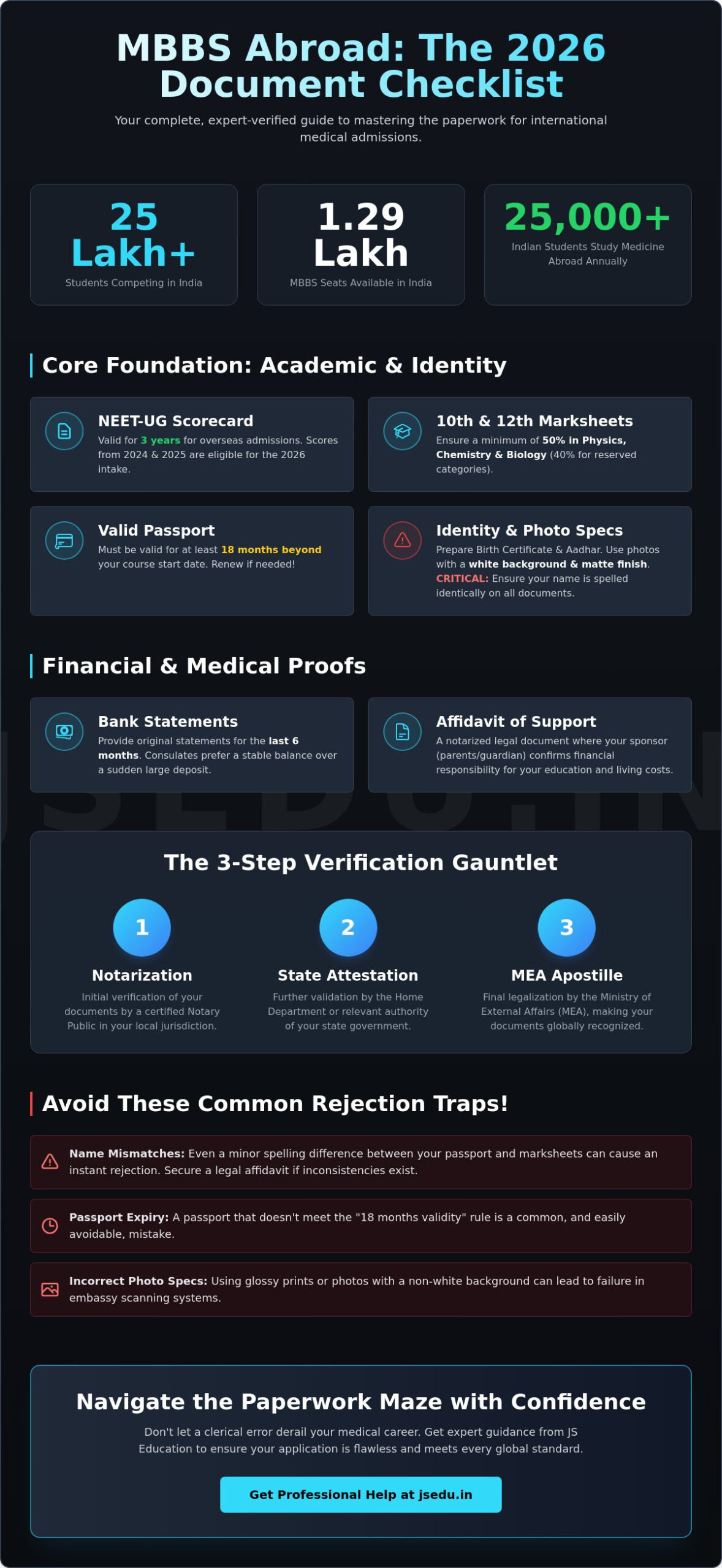
Did you know that in 2026, approximately 25 lakh students are competing for just 1.29 lakh MBBS seats in India? This intense competition drives over 25,000 Indian students to seek medical education overseas annually. However, securing a seat isn’t just about your academic performance; it’s about the precision of your paperwork. Understanding the exact documents required for MBBS abroad is the difference between a successful enrollment and a heartbreaking rejection due to a minor clerical error.
It’s natural to feel anxious about the difference between notarization and an apostille, or whether your NEET scorecard remains valid for your 2026 intake. We’re here to replace that confusion with professional clarity. This guide promises to help you master the complex paperwork of international medical admissions with our comprehensive, expert-verified document guide for 2026. We’ll walk you through a step-by-step checklist, explain NMC regulations in plain English, and provide the confidence you need to ensure your paperwork meets every global standard before you board your flight.
Key Takeaways
- Understand the specific timeline for NEET-UG scorecard validity to ensure your results meet the three-year eligibility window for 2026 admissions.
- Master the multi-stage verification process for all documents required for MBBS abroad, ranging from local notarization to the final Ministry of External Affairs apostille.
- Learn how to structure your financial documentation and Affidavit of Support to satisfy strict university and visa solvency requirements.
- Identify country-specific paperwork needs for destinations like Georgia, Italy, and Poland to ensure your application aligns with local education ministry standards.
- Recognize and correct common clerical pitfalls, such as minor name variations across identity proofs, that frequently cause avoidable admission rejections.
The Core Foundation: Mandatory Academic and Identity Documents for 2026
Your path to becoming a successful International Medical Graduate (IMG) begins long before you set foot in a lecture hall. It starts with a dossier that leaves zero room for administrative doubt. Many students mistakenly assume the documents required for MBBS abroad are only for the university’s eyes. In reality, you’re preparing two distinct sets of paperwork: one for the university offer letter and a far more rigorous, legalized set for your student visa application. Missing this distinction is why many applications fail before they even reach an admissions officer.
The National Medical Commission (NMC) provides a significant advantage regarding the NEET-UG scorecard. Your qualification remains valid for three years for the purpose of admission abroad. If you cleared the exam in 2024 or 2025, you’re eligible for the 2026 intake without re-sitting the test. However, your passport requires stricter scrutiny. It must remain valid for at least 18 months beyond your intended start date. If your current passport expires in mid-2027, you should initiate a renewal immediately. Consulates are strict about this window because it ensures you have valid identification while applying for your temporary residency permit after arrival.
Academic Transcripts and Marksheets
While Indian students are accustomed to receiving annual marksheets, many medical schools in Europe and Eurasia require an official academic transcript. This document is a consolidated record of your subjects and grades over your entire high school tenure. To qualify for most international programs, you must meet the “50% PCB” rule. This means your combined score in Physics, Chemistry, and Biology must be at least 50% for general category students, or 40% for reserved categories. Whether you graduated from a CBSE, ICSE, or State Board, these percentage requirements are the baseline for NMC eligibility and university acceptance.
Identity and Travel Credentials
Precision in your identity documents is vital. Your passport-sized photographs must feature a plain white background and a matte finish; glossy prints often fail embassy scanning protocols. Beyond your passport, keep your original Birth Certificate and Aadhar card ready as secondary proof of identity. The most common pitfall we see involves name discrepancies. If your name is spelled differently across your 10th marksheet and your passport, you must secure a legal affidavit before submitting your visa file. Minor clerical inconsistencies are the primary reason for application rejections, but they’re entirely preventable with early detection and professional guidance.
Financial and Medical Documentation: Proving Solvency and Health
Embassies need to know you can afford tuition and living expenses without relying on illegal employment. This is why the financial portion of the documents required for MBBS abroad is so critical. While the university might only look at your academic merit, the visa stage demands absolute transparency regarding your “Source of Funds.” It’s not enough to show a specific balance; you must demonstrate the legitimacy of those funds through a clear paper trail.
A vital document often overlooked by students is the Affidavit of Support. This is a legal commitment where your parents or guardians formally declare their responsibility for your educational and personal expenses. This document, typically notarized on stamp paper, acts as a bridge of trust between your family and the foreign consulate. Similar checklists for international students are maintained by various governments, such as the Egyptian Ministry of Higher Education application portal, which confirms that academic, identity, and financial proofs are the universal pillars of medical admissions.
Financial Solvency Proofs
Consulates usually require original bank statements covering the last six months of transactions. These statements should show a consistent and stable balance rather than a sudden, large deposit made just before the visa interview. For students heading to Georgia, Italy, or Poland, the liquid funds should ideally cover the first year’s tuition and a year of living expenses. If you’re utilizing an education loan, a formal loan sanction letter from a recognized bank is a highly respected form of proof. If the financial requirements seem daunting, the advisors at JS Education can help you structure your financial file to meet the specific solvency benchmarks of your chosen destination.
Medical Clearance and Vaccinations
Your physical health is a matter of public safety in your host country. Most European nations require a comprehensive medical fitness certificate issued by a registered medical practitioner. This process involves specific lab reports for HIV and Hepatitis B, which are mandatory for students entering clinical environments. Additionally, a clear Chest X-ray report is often required to rule out tuberculosis. While specific COVID-19 mandates vary by region in 2026, you should maintain an updated vaccination record. Finally, you must secure international student health insurance. This is a non-negotiable requirement for the visa, ensuring you have access to medical care throughout your program without straining the host country’s resources.
Destination-Specific Requirements: Georgia, Italy, and Poland
Applying to a medical university in Tbilisi is vastly different from applying to one in Rome or Warsaw. A “one-size-fits-all” approach to the documents required for MBBS abroad is a frequent cause of visa rejection. Each nation has unique legal frameworks that determine how foreign qualifications are recognized. Failing to provide a country-specific document, even if your academic record is perfect, can stall your career by an entire year. Precision isn’t just a preference; it’s a mandatory requirement for international success.
Unique Requirements for Georgia and Italy
For students pursuing MBBS in Georgia, the most critical step is obtaining recognition from the Ministry of Education and Science (MES) of Georgia. This process requires your academic documents to be Apostilled. Without this international legalization, the Georgian government won’t issue the mandatory enrollment decree. Italy presents a different challenge. Beyond your IMAT score, you must secure a Declaration of Value (DOV). This is an official document issued by the Italian Embassy in India that confirms your 12 years of schooling are equivalent to the Italian education system. It’s a meticulous process that requires early planning and coordination with the consulate.
Poland and Czech Republic Specifics
Poland and the Czech Republic often require documents to be translated into their respective national languages by sworn translators. These aren’t standard translations; they’re legally binding versions recognized by European courts and universities. You’ll also need an Eligibility Certificate from your local District Education Office in India. This certificate must explicitly state that your 12th-standard qualification entitles you to pursue higher education in India. Before you invest in expensive translation services, it’s vital to conduct thorough MBBS abroad eligibility checks to ensure your specific board and subject combination meet the criteria of these Central European nations.
Why do these nuances matter? Because a single missing stamp can lead to a visa denial that stays on your record. Understanding the specific documents required for MBBS abroad for each destination ensures your transition is seamless. Whether it’s the MES recognition in Georgia or the DOV in Italy, being proactive about destination-specific paperwork is what separates a successful applicant from a rejected one. Don’t leave your medical career to chance when specific, expert-led guidance can bridge the gap between India and your future medical school.
The Verification Protocol: Notarization, Apostille, and MEA
Collecting the necessary documents required for MBBS abroad is only half the battle. To ensure these papers are legally valid in a foreign country, you must follow a strict hierarchy of verification. This protocol transforms your Indian certificates into globally recognized legal instruments. Without this sequence, a university in Georgia or Poland cannot verify your identity or academic history, leading to an immediate halt in your admission process. It’s a methodical journey from local offices to national ministries.
The journey begins with local notarization. A registered advocate must verify your original documents and provide a notarized copy. Once completed, the next step is state-level attestation. Depending on your state of residence and the specific university requirements, this is handled by the State Home Department or a Sub-Divisional Magistrate (SDM). This state-level check is the prerequisite for the Ministry of External Affairs (MEA) to take over. The MEA provides the final layer of Indian validation before the document reaches international eyes. For countries that are part of the Hague Convention, this involves an Apostille. For others, a final round of Embassy Legalization is required to bridge the gap between two different legal systems.
Understanding the Apostille
An Apostille is the international standard for document legalization. Unlike a standard ink stamp, an MEA Apostille is a high-security sticker placed on the back of your original document. This sticker contains a unique identification number that foreign authorities use to verify the document’s authenticity online. Since countries like Georgia and Poland are members of the Hague Convention, they specifically mandate this sticker for all academic and personal records. A simple notarization is never enough for these destinations; the Apostille is the non-negotiable seal of trust that makes your Indian degree recognized abroad.
Translation and Notarization Standards
Language barriers often complicate the legal process. While many universities accept English documents, certain European nations require a “sworn translation.” A regular translator cannot provide this. A sworn translator is authorized by a specific government or embassy to provide a legally binding version of your records. Ensuring the translator’s seal is recognized by the destination embassy is a technical detail that students often miss. Managing these complex legal steps is a primary reason why many families rely on MBBS in Europe consultants to handle the heavy lifting of the verification protocol.
This verification protocol is time-sensitive and requires precision at every level. A single error in the SDM attestation can cause the MEA to reject your file, delaying your visa by weeks. If you want to ensure your documents required for MBBS abroad are processed without a single hitch, you can consult with our legal documentation experts to streamline your entire verification journey from the first stamp to the final visa approval.
Common Documentation Pitfalls and How JS Education Protects You
Why do some students with excellent NEET scores still face visa rejections? Often, the answer lies in a single, overlooked detail within the documents required for MBBS abroad. Even a minor spelling discrepancy between your passport and your 12th standard marksheet can trigger a red flag for consulate officers. These clerical inconsistencies suggest a lack of procedural integrity, which can lead to months of delays or a total rejection of your application. In the high-stakes environment of medical admissions, precision isn’t just a goal; it’s a necessity.
Tracking your NEET eligibility is another critical area where students stumble. While the scorecard is valid for three years for abroad admissions, you must ensure your specific score falls within the valid window for the 2026 intake. Additionally, many applicants forget that prestigious European universities require more than just marksheets. Missing Letters of Recommendation (LORs) or a poorly drafted Statement of Purpose (SOP) can weaken your profile, making you appear less committed than other international candidates. These documents provide the narrative of your ambition, and their absence can be fatal to your file.
Avoiding Clerical and Legal Errors
Success begins with a meticulous cross-check of your identity proofs. Your name, father’s name, and date of birth must be identical across your Aadhar card, passport, and academic certificates. If you find a mismatch, you must resolve it legally through an affidavit before starting the apostille process. Financial documents are equally sensitive. Bank statements must be printed on official letterhead with clear bank seals and signatures. Beware of unauthorized agents who promise “quick” legalization; using fraudulent stamps is a criminal offense that will permanently ban you from entering your destination country.
The JS Education Advantage
We believe that your focus should be on your medical studies, not on navigating government offices. Our “Zero-Error” audit is designed to catch every potential pitfall before your file reaches the embassy. We provide end-to-end support for MEA attestation and Apostille, ensuring every stamp is authentic and recognized. While we specialize in medical degrees, we also offer specialized guidance for physiotherapy courses in Europe and international nursing programs. Our goal is to hand you a “Ready-to-Fly” document folder that meets every NMC and university standard.
By partnering with a seasoned mentor, you turn a stressful administrative hurdle into a structured, manageable plan. We act as your bridge-builder, connecting your local Indian qualifications to the global standards of world-class medical institutions. When you submit your documents required for MBBS abroad through our verified channel, you do so with the confidence that your paperwork is as prepared as you are for this high-stakes life decision. Your ambition deserves the protection of expert-led precision.
Take Command of Your Global Medical Career
Securing your seat in a world-class medical university requires more than just academic merit; it demands a flawlessly executed documentation strategy. From the multi-layered MEA verification process to the specific legal requirements of countries like Georgia, Italy, and Poland, every stamp counts. Navigating the documents required for MBBS abroad doesn’t have to be a source of stress. By addressing potential name discrepancies and solvency proofs early, you transform a complex legal journey into a structured path toward your future as a physician.
With over 20 years of expertise in medical consultancy and a track record of 1,000+ successful student placements in Europe, we understand the stakes of your application. We are official partners with top Georgian and Polish universities, providing you with a direct bridge to global standards. Don’t leave your career to chance. Book a Free Documentation Audit with JS Education Experts today to ensure your file is audit-ready and compliant with all 2026 regulations. Your ambition is our priority, and we’re here to ensure your transition is as seamless as your potential is great.
Frequently Asked Questions
Is NEET mandatory for MBBS abroad in 2026?
Yes, qualifying for NEET-UG is absolutely mandatory for any Indian student seeking to study medicine overseas. This National Medical Commission (NMC) regulation ensures that you remain eligible to sit for the FMGE or NExT licensing exams upon your return to India. Without a qualifying NEET score, your foreign medical degree won’t be recognized for medical practice within Indian borders.
How long is the NEET scorecard valid for studying medicine abroad?
Your NEET-UG scorecard remains valid for three years specifically for the purpose of admission to an MBBS program abroad. If you qualified in 2024 or 2025, you can still use that score for your 2026 application. This flexibility allows students to plan their international transition without the immediate pressure of re-taking the entrance exam every year.
Do I need to provide original documents to the university or the embassy?
You’ll typically submit high-quality scanned copies for the initial university offer letter, but the visa stage requires original documents for verification. Embassies need to see the physical Apostille stickers and official seals on your marksheets and birth certificate. We recommend maintaining a dedicated folder to keep these originals safe during the multi-stage verification process.
Can I apply for an MBBS abroad if my passport is currently under process?
You can often begin the university application with your Aadhar card or a passport application receipt, but you’ll need the actual passport for the final admission letter and visa. Since the documents required for MBBS abroad must include your passport number for official invitations, it’s vital to initiate your passport application at least six months before the intake.
What is an Apostille and is it mandatory for all countries?
An Apostille is a specialized certificate issued by the Ministry of External Affairs that legalizes your Indian documents for use in countries belonging to the Hague Convention. It’s mandatory for popular destinations like Georgia and Poland. For non-Hague countries, you’ll instead go through a standard embassy legalization process to ensure your papers are recognized by foreign authorities.
Are English proficiency tests like IELTS or TOEFL required for Georgia or Italy?
Most universities in Georgia and Italy don’t mandate IELTS or TOEFL if your medium of instruction in high school was English. Instead, you’ll provide a Medium of Instruction (MOI) certificate from your school. However, Italy’s IMAT exam and certain Polish universities may have specific communicative requirements that we’ll help you navigate during your application journey.
What happens if there is a spelling mistake in my marksheet compared to my passport?
If there’s a name discrepancy, you must secure a legal affidavit from a notary to confirm that both names belong to the same person. Minor clerical errors are common but can lead to visa rejection if left unaddressed. Our team reviews all documents required for MBBS abroad to identify these mismatches early, ensuring they’re legally corrected before submission.
Does JS Education help with the translation of documents into foreign languages?
Yes, we provide comprehensive support for the legal translation of your documents into languages like Polish or Georgian when required by the university or embassy. We work with sworn translators whose seals are officially recognized by international consulates. This ensures your academic and personal records meet the exact linguistic and legal standards of your host country without any procedural delays.