



Why should your dream of becoming a dentist be held hostage by the skyrocketing tuition fees of Indian private colleges? You’ve likely spent months researching dental programs, only to feel overwhelmed by complex admission processes and the nagging fear that a foreign degree won’t be recognized by the Dental Council of India. It’s a high-stakes decision, and you deserve a path that offers both clinical excellence and financial transparency.
Choosing a BDS in Georgia for Indian students is no longer just a backup plan; it’s a strategic move toward a global career. We’ll show you exactly how to secure a world-class dental degree while staying fully compliant with the 2026 NMC regulations, including the mandatory 5.5-year course duration and internship requirements. This guide provides a clear breakdown of your five-year budget and a step-by-step roadmap for a hassle-free admission. From understanding visa categories to verifying English-medium curriculum standards, you’ll gain the clarity needed to transition from an aspiring student to a licensed professional with confidence.
Key Takeaways
- Discover why Georgian dental infrastructure, featuring high-tech simulation centers, often surpasses the clinical facilities found in Indian private colleges.
- Navigate the 2026 NMC regulations with confidence by understanding the 300 ECTS credit system and the mandatory 5-year duration for foreign dental degrees.
- Gain a clear, realistic view of the total 5-year budget for a BDS in Georgia for Indian students, covering everything from annual tuition to monthly living costs in Tbilisi.
- Identify the top-tier universities offering English-taught programs that balance academic rigor with global career mobility.
- Master the admission journey with a definitive checklist of documents and NEET-UG requirements to ensure a seamless transition to your international campus.
Why BDS in Georgia is the Strategic Choice for Indian Students in 2026
Securing a dental seat in India has become an uphill battle. With the 2026 NEET-UG competition reaching record highs, many capable students find themselves sidelined by a lack of government seats or the crushing financial weight of private institutions. This is where pursuing a BDS in Georgia for Indian students transforms from a simple alternative into a high-value strategic decision. Georgian universities provide a robust safety net without compromising on academic rigor or clinical standards.
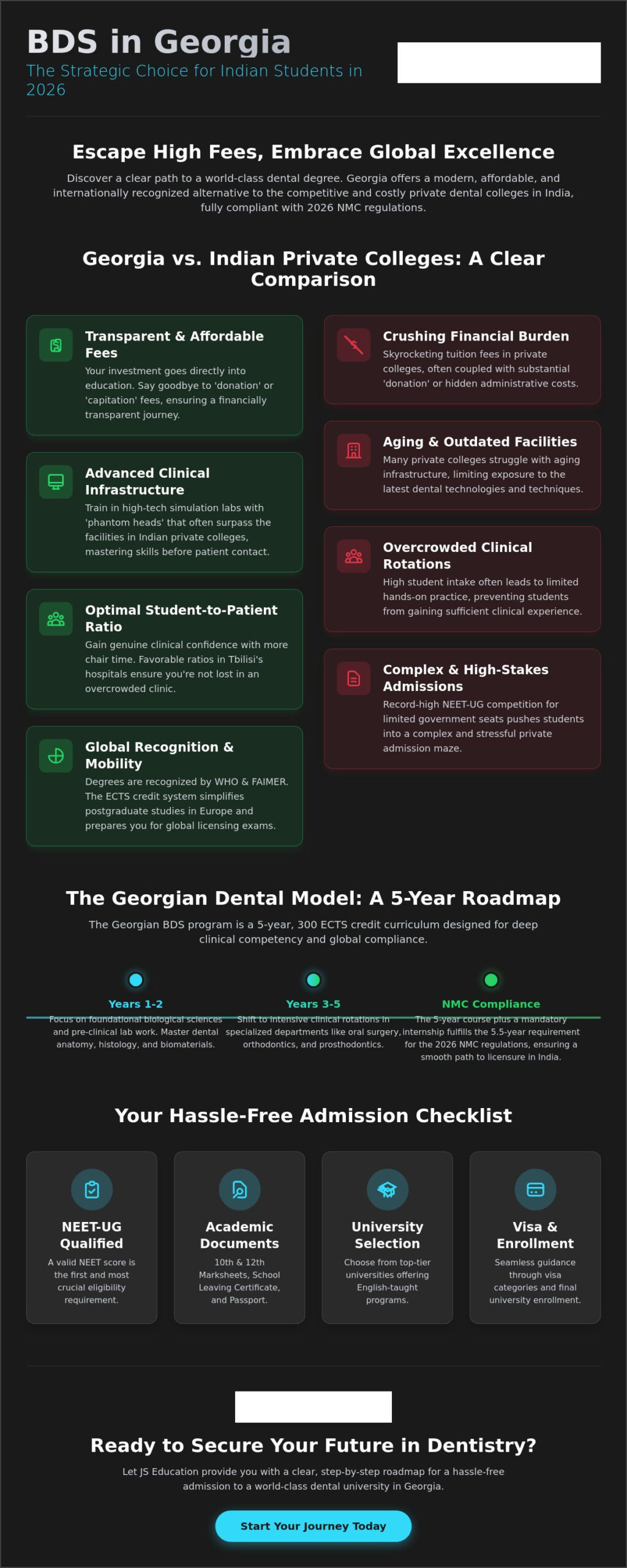
Georgian dental schools prioritize modern technology, often utilizing advanced ‘phantom head’ simulation labs that surpass the aging infrastructure found in many Indian private colleges. These labs allow you to master intricate procedures in a controlled environment before you begin actual clinical rotations. This early hands-on mastery is a hallmark of the Georgian education system, which has successfully integrated English-medium instruction to cater to a growing international cohort. From day one, you’ll learn in a language you’re comfortable with, eliminating the stress of a foreign language barrier while preparing for global exams like the NBDE in the USA or clinical licensing in Europe.
Georgia vs. Indian Private Dental Colleges
The absence of ‘donation’ or ‘capitation’ fees is perhaps the most immediate relief for Indian families. In Georgia, your investment goes directly into your education rather than administrative hidden costs. While Indian private colleges often suffer from overcrowded clinical rotations, Tbilisi’s hospitals maintain favorable student-to-patient ratios. This ensures you get the necessary chair time to build genuine clinical confidence. The Georgian Dental Advantage is a unique synthesis of high European Credit Transfer System (ECTS) standards and a cost-effective fee structure that respects your family’s financial planning.
International Recognition and Accreditations
Recognition is the cornerstone of any medical degree. Georgian dental programs are accredited by the Ministry of Education and Science of Georgia and recognized by global bodies like the WHO and FAIMER. The ECTS framework is particularly relevant for 2026 graduates, as it ensures your credits are transferable across Europe, simplifying the path to postgraduate specialization. This streamlined regulatory environment mirrors the successful MBBS in Georgia for Indian students pathway, which has helped thousands of Indian doctors achieve global mobility. Whether you aim for the USMLE in the USA or clinical practice in the UK, your degree serves as a respected, valid credential that opens doors worldwide.
Curriculum, Duration, and Clinical Exposure: The Georgian Dental Model
The 5-year BDS cycle in Georgia is meticulously structured around 300 ECTS (European Credit Transfer System) credits. For Indian parents, this provides a transparent metric of their child’s academic progress and ensures the degree meets international benchmarks. Unlike older models that separate theory from practice, the Georgian system uses an ‘integrated’ approach. This means you’ll begin connecting biological sciences to clinical outcomes much earlier than in traditional programs. A BDS in Georgia for Indian students isn’t just about passing exams; it’s about developing the hand-eye coordination and diagnostic intuition required for a successful practice.
The curriculum is designed to be progressive. You’ll start with the fundamental building blocks of dental anatomy, histology, and biomaterials. As you move into the later years, the focus shifts entirely to clinical rotations. This is where you’ll spend your time in specialized departments like oral surgery, orthodontics, and prosthodontics. Institutions like Tbilisi State Medical University’s Dental Program lead this charge, offering a curriculum that blends rigorous academic study with immediate practical application in modern clinics.
Year-by-Year Breakdown of the BDS Program
- Years 1-2: You’ll focus on the biological sciences and fundamental dental techniques. These years are spent primarily in the classroom and pre-clinical labs, mastering the science behind oral health.
- Years 3-5: This is the transition to clinical practice. You’ll work with real patients under the expert supervision of seasoned dental professionals. It’s a high-stakes environment that builds genuine confidence.
- Assessment: Georgia uses OSCEs (Objective Structured Clinical Examinations) alongside written exams. This ensures you’re tested on your actual clinical skills, not just your ability to memorize a textbook.
Advanced Dental Technology in Georgian Universities
One of the most significant advantages of studying in Georgia is the exposure to 21st-century dental technology. You’ll gain hands-on experience with 3D dental imaging, CAD/CAM technology, and digital impression systems. These tools are standard in European and American clinics, and learning them now gives you a massive competitive edge. Phantom Head labs serve as the essential bridge in this process. They allow you to perfect your drilling and filling techniques on realistic models before you ever treat a patient. Georgian dental labs prepare students for 21st-century dentistry by replacing traditional guesswork with digital precision and evidence-based practice.
If you want to see how these modules align with your specific career goals, the team at JS Education can help you compare university-specific syllabi to ensure they meet your expectations.
Top-Ranked Georgian Dental Universities for Indian Aspirants
Selecting the right institution is the most critical step in your international education journey. Georgia offers a variety of universities that cater specifically to the needs of international cohorts, ensuring that a BDS in Georgia for Indian students meets both academic and lifestyle expectations. While several universities offer dental programs, a few stand out due to their long-standing reputation and specialized infrastructure.
Tbilisi State Medical University (TSMU) remains the gold standard for medical and dental education in the Caucasus region. As a public institution with decades of history, it offers a traditional, rigorous academic environment that is highly respected by global medical boards. If you prefer a more contemporary setting, Georgian National University (SEU) provides a modern campus equipped with high-tech dental simulation centers. These facilities allow you to practice complex procedures using the digital technology mentioned in the previous section. For those who enjoy a coastal environment, Batumi Shota Rustaveli State University offers a vibrant Indian student community and a relaxed pace of life. Meanwhile, Ilia State University is known for its research-oriented approach and strong ties to international dental associations, making it ideal for students aiming for global research careers.
Choosing Between Government and Private Universities
The choice between a government university like TSMU and a top-tier private institution like SEU often comes down to your preferred learning style. Government universities typically have larger ‘Indian batches,’ which provides a strong peer support system but may mean more competition for clinical chair time. Private universities often invest heavily in the latest dental technology and may offer smaller class sizes. You’ll also find that many Georgian universities now host visiting professors from Europe and India, ensuring that the curriculum remains relevant to the licensing exams you’ll face back home.
University Selection Checklist for 2026
Don’t leave your future to chance. When evaluating universities for the 2026 intake, use this definitive checklist to ensure your degree holds its value:
- Regulatory Compliance: Verify that the university is recognized by the Ministry of Education and Science of Georgia and follows the NMC/DCI guidelines regarding course duration.
- Language of Instruction: Ensure the program is 100% English-medium and that this is clearly stated on your admission letter.
- Clinical Facilities: Confirm the presence of an on-campus dental clinic. You need direct access to patient rotations to fulfill your 12-month compulsory internship.
- Student Logistics: Evaluate the hostel facilities and their proximity to Indian mess halls or grocery stores. Tbilisi’s public transport is affordable, but living close to campus saves valuable study time.
Choosing the right fit requires balancing these technical requirements with your personal comfort. It’s about finding a place where you can excel academically while feeling at home.
Financial Planning: BDS Fees in Georgia and Cost of Living for Indians
Financial clarity is the foundation of a stress-free education. For the 2026 intake, tuition fees for public universities generally range from USD 3,000 to USD 7,000 per year. Private institutions offer a different tier of infrastructure, with fees ranging from USD 8,000 to USD 15,000 annually. For example, Caucasus International University maintains a stable fee structure, charging USD 4,800 for the first year and USD 4,500 for consecutive years. This predictability allows families to plan a BDS in Georgia for Indian students without the anxiety of hidden hikes or sudden “donation” requests common in other regions.
Living costs in Tbilisi typically fall between 1,200 and 1,800 GEL per month. With the early 2026 exchange rate holding at approximately 1 USD to 2.75 GEL, Georgia remains one of the most affordable European destinations. Students in Batumi may find slightly lower rent, but Tbilisi offers the most robust network of Indian mess services and grocery stores. A monthly grocery budget of 350 to 600 GEL is sufficient for those who cook at home. If you prefer a mess service, these are readily available and provide authentic Indian meals, ensuring you maintain your health and focus on your studies.
Tuition and Administrative Costs
Your budget must account for more than just tuition. Expect a one-time admission fee followed by recurring annual costs. Mandatory health insurance and annual visa extensions are essential for your legal stay. The visa application fee is USD 20, plus a VFS service fee of ₹1,500. Additionally, dental students must budget for high-quality clinical supplies and textbooks. While these costs are manageable, identifying them early prevents mid-course financial strain. You can compare these requirements with our guide on Nursing Programs Abroad for Indian Students to see how dental education investments differ from other medical tracks.
Living as an Indian Student in Georgia
Choosing between a university hostel and a shared apartment is a major decision. Hostels are economical, costing 300 to 500 GEL monthly, and offer immediate proximity to classes. Shared apartments provide more independence for 600 to 800 GEL but require managing utilities, which typically range from 150 to 200 GEL. Georgia hosts a vibrant Indian community that organizes cultural celebrations like Diwali and Holi, making the transition easier. Don’t be swayed by myths regarding part-time work. The BDS curriculum is intensive, and your primary focus must remain on mastering clinical skills rather than seeking jobs that could compromise your academic standing.
Every student’s financial situation is unique. If you need a customized 5-year budget plan tailored to a specific university, contact the experts at JS Education for a transparent breakdown of all costs.
Navigating the Admission Journey: The JS Education Pathway
The transition from an aspirant to a dental student in Tbilisi requires meticulous planning and adherence to strict regulatory timelines. Securing a BDS in Georgia for Indian students starts with meeting the foundational eligibility criteria. You must have qualified for the NEET-UG exam, as this is a non-negotiable requirement for the National Medical Commission (NMC) to recognize your degree later. Academically, you need a minimum of 50% in Physics, Chemistry, and Biology (PCB) in your 12th-standard examinations, though specific universities may have slightly higher benchmarks for the 2026 intake.
The documentation phase is where many students feel the most pressure. Beyond your 10th and 12th mark sheets, you’ll need a valid passport, a comprehensive medical fitness certificate, and passport-sized photographs. The JS Education ‘Seamless Admission’ process is designed to handle these complexities on your behalf. We manage everything from initial university selection to on-ground support once you land in Georgia. This includes the crucial Apostille process in India, which involves legalizing your educational documents for international use. Unlike generic consultants, we ensure your NEET certificate validation fee of ₹538 is processed correctly and that your D3 category immigration visa application is error-free.
Step-by-Step Admission Process
- Step 1: Registration and Offer Letter: Submit your digital documents for initial screening. Once the university verifies your eligibility, you’ll receive a formal offer letter.
- Step 2: Ministry Approval: Your documents are sent to the Ministry of Education and Science of Georgia for recognition. This stage is vital for your enrollment to be officially registered in the Georgian state system.
- Step 3: Visa and Pre-Departure: After paying the USD 20 visa fee and the ₹1,500 VFS service fee, we guide you through the visa interview. Our pre-departure orientation ensures you’re prepared for the cultural and academic shift.
Post-Graduation: Practicing in India or Abroad
Your journey doesn’t end with a degree. To practice in India, you must clear the Foreign Medical Graduate Examination (FMGE) or the upcoming National Exit Test (NExT). The 2026 regulations are clear: your course must span 5.5 years, including a 12-month internship at the same institution. Georgian universities have updated their programs to align perfectly with these DCI requirements. If you choose not to return to India immediately, your degree serves as a gateway to MDS programs in Europe or the USA. Many graduates leverage their ECTS credits to pursue specializations in high-demand fields like implantology or pediatric dentistry across the EU. This global mobility is the ultimate reward for your investment. Start your dental journey with JS Education today!
Secure Your Seat in a Global Dental Career
You now have a clear roadmap for your international dental education. Choosing a BDS in Georgia for Indian students allows you to bypass the financial strain of private colleges while gaining access to advanced clinical simulation labs and English-medium instruction. By aligning your studies with the 2026 NMC regulations, you ensure that your degree remains a powerful asset for practicing in India or pursuing postgraduate specialization in the USA and Europe. Success in this journey requires precision, from early university selection to the final Apostille process.
As official partners with top Georgian medical universities, JS Education brings over 20 years of expertise to your admission process. We’ve helped more than 1,000 students successfully transition to their new campuses, and we’re ready to do the same for you. Don’t let complex regulations stand in the way of your ambition. Book a Free 2026 BDS Admission Consultation with JS Education and take the first definitive step toward your clinical success. Your future as a skilled dentist is within reach, and we’re here to ensure your path is seamless and secure.
Frequently Asked Questions
Is BDS from Georgia recognized by the Dental Council of India (DCI)?
Yes, a BDS degree from Georgia is fully recognized by the Dental Council of India and the National Medical Commission (NMC). To ensure your degree is valid, you must enroll in a university recognized by the Ministry of Education and Science of Georgia and listed with the WHO. This recognition is essential for appearing in Indian licensing exams after graduation.
What is the total duration of the BDS course in Georgia for Indian students?
The total duration for a BDS in Georgia for Indian students is 5.5 years. This includes 54 months of intensive academic study and clinical training, followed by a mandatory 12-month internship completed at the same institution. This structure complies with the latest NMC FMGL regulations, ensuring your degree meets all Indian registration requirements.
Is NEET-UG mandatory for studying BDS in Georgia in 2026?
Yes, qualifying for the NEET-UG exam is a mandatory requirement for Indian students who intend to practice dentistry in India after their foreign studies. Your NEET scorecard is a vital document for the eligibility certificate and for appearing in the National Exit Test (NExT) or FMGE upon your return. You don’t need a high rank, but you must meet the qualifying cutoff.
What is the medium of instruction for dental programs in Georgia?
The medium of instruction for all dental programs catering to international students in Georgia is English. Lectures, textbooks, and clinical assessments are conducted entirely in English, which eliminates the need to learn the local Georgian language for academic purposes. This allows you to focus on mastering advanced dental techniques and European medical standards from day one.
Can I do an internship in India after completing BDS in Georgia?
No, you must complete your 12-month compulsory internship at the same Georgian university where you finished your academic studies. Current NMC regulations don’t allow students to split their clinical training between two countries. After you finish your degree and internship in Georgia, you’ll be eligible to sit for the Indian licensing exams to register as a practitioner.
What is the average cost of living for an Indian dental student in Tbilisi?
The average monthly cost of living for a student in Tbilisi ranges from 1,200 to 1,800 GEL. This budget covers your shared accommodation, groceries, and utilities. Public transportation is very affordable for students; a single metro or bus trip costs only 0.20 GEL with a student card, making it easy to manage your daily commute on a modest budget.
Are there Indian mess facilities available in Georgian dental universities?
Yes, Indian mess facilities and tiffin services are readily available near major universities in Tbilisi and Batumi. Many Indian students choose these services for authentic vegetarian and non-vegetarian meals. Additionally, local supermarkets stock common Indian spices and pulses, so students who prefer cooking at home can easily find the ingredients they need for a familiar diet.
What is the success rate of Georgian dental graduates in the FMGE/NExT exam?
Georgian dental graduates historically show strong performance in Indian licensing exams due to the high-tech clinical exposure they receive abroad. While individual success depends on personal preparation, the ECTS-based curriculum and extensive ‘phantom head’ lab practice provide an excellent foundation. Many students find the Georgian model aligns well with the clinical reasoning required for the NExT exam.