



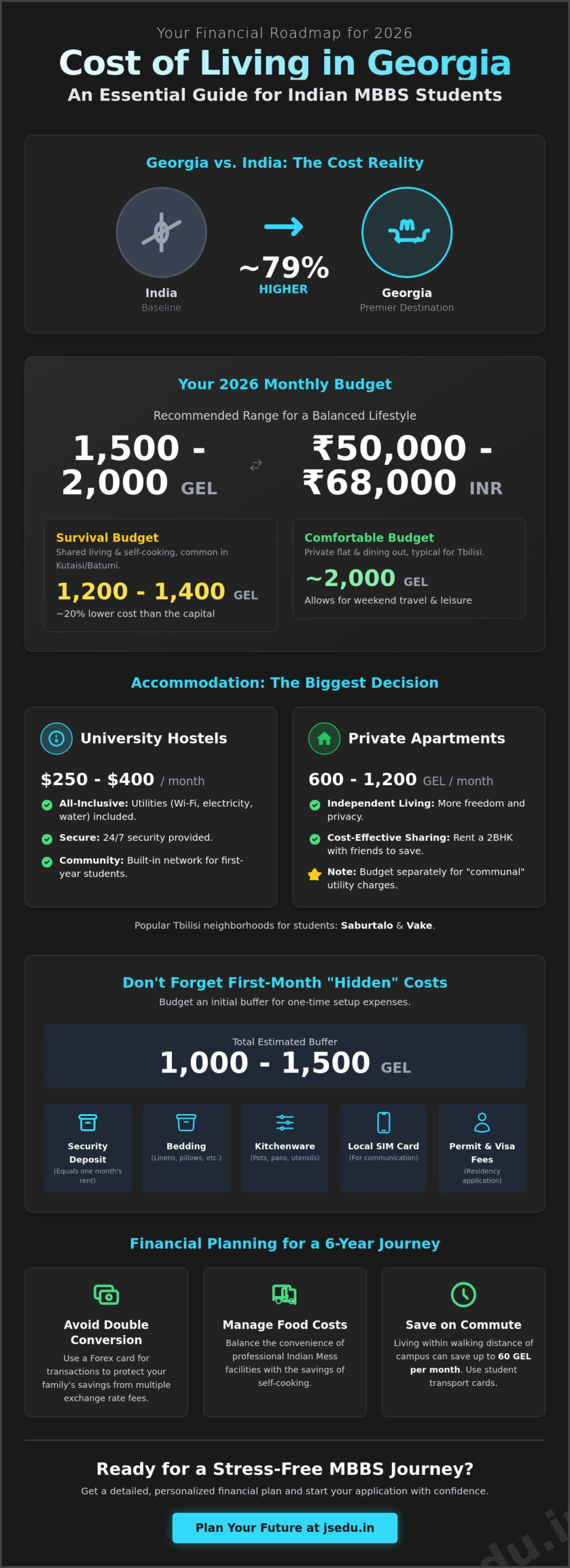
Did you know that the cost of living in Georgia is approximately 79% higher than in India? While Georgia remains a premier destination for medical education, many students arrive only to find that their initial budget estimates were based on outdated or incomplete information. Understanding the actual cost of living in Georgia for Indian students is the first step toward a stress-free six-year MBBS journey. You shouldn’t have to worry about hidden fees or fluctuating currency exchange rates when you’re trying to master human anatomy.
We understand that you need more than just a vague estimate; you require a reliable financial roadmap. This guide provides a detailed, itemized breakdown of monthly expenses for 2026, converted into both GEL and INR for your convenience. You’ll discover why the average monthly budget sits at roughly 64,000 INR and how that breaks down into rent, groceries, and utilities in cities like Tbilisi and Kutaisi. We’ll also explore practical ways to save on food and housing, ensuring you can manage your total financial commitment with absolute confidence from day one.
Key Takeaways
- Establish a realistic 2026 baseline budget of 1,500 to 2,000 GEL per month to ensure your financial planning aligns with current market stabilization.
- Evaluate the cost-to-comfort ratio between university-managed hostels and private apartments in student-friendly neighborhoods like Saburtalo and Vake.
- Master the balance between professional Indian Mess facilities and self-cooking to effectively manage the monthly cost of living in Georgia for Indian students.
- Identify and plan for ‘invisible’ expenses, including utility fluctuations and seasonal costs, while utilizing discounted student transport cards.
- Protect your family’s savings from the ‘double conversion’ trap by implementing strategic currency exchange and Forex card management.
Monthly Cost of Living in Georgia for Indian Students: 2026 Estimates
Planning for a medical degree abroad requires more than just comparing tuition fees. In 2026, the cost of living in Georgia for Indian students has reached a period of post-inflation stabilization. While the Caucasus region experienced significant price shifts in previous years, the current market offers a more predictable environment for long-term financial planning. On average, an Indian student should expect to spend between 1,500 GEL and 2,000 GEL per month. This translates to approximately 50,000 to 68,000 INR, depending on the current exchange rate and your personal lifestyle choices.
Understanding Georgia’s Economic Landscape is vital for families remitting funds from India. The Georgian Lari (GEL) has shown resilience, but the exchange rate against the Indian Rupee (INR) remains a variable that can impact your monthly budget. When compared to other popular destinations like Italy or Poland, Georgia remains a highly cost-effective choice. It provides a European lifestyle at a fraction of the price found in Western Europe, though it’s now slightly more expensive than some CIS countries due to its modernizing infrastructure and alignment with EU standards. Before committing to this financial investment, many families also want to understand whether MBBS in Georgia is genuinely good for Indian students or simply a backup option — a question worth addressing alongside your budget planning.
The ‘Bare Minimum’ vs. ‘Comfortable’ Student Budget
A survival budget focuses strictly on shared dormitory living and self-cooking, often hovering around 1,200 to 1,400 GEL. This is common for students in cities like Kutaisi or Batumi, where expenses are often 20% lower than in the capital. Conversely, a ‘comfortable’ lifestyle in Tbilisi allows for private apartment living, occasional dining at Indian restaurants, and weekend travel. This typically requires the full 2,000 GEL budget. Your choice of city is the single most significant factor in determining your cost of living in Georgia for Indian students.
Initial One-Time Setup Costs for New Students
Many families overlook the “hidden” expenses of the first month. Beyond your recurring rent, you’ll need an initial buffer of about 1,000 to 1,500 GEL for setup. This covers essential bedding, kitchenware, and a local SIM card. You must also account for the residence permit application fees and the D-type student visa processing, which are critical for your legal stay. Before finalizing your institution, it’s equally important to verify your chosen university against the NMC recognized universities in Georgia to ensure your degree remains valid for the NExT exam back home. In 2026, security deposits for private apartments generally equal one month’s rent, so ensure your first transfer from India includes these upfront capital requirements to avoid early financial stress.
Accommodation Options: University Hostels vs. Private Apartments
Choosing where to live is the most critical decision you’ll make after securing your admission. This choice doesn’t just dictate your comfort; it fundamentally shapes the cost of living in Georgia for Indian students. While some prefer the structured environment of a university dormitory, others seek the independence of a private flat. Each path has distinct financial implications that you must weigh carefully before you arrive in Tbilisi or Batumi. Proximity to your campus is a major factor. Living within walking distance can save you up to 60 GEL per month in transport costs, which adds up significantly over a six-year program.
Hostel Life: Costs and Inclusions
For many first-year students, university-managed hostels provide a seamless transition into Georgian life. In 2026, typical hostel fees range from 250 USD to 400 USD per month. These fees are generally inclusive of high-speed Wi-Fi, electricity, water, and 24/7 security. This “all-in” pricing model protects you from the seasonal price hikes common in private rentals. If you want to compare specific facilities across different institutions, you can find detailed breakdowns in our MBBS in Georgia for Indian Students: The Definitive 2026 Admission Guide. Hostels offer a built-in community, which is invaluable during those intense first semesters of medical school.
Renting a Private Flat: The Hidden Expenses
Once students become familiar with the city, many move into private apartments. In Tbilisi, neighborhoods like Saburtalo and Vake are the most popular student hubs due to their safety and proximity to medical universities. A private 1BHK apartment typically costs between 1,000 and 1,200 GEL, while sharing a 2BHK can bring your individual rent down to 600 or 800 GEL. However, you must account for “communal” charges. You can find more data on Detailed Monthly Expenses in Georgia to see how these costs fluctuate.
The “Central Heating” factor is the most significant hidden expense in a private flat. During the Georgian winter, your utility bill for electricity and heating can jump from a modest 150 GEL to as high as 350 GEL. Unlike hostels, private rentals require you to manage these payments yourself. It’s also legally mandatory to have a formal, notarized rental agreement. This document isn’t just for your protection; it’s a requirement for your residence permit application. Planning your housing early ensures a smoother start to your studies. For personalized help with your application and housing transition, consider seeking professional admission support to avoid common relocation pitfalls.
Food and Dining: Managing Grocery Expenses and Indian Mess Facilities
Dietary habits play a significant role in the monthly cost of living in Georgia for Indian students. While the local Georgian cuisine is world-renowned, medical students often find it difficult to balance rigorous study schedules with daily meal preparation. This has led to a robust ecosystem of Indian mess facilities and tiffin services tailored specifically to the needs of the diaspora. While Georgia’s economy has stabilized, as noted in the Financial Overview by the World Bank, food prices remain sensitive to global supply chains. You’ll find that your food budget is the most flexible part of your expenses, depending on whether you choose to cook or subscribe to a meal plan.
Indian Mess and Tiffin Services in 2026
For most first-year students, joining an Indian mess is a strategic move. It eliminates the stress of grocery shopping while providing a taste of home during the initial adjustment period. In 2026, typical monthly mess charges range from 120 USD to 150 USD. These plans generally cover three meals a day: breakfast, lunch, and dinner. Tiffin services are also popular, offering more flexibility for those who prefer to eat at their own pace. You can easily find reliable providers located near the top medical universities in Georgia, particularly in student-heavy districts like Saburtalo.
Local Grocery Shopping: Supermarkets vs. Bazari
If you prefer self-cooking, your monthly grocery bill will likely range between 350 and 600 GEL. This is the most cost-effective way to manage your budget, though it requires time for preparation. Modern supermarkets like Carrefour, Spar, and Nikora offer convenience, but they’re often pricier than local alternatives. For the best value, students frequent the local ‘Bazari’ (open markets) for fresh produce, where you can find seasonal fruits and vegetables at significantly lower rates. Here is a look at the average prices for staples in 2026:
- Milk (1L): 3 to 6 GEL
- Bread (1 lb): 1 to 3.5 GEL
- Eggs (1 dozen): 5 to 8.5 GEL
- Basmati Rice (1kg): 8 to 12 GEL (available in specialized Indian stores)
- Lentils/Dal (1kg): 6 to 10 GEL
Finding Indian ingredients in Tbilisi has become much easier. Specialized shops in the city center stock everything from turmeric and garam masala to specific brands of tea. While these imported items carry a slight premium, they’re essential for maintaining a familiar diet. Balancing these costs with local staples is the secret to keeping your food expenses manageable over your six-year journey.
Daily Commute, Utilities, and Lifestyle: The ‘Invisible’ Costs
While housing and food dominate your budget, the smaller “invisible” expenses often determine your financial comfort. These daily outgoings are a key component of the cost of living in Georgia for Indian students. Managing them effectively allows you to focus on your medical studies without constant financial stress. From your morning commute to your evening study sessions, these operational costs require a structured approach to avoid overspending.
Transportation and Connectivity
Georgia’s public transport system is remarkably efficient and affordable. In Tbilisi, you’ll rely on the Metro, modern buses, and the iconic ‘Marshrutka’ minibuses. A standard monthly public transport pass costs 40 GEL. However, once you receive your student ID, you can apply for a student transport card. This card offers significantly discounted fares, making your daily commute to the university almost negligible. For late-night study sessions or group projects, taxi apps like Bolt and Yandex are indispensable. A short ride across student hubs typically costs between 5 and 10 GEL.
Staying connected with family in India is a non-negotiable expense. Magti and Silknet are the primary providers. Most students opt for unlimited data plans, which are essential for research and video calls. High-speed fiber internet for your apartment usually ranges from 30 to 50 GEL per month. It’s a small price to pay for seamless communication and access to digital learning resources.
Entertainment and Personal Care
Maintaining a healthy lifestyle is vital for the rigors of an MBBS program. Most universities have fitness centers nearby, with monthly gym memberships costing between 80 and 150 GEL. If your private apartment lacks a washing machine, professional laundry services charge roughly 5 to 10 GEL per load. These small fees can add up, so it’s wise to factor them into your monthly estimate from the start.
Don’t forget to budget for leisure and personal well-being. Exploring Georgia’s stunning landscapes or enjoying a coffee at a local cafe is part of the global education experience. A cinema ticket costs about 15 to 20 GEL. Additionally, mandatory health insurance is a legal requirement for your residence permit. This typically costs between 300 and 600 GEL annually. Planning for these “minor” costs ensures you won’t face surprises halfway through the semester. If you’re ready to take the first step toward your medical career, you can apply for MBBS in Georgia admission today and let our experts handle the complexities of your transition.
Financial Planning and Budgeting Tips for a 6-Year MBBS Journey
Mastering the cost of living in Georgia for Indian students requires a long-term strategy rather than a month-to-month approach. A six-year medical program is a marathon, and your financial health is just as important as your academic performance. One of the most common mistakes students make is falling into the ‘Double Conversion’ trap. By converting INR to USD in India and then USD to GEL upon arrival, you can lose up to 5% of your total budget to bank fees and unfavorable exchange rates. We recommend carrying a multi-currency Forex card or using specialized transfer services to minimize these losses. If you’re still weighing the overall value of this investment, our detailed analysis of whether MBBS in Georgia is good for Indian students in 2026 separates fact from fiction on NMC compliance and career prospects.
How do you account for the unexpected? At JS Education, we advise families to maintain a 10% annual buffer in their budget. While Georgia’s economy has stabilized in 2026, global inflation can still impact local prices. Additionally, don’t forget to plan for vacations. If you stay in Georgia during the summer or winter breaks, your utility costs might decrease, but your leisure spending often rises. Conversely, if you travel home to India, you must still account for your rent or hostel fees to secure your room for the following semester.
Smart Money Management for Students
Opening a local bank account with TBC Bank or the Bank of Georgia is one of the first steps we help our students complete. These institutions offer modern mobile apps that make tracking your GEL expenses effortless. We also suggest using budgeting apps like Splitwise or Wallet to categorize your spending. These tools help you see exactly where your money goes, whether it’s on extra textbooks or weekend cafes. Saving on international transfers is also easier when you use a local account, as it avoids the high fees associated with withdrawing cash from Indian debit cards at Georgian ATMs.
What about part-time work? While international students are legally permitted to work up to 20 hours per week, the reality for medical students is quite different. The rigors of an MBBS curriculum leave very little time for employment. New regulations effective May 1, 2026, have restricted certain occupations for non-permanent residents. We strongly advise students to have their full budget funded from India rather than relying on part-time income to cover essential living costs. To protect your investment further, ensure your university meets all current FMGL regulations by reviewing the full list of NMC recognized universities in Georgia for 2026 compliance before committing to any institution.
How JS Education Supports Your Financial Transition
Our commitment to your success extends far beyond the admission letter. We conduct comprehensive pre-departure briefings that cover every detail of local life, from managing a grocery budget to understanding utility bills. We also assist in finding verified, budget-friendly accommodation to ensure you aren’t overpaying for rent. Our team provides ongoing support throughout your six-year journey, helping you navigate any financial shifts or regulatory changes that may arise. When you choose to study MBBS in Georgia with us, you gain a strategic partner invested in your long-term stability and professional growth.
Empowering Your Medical Career with Financial Confidence
Understanding the actual cost of living in Georgia for Indian students is the foundation of a successful six-year medical program. By balancing shared housing costs with efficient meal planning and utilizing student discounts, you can maintain a high standard of living while staying within your budget. Success abroad isn’t just about spending less; it’s about planning for fluctuations and having a reliable support system on the ground when you need it most. Accurate budgeting ensures that your focus remains where it belongs: on your medical education.
At JS Education, we leverage over 20 years of expertise in medical admissions to ensure your transition is seamless and transparent. We provide clear fee structures with no hidden costs and dedicated on-ground support in Georgia to help you navigate every local challenge. Your dream of becoming a global healthcare professional is within reach when you have the right partner by your side. Plan your affordable MBBS journey with JS Education today! We’re here to turn your international ambition into a tangible, stress-free reality.
Frequently Asked Questions
Is Georgia expensive for Indian students compared to India?
Yes, the cost of living in Georgia is approximately 79% higher than in India. While daily expenses like groceries and utilities are more costly, the total investment remains significantly lower than private medical education in India or Western Europe. Most students find the quality of life and international exposure well worth the additional monthly expenditure.
How much is the average monthly rent for a student in Tbilisi in 2026?
Rent in Tbilisi generally ranges from 600 GEL for a shared apartment to 1,200 GEL for a private 1BHK in popular student districts like Saburtalo. Prices vary based on the apartment’s condition and its proximity to major medical universities. It’s common for students to share flats to keep the cost of living in Georgia for Indian students more manageable.
Can Indian students find vegetarian food easily in Georgia?
Indian students can find vegetarian options quite easily through specialized Indian mess facilities and local markets. Many traditional Georgian dishes are also vegetarian-friendly, such as Lobio and various cheese-based breads. Additionally, specialized stores in Tbilisi stock essential Indian staples like basmati rice, lentils, and specific spices for those who prefer self-cooking.
What is the cost of a student visa and residence permit in Georgia?
The D-type student visa and the subsequent residence permit involve government processing fees that are mandatory for all international students. While these costs are not excessive, they’re a critical part of your initial setup budget. You should verify the exact current rates with your admission advisor as these fees are subject to periodic updates by the Georgian government.
Is it cheaper to live in a university hostel or a private flat?
University hostels are usually the cheaper option because their monthly fees of 250 to 400 USD typically include electricity, water, and internet. Private flats might have lower base rents in some areas, but once you add utility bills and the high cost of winter heating, the total monthly spend often exceeds that of a hostel.
How much should I budget for health insurance in Georgia?
You should budget between 300 and 600 GEL annually for mandatory health insurance. This coverage isn’t just a safety net for your health; it’s a legal requirement for maintaining your residence permit. Having a comprehensive policy ensures you won’t face unexpected medical bills during your six-year MBBS program.
Are there any hidden costs in the Georgia MBBS admission process?
Hidden costs typically include document translation, notarization, and initial apartment security deposits that aren’t always mentioned in basic brochures. At JS Education, we prioritize transparency and provide a full itemized list of these procedural expenses. This allows families to plan their finances without worrying about surprise charges during the first semester.
Can I work part-time in Georgia to cover my living expenses?
While you’re legally permitted to work 20 hours per week, it’s very difficult for medical students to balance a job with their intense academic schedule. Recent regulations have also restricted certain informal work options for international students. We strongly recommend that your entire budget is funded from India to ensure your focus remains entirely on your medical training.