



Choosing the cheapest medical seat often feels like the smartest move for your family’s finances, but the most affordable path isn’t always the one that aligns with your long-term ambitions. You’re likely feeling the pressure of India’s intense competition and worrying if a foreign degree will truly satisfy the strict 2021 NMC regulations. It’s difficult to cut through the noise when comparing MBBS in Georgia vs Poland for Indian students, especially when realistic total budgets can vary by as much as ₹50 lakh.
We’ve designed this guide to provide a transparent, expert-led analysis of tuition fees, clinical standards, and post-graduation prospects. You’ll gain the clarity needed to secure a high-quality education that protects your investment and ensures global mobility. We’ll explore why Georgia remains the undisputed leader for budget-friendly compliance and how Poland serves as a strategic gateway for students who want to practice medicine within the European Union.
Key Takeaways
- Explore why Georgia serves as a strategic hub for budget-conscious students seeking a high-quality, English-medium medical curriculum.
- Discover how a degree from Poland acts as a premium gateway to the European Union healthcare system and global residency opportunities.
- Compare the total financial investment required for MBBS in Georgia vs Poland for Indian students to ensure your choice aligns with your family’s realistic budget.
- Verify the specific NMC 2021 compliance details, including the mandatory six-year course duration and clinical internship requirements for both countries.
- Identify which destination best fits your professional profile, whether you prioritize immediate affordability or long-term EU-wide career mobility.
The Great Debate: Why Indian Students Choose Between Georgia and Poland in 2026
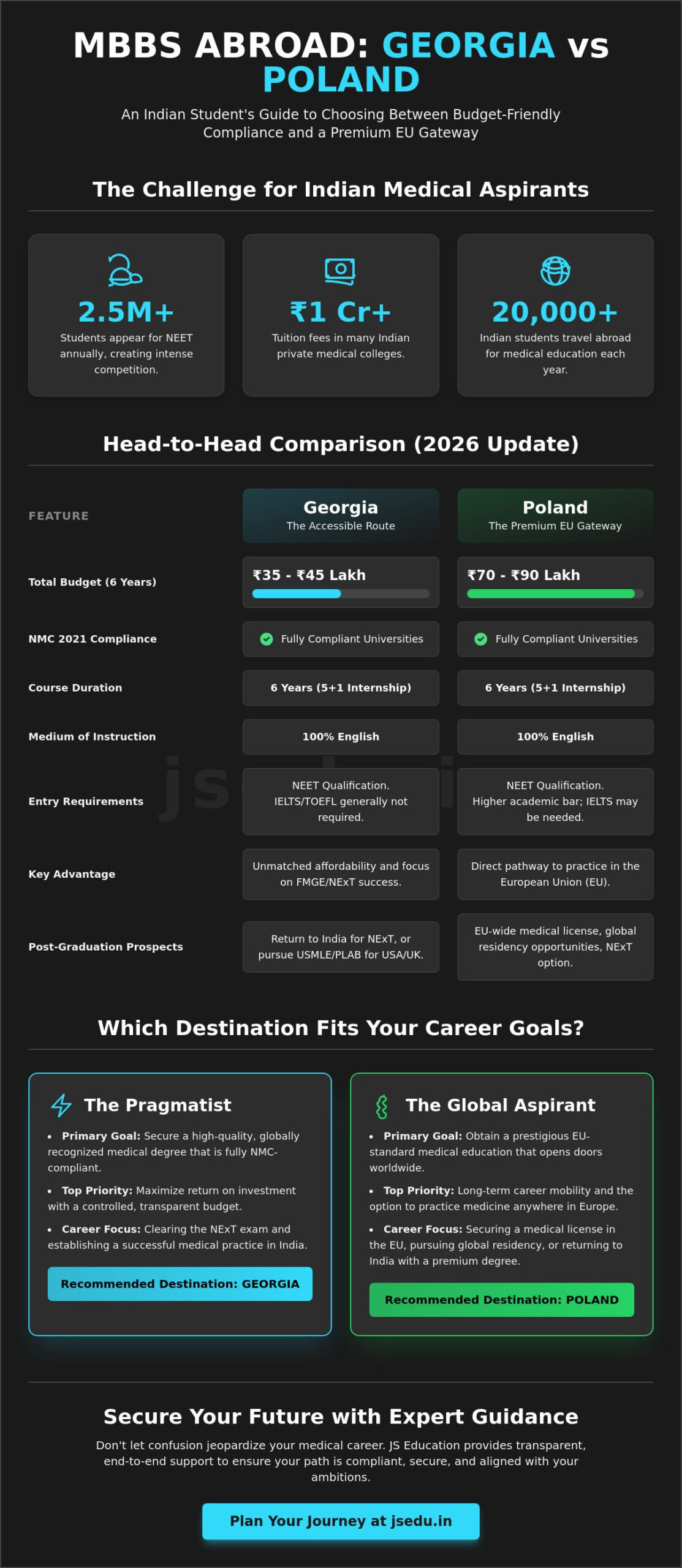
Securing a medical seat in India has become a Herculean task. With over 2.5 million students appearing for NEET annually, the saturation in Indian private medical colleges is palpable. High tuition fees, often exceeding ₹1 crore, coupled with a staggering shortage of seats, leave many qualified aspirants looking for viable alternatives. This search often leads to a comparison of MBBS in Georgia vs Poland for Indian students, two destinations that have emerged as frontrunners for their academic rigor and procedural transparency.
The choice between these two nations often boils down to what we call the “Golden Dilemma.” Georgia offers unparalleled accessibility with a focus on high FMGE/NExT pass rates and lower living costs. Poland, on the other hand, provides the prestige of an EU-standard education and a direct pathway to residency in Europe. As we move through 2026, this decision is more critical than ever. The National Medical Commission (NMC) has tightened its 2021 regulations, making it mandatory for students to choose universities that strictly adhere to specific duration and internship criteria. Choosing the wrong destination now could jeopardize your future license to practice in India.
The Rise of International Medical Education
More than 20,000 Indian students now travel to medical schools in Georgia and Poland every year. This shift isn’t just about escaping high costs; it’s about strategic career planning. With the implementation of the National Exit Test (NExT), the focus has shifted from where you study to how well you’re prepared for clinical practice. Both countries host universities recognized by the WHO and ECFMG, ensuring your degree carries weight from New Delhi to New York. These institutions have adapted their curricula to be 100% English-medium, specifically catering to the global mobility requirements of international cohorts.
JS Education’s Perspective: Beyond the Brochure
JS Education acts as your strategic partner in this journey. We’ve spent the last 20 years navigating the complexities of international admission protocols to ensure students don’t fall into the trap of non-compliant programs. Our role is to provide procedural integrity. We don’t just help you fill out forms; we ensure a seamless transition that respects the gravity of your educational investment. Parents often worry about hidden costs or sudden regulatory changes. We address these fears by maintaining direct relationships with top-tier universities, ensuring that every step, from document verification to hostel allotment, is handled with transparency and care. Your ambition deserves a path that is both safe and world-class.
MBBS in Georgia: The Most Accessible Route for Indian Medical Aspirants
Georgia has solidified its position as the education hub of the Caucasus region, specifically for medical studies. It isn’t merely a fallback option for those who miss out on Indian seats; it’s a destination of choice for students seeking academic excellence without the prohibitive costs of private domestic colleges. The curriculum is 100% English-medium, meticulously designed to cater to international cohorts. This ensures that language is never a barrier to mastering complex clinical concepts. One of the most significant advantages is the ease of entry. Most Georgian universities don’t require IELTS or TOEFL scores, removing a major hurdle that often delays the dreams of Indian aspirants. When comparing MBBS in Georgia vs Poland for Indian students, the sheer accessibility and affordability of the Georgian system often make it the more practical choice for many families.
Top Universities and Infrastructure in Georgia
The academic landscape is led by institutions like Tbilisi State Medical University, which carries a clinical legacy spanning over a century. Choosing between government and private universities is a crucial step. Government universities offer deep-rooted clinical exposure in state-run hospitals, while private institutions often feature cutting-edge infrastructure and modern simulation labs. These labs are essential for hands-on training before students enter real-world clinical rotations. Most top-tier Georgian universities have integrated USMLE and PLAB preparation into their schedules, acknowledging that their students often aim for global careers in the USA or UK. This forward-thinking approach ensures you aren’t just earning a degree, but preparing for a worldwide medical career.
Safety and Student Life in Georgia
Safety is a primary concern for parents sending their children abroad. Georgia consistently ranks among the top 10 safest countries globally, offering a secure environment that allows students to focus entirely on their studies. Cities like Tbilisi and Batumi have developed a vibrant Indian diaspora, which has led to the establishment of numerous Indian mess facilities and grocery stores. This makes the cultural transition much easier for teenagers living away from home for the first time. The visa process is another area where Georgia excels. Through the guidance of JS Education, the application and approval stages are remarkably seamless, ensuring that students can join their classes on time without administrative delays. If you’re ready to start your journey, you can explore the latest admission intake details to begin your application today.
MBBS in Poland: Premium EU-Standard Medical Education
Poland represents the gold standard for students who view their medical degree as a long-term investment in European residency. While Georgia offers a seamless entry point, Poland provides a direct gateway to the entire European Union healthcare system. The country boasts a rich medical heritage, being the home of pioneers like Nicolaus Copernicus. Today, that legacy continues through the Polish Accreditation Committee. This body enforces stringent quality controls across all medical programs, ensuring that every graduate meets the high standards required to practice within the Schengen Area and beyond. This oversight is a significant differentiator for those comparing MBBS in Georgia vs Poland for Indian students.
The EU Advantage and Global Recognition
Professional mobility is perhaps the most compelling reason to choose Poland. Graduates are eligible for the EU Blue Card, a work and residence permit that simplifies the process of staying and practicing in Europe after graduation. Additionally, the Schengen visa allows students to undertake clinical electives in 27 different countries. This provides exposure to diverse healthcare models and advanced medical technologies. Polish degrees are widely recognized by major medical boards, including the General Medical Council (GMC) in the UK. This makes it an ideal choice for those aiming for careers in Western Europe or the British Isles. The level of international integration here is simply unmatched by non-EU destinations.
Academic Rigor and Entry Requirements
The prestige of a Polish medical education comes with higher expectations. Unlike many other foreign destinations, Polish universities typically require a minimum of 60% in Physics, Chemistry, and Biology in the 12th grade. The admission process is competitive. Many top-tier schools conduct rigorous interviews or specific entrance tests to assess a candidate’s scientific aptitude and English proficiency. This high barrier to entry ensures a classroom environment filled with high-achieving peers. It significantly enhances the learning experience and peer-to-peer knowledge exchange.
Clinical experience in Poland is notably different from non-EU options. Students spend their clinical years in world-class hospitals equipped with the latest robotic surgical systems and diagnostic technology. These rotations follow standardized EU protocols that prepare you for the highest levels of global medical practice. They aren’t just observational; they’re immersive. Securing a seat here requires professional guidance to navigate the competitive application cycles, but the rewards are a world-class professional foundation. If you’re aiming for a career at the peak of international medicine, Poland provides the infrastructure to get you there.
Head-to-Head Comparison: Fees, Duration, and NMC Compliance (2026 Update)
Making a final decision requires more than just looking at university rankings. It demands a thorough audit of your financial capacity and a strict verification of legal compliance. When evaluating MBBS in Georgia vs Poland for Indian students, the contrast in financial commitment is often the deciding factor for most families. While both destinations offer high academic standards, their cost structures and administrative requirements differ significantly. You must ensure that your chosen university doesn’t just offer a degree, but a valid license to practice back in India.
Financial Breakdown: Georgia vs Poland
Georgia remains the most budget-friendly option for Indian families. Annual tuition fees in Georgia typically range from $4,000 to $8,000. When you include hostel fees and daily expenses, a realistic total budget for the entire six-year program falls between ₹35 lakh and ₹45 lakh. Living costs are notably low, with students spending approximately ₹1.5 lakh to ₹2 lakh per year on food and accommodation.
Poland operates on a different financial scale. Tuition fees here range from €8,500 to €12,000 per year. The total investment, including living expenses in cities like Warsaw or Lublin, can reach between ₹70 lakh and ₹1 crore. Monthly living costs in Poland are estimated between ₹25,000 and ₹35,000. Beyond tuition, you should account for hidden costs such as mandatory health insurance, annual visa renewals, and university registration fees, which are often higher in the EU. If you need a detailed cost sheet for specific universities, you can request a transparent fee breakdown from JS Education to avoid any surprises.
Technical Compliance with NMC 2021 Regulations
The National Medical Commission (NMC) 2021 regulations are non-negotiable. Both Georgia and Poland have structured their 2026 curricula to meet these strict standards. The primary requirement is a minimum of 54 months of academic study, followed by a mandatory 12-month clinical internship at the same foreign university. Both countries offer a 6-year program that comfortably satisfies this rule.
Another critical factor is the medium of instruction. The NMC requires the entire course, including clinical rotations, to be conducted in English. While both countries comply, students in Poland must learn basic Polish to interact with local patients during their third-year clinical rounds. Georgia follows a similar model with the Georgian language. This clinical exposure is vital for passing the NExT exam in India, as the curriculum covers all 19 required clinical subjects. We only partner with universities listed in the World Directory of Medical Schools (WDOMS) to ensure your degree remains globally recognized and legally sound.
Strategic Choice: How to Decide Which Destination Fits Your Career Goals
Selecting the right country is a strategic decision that shapes your entire professional trajectory. When weighing MBBS in Georgia vs Poland for Indian students, you must look beyond the immediate admission and consider your life ten years from now. Are you aiming to serve as a specialist in a leading Indian hospital, or do you envision yourself practicing in the heart of Western Europe? Your answer to this question determines which destination is your best strategic partner.
The “Budget Student” profile typically finds Georgia to be the most logical choice. If your primary goal is to obtain a high-quality, NMC-compliant education and return to India to clear the NExT exam, Georgia offers the highest return on investment. With tuition fees starting as low as $4,000, you can complete your degree without placing an overwhelming financial burden on your family. This allows you to focus your resources on post-graduate specializations later.
Conversely, the “Global Aspirant” profile is better suited for Poland. While the investment is higher, reaching up to ₹1 crore for the full duration, the long-term ROI is found in global mobility. Poland’s EU status and the possibility of obtaining an EU Blue Card make it a launchpad for careers in Germany, the UK, or Scandinavia. You aren’t just paying for a degree; you’re paying for a seat in the European healthcare ecosystem.
Decision Matrix: Georgia or Poland?
To finalize your choice, evaluate your profile against these three pillars:
- Academic Readiness: Do you have the 60% PCB score and the confidence to clear the rigorous interviews required by Polish medical schools? If you prefer a more accessible entry point without entrance tests, Georgia is the safer path.
- Financial Sustainability: Can your family’s financial plan sustain the higher cost of living in Poland for six years? Remember that Poland’s monthly expenses are nearly double those in Georgia.
- Climate and Culture: Both countries experience cold winters, but Poland offers a more central European lifestyle with easy rail access to 27 Schengen countries for clinical electives.
Taking the Next Step with JS Education
Our role as your trusted advisor is to ensure that your transition is entirely hassle-free. We begin with a comprehensive profile assessment to match your academic strengths with the right university. From document verification and translation to securing your visa, we manage the procedural integrity of your application so you can focus on your studies. We don’t believe in high-pressure tactics; we believe in informed decisions that lead to successful clinical careers. Start your medical journey with JS Education today.
Your Path to a Global Medical Career
The choice between these two prestigious destinations depends entirely on your personal career roadmap. Georgia stands as the most affordable, NMC-compliant option for those focused on returning to India, while Poland offers a strategic advantage for those seeking long-term residency in the European Union. Both countries provide the English-medium clinical training necessary to excel in the NExT exam and beyond. You aren’t just choosing a university; you’re selecting the environment where you’ll transform into a healthcare professional.
Navigating the complexities of MBBS in Georgia vs Poland for Indian students requires more than just a brochure. It requires a partner with a proven track record. JS Education brings 20+ years of excellence to your side as an official representative of top European universities. Having successfully placed 1000+ students abroad, we’re ready to help you manage every detail of this high-stakes transition with transparency and care.
Don’t leave your future to chance. Get a Free Personalized Comparison Report from JS Education Specialists and take the first step toward your white coat. Your journey to becoming a world-class doctor starts with a single, well-informed decision. We’re here to help you make it.
Frequently Asked Questions
Is MBBS in Georgia vs Poland better for clearing the NExT exam in India?
Both destinations provide a solid foundation for the NExT exam by covering all 19 required clinical subjects in their curricula. Georgia is often preferred by students focusing on historical FMGE success rates, while Poland’s EU-standard clinical training offers deep diagnostic knowledge. The key to clearing NExT is choosing a university with strong simulation labs and USMLE-aligned training modules.
Are medical universities in Georgia and Poland recognized by the NMC in 2026?
Yes, top universities in both countries comply with the NMC 2021 Foreign Medical Graduate Licentiate regulations. They meet the mandatory 54-month academic study duration and provide the required 12-month clinical internship within the same institution. It’s vital to verify that your specific university is listed in the World Directory of Medical Schools (WDOMS) to ensure your degree remains valid in India.
What is the total cost of MBBS in Georgia for Indian students including living expenses?
A realistic total budget for the six-year program in Georgia ranges from ₹35 lakh to ₹45 lakh. This estimate includes annual tuition fees between $4,000 and $8,000, along with living expenses of approximately ₹1.5 lakh to ₹2 lakh per year. Students should also account for annual visa renewals and mandatory health insurance to avoid unexpected financial strain during their stay.
Can Indian students work in Poland or other EU countries after completing their MBBS?
Graduates from Polish medical universities are eligible to apply for the EU Blue Card, which simplifies the process of working and residing within the European Union. Since Poland is a Schengen member, your degree and clinical experience are highly valued across 27 European nations. This provides a clear pathway to international residency and professional practice that isn’t directly available through non-EU destinations.
Is it mandatory to learn the local language in Georgia or Poland for clinical rotations?
Learning the basics of the local language is mandatory for clinical rotations starting from the third year. While the medium of instruction for MBBS in Georgia vs Poland for Indian students is 100% English, you must communicate with local patients during hospital rounds. Universities provide dedicated language classes during the first two years to ensure you’re prepared for these patient interactions.
Do I need to clear NEET to study MBBS in Georgia or Poland?
Yes, qualifying NEET is an absolute requirement for any Indian student planning to study medicine abroad. Without a qualifying NEET score, you won’t be eligible to sit for the NExT exam or obtain a license to practice medicine in India after graduation. This regulation applies regardless of whether you choose Georgia, Poland, or any other international medical destination.
What are the eligibility criteria for Indian students in Polish medical universities?
Polish medical universities generally require a minimum of 60% in Physics, Chemistry, and Biology in your 12th-grade examinations. The admission process is more competitive than in Georgia and often includes a university-specific entrance test or a formal interview. These assessments evaluate your scientific aptitude and English proficiency to ensure you can manage the rigorous EU-standard academic workload.
How does JS Education help in the MBBS admission process for Georgia and Poland?
JS Education acts as your trusted advisor by managing the entire admission lifecycle from initial profile assessment to successful placement. We handle complex documentation, translations, and visa processes to ensure your application meets all procedural requirements. With 20 years of experience, we help you choose a university that aligns perfectly with your budget and long-term career ambitions.