



What if the high tuition of a private Indian college could instead fund a world-class degree in Central Europe that opens doors to the entire EU? It’s a question more Indian students are asking as they weigh the benefits of studying physiotherapy in Poland vs Czech Republic against stagnant career prospects at home. You’ve likely felt the stress of wondering if a degree from abroad is truly valid in India or if language barriers will prevent you from succeeding in a clinical setting.
We understand these high-stakes decisions require transparency and expert guidance. This 2026 comparison helps you navigate everything from Poland’s accessible €3,500 annual tuition to the historic prestige of Czech institutions like Charles University. We’ll examine clinical internship quality, the 5-year integrated Master’s pathways, and the specific steps to ensure your global career recognition is guaranteed. By the end of this guide, you’ll have a clear, hassle-free roadmap to starting your medical journey abroad with total confidence.
Key Takeaways
- Understand the core differences in academic structure, including why the choice between physiotherapy in Poland vs Czech Republic impacts your total study duration and hands-on clinical hours.
- Get a transparent breakdown of 2026 tuition fees and monthly living costs in major student hubs like Warsaw and Prague to match your personal budget.
- Learn about the “Blue Card” work permit and how to ensure your European degree meets the specific registration requirements for the UK, USA, or India.
- Discover how EU-mandated clinical training hours translate into practical experience that makes you a competitive candidate in the global healthcare market.
- Use our final decision checklist to select the destination that aligns with your long-term goals for clinical specialization and international mobility.
The Rise of Physiotherapy in Central Europe: Why Poland and Czechia?
By 2026, the global demand for skilled physiotherapists is projected to reach new heights as healthcare systems shift toward preventative care and non-invasive rehabilitation. For Indian students, the competitive pressure and low return on investment at domestic private colleges have made international education a strategic necessity. When evaluating your options, the debate often centers on physiotherapy in Poland vs Czech Republic. These two nations have transformed into European hubs for medical education, offering English-taught programs that meet the highest international standards.
Central Europe’s ascent isn’t accidental. Both countries strictly follow the Bologna Process, a system that ensures academic degrees are compatible and portable across the European Union. This framework allows you to start your journey in Warsaw or Prague and eventually practice in Germany, Ireland, or even return to India with a globally recognized qualification. The healthcare system in Poland and the Czech Republic has moved away from generalist medical training toward highly specialized healthcare roles. This evolution ensures that physiotherapy students receive intensive, focused instruction in biomechanics, kinesiology, and advanced therapeutic techniques from their very first semester.
The Appeal of Central European Healthcare Education
Choosing to study within the Schengen Area provides a level of clinical exposure that is difficult to find elsewhere. Unlike programs in the UK or USA, which often come with prohibitive price tags and complex entry requirements, Poland and the Czech Republic offer a more accessible pathway without compromising on quality. The clinical training standards are exceptionally high; students are required to complete extensive practical hours in state-of-the-art hospitals and rehabilitation centers. As your trusted advisor, JS Education evaluates these programs based on their clinical depth and faculty expertise. We focus on universities that provide a seamless transition from classroom theory to patient-side practice, ensuring you feel prepared for the rigors of a professional healthcare environment.
Poland vs. Czech Republic: A Quick 2026 Snapshot
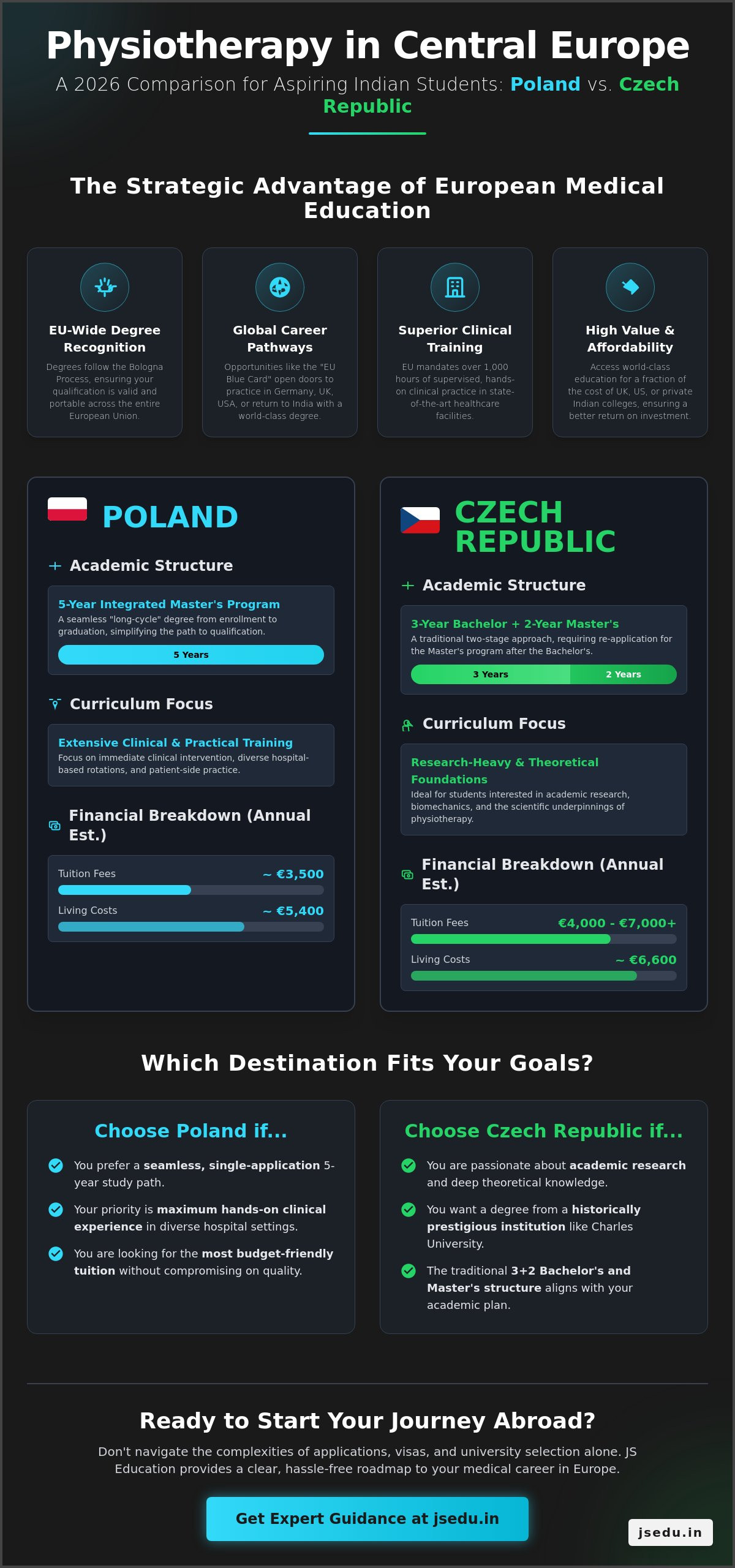
While both countries offer world-class education, they cater to slightly different professional goals. In 2026, Poland remains a leader for students seeking massive clinical infrastructure. Cities like Lublin and Warsaw are home to universities that offer integrated 5-year Master’s programs, which often simplify the licensing process for international graduates. Conversely, the Czech Republic is renowned for its research-heavy curricula. Institutions like Charles University carry immense historical prestige and are ideal for those who want to dive deep into the scientific foundations of the profession. Fortunately, the visa processes for Indian applicants in both nations are remarkably similar. Both require standard documentation such as proof of funds and comprehensive health insurance, making the administrative journey manageable for you and your family.
Comparing Academic Excellence: University Rankings and Curriculum
Selecting the right educational framework is a critical step when evaluating physiotherapy in Poland vs Czech Republic. Both nations follow the Bologna Process, yet they offer distinct paths to professional qualification. In the Czech Republic, the standard route involves a 3-year Bachelor’s degree followed by a 2-year Master’s. Poland frequently utilizes a “long-cycle” 5-year integrated Master’s program. This integrated model is particularly beneficial for Indian students as it eliminates the need to re-apply for a Master’s seat after three years, providing a seamless five-year journey from enrollment to graduation.
Clinical standards across both countries are governed by strict EU mandates. To practice as a professional, you must complete over 1,000 hours of supervised hands-on training. The World Physiotherapy profile of Poland confirms that the profession is highly regulated, ensuring that your clinical hours meet international benchmarks. While Polish universities often focus on immediate clinical intervention and hospital-based practice, Czech institutions are known for their deep theoretical foundations and research-heavy approach. Choosing between them depends on whether you prefer a curriculum rooted in biomechanical research or one focused on diverse clinical rotations.
Top Physiotherapy Universities in Poland
The Medical University of Warsaw and Vincent Pol University in Lublin are premier choices for international students. Warsaw offers the prestige of a top-ranked medical capital, while Lublin is celebrated for its vibrant and established international student community. The curriculum in these institutions is heavily weighted toward orthopedics, neurology, and sports medicine. This clinical focus ensures that graduates are well-prepared for the practical demands of modern healthcare. If you’re looking for a program with a strong community feel and robust clinical ties, our team at JS Education can help you secure a seat in these competitive faculties.
Top Physiotherapy Universities in the Czech Republic
Charles University in Prague stands as a beacon of academic excellence, particularly its Faculty of Physical Education and Sport. It is one of the oldest and most respected universities in the world, offering a degree that carries significant weight globally. Masaryk University in Brno is another excellent option, known for its modern facilities and unique approach to rehabilitation. The Czech curriculum often integrates social and work-rehabilitation methods, viewing the patient’s recovery through a holistic lens. This theoretical depth is ideal for students who wish to pursue specialized research or academic roles in the future. Ultimately, the choice of physiotherapy in Poland vs Czech Republic will depend on your specific career aspirations and preferred learning style.
Financial and Eligibility Breakdown: Fees and Requirements
Financial clarity is the foundation of any successful study abroad plan. When comparing physiotherapy in Poland vs Czech Republic, the initial investment varies significantly based on the institution’s prestige and location. For the 2026 intake, Poland remains the more budget-friendly option for Indian families. Universities like Vincent Pol University in Lublin offer tuition at approximately €3,500 per year, while others like Andrzej Frycz Modrzewski Krakow University start around €3,600. In contrast, Czech institutions like Palacký University Olomouc or Charles University command higher fees, often ranging from €8,000 to over €9,100 per academic year. While Czechia can be slightly more expensive, the ROI is high due to the immense global recognition of its historic medical faculties.
Beyond tuition, you must account for “hidden costs” that often surprise unprepared students. These include mandatory health insurance with a minimum €30,000 coverage, visa application fees (approximately €80 for Poland and 2,500 CZK for Czechia), and document translation fees. Visa renewals and residence permit applications also require small administrative payments. To support meritorious Indian students, several universities offer partial scholarships or tuition reductions based on academic performance, which can lower your annual costs by as much as €1,000 in certain Polish institutions.
Eligibility Criteria for Indian Students
The path to admission is straightforward if you plan ahead. Most universities require a minimum of 50% to 60% in your Class 12 board exams, specifically in Physics, Chemistry, and Biology (PCB). Does the NEET exam matter for physiotherapy abroad in 2026? While NEET isn’t strictly mandatory for physiotherapy as it is for MBBS, having a qualified score can strengthen your visa application and prove your academic intent. English proficiency is also vital. You’ll generally need an IELTS score of 6.0 or higher, though some universities allow you to sit for their internal English entrance exams instead.
Cost of Living: Warsaw vs. Prague vs. Brno
Living expenses in Central Europe are remarkably affordable compared to Western Europe. In Poland, students typically spend between €400 and €600 per month. Student dormitories are the most economical choice, costing between €80 and €150 monthly. If you prefer a private apartment in Warsaw, expect to pay between €200 and €400. Prague is slightly costlier, with monthly averages ranging from €500 to €750. However, cities like Brno offer a middle ground with high-quality facilities at a lower price point than the capital. You’ll also benefit from the “Schengen Lifestyle,” where a valid student ID grants significant discounts on public transport, museums, and even local eateries, making daily life manageable and enjoyable.
- Poland Proof of Funds: Demonstrate approximately ₹6-8 Lakhs for a smooth visa process.
- Czech Proof of Funds: Show roughly 124,500 CZK to cover a year’s stay.
- Visa Processing: Poland takes 15-21 days, while Czechia can take 60 days or longer.
Clinical Training and Global Career Prospects
The decision to pursue physiotherapy in Poland vs Czech Republic is often driven by the desire for a global career. A degree from either nation acts as a professional passport, recognized across all European Union member states. This recognition is built on the rigorous clinical standards these countries maintain. To ensure graduates can practice internationally, curricula are designed to meet the requirements of major global bodies, such as the Health and Care Professions Council (HCPC) in the UK and the Federation of State Boards of Physical Therapy (FSBPT) in the USA. If you intend to take the NPTE in America or register in London, your 1,000 plus clinical hours from a Polish or Czech university provide the necessary foundation for transcript evaluation.
Global mobility is further supported by the EU Blue Card, a work permit designed for highly qualified non-EU professionals. Both Poland and the Czech Republic offer post-study work search periods, allowing you to secure employment in local hospitals or private clinics. In Poland, the median salary for a physiotherapist is approximately 6,000 to 6,500 PLN gross per month. While many graduates choose to stay in Europe, the experience gained in a high-tech Schengen healthcare environment makes your resume stand out to employers worldwide, from Dubai to Toronto.
Internships and Practical Experience
The internship models in these two countries offer different professional flavors. The Polish model is characterized by early and frequent hospital exposure. You’ll likely find yourself in busy orthopedic or cardiac wards as early as your second year, managing diverse patient cases. Conversely, the Czech Republic is world-renowned for its specialized rehabilitation centers and historic thermal spas. Their training often emphasizes long-term neurological recovery and balneotherapy. At JS Education, we assist our students in selecting universities that have the strongest ties to prestigious clinical sites, ensuring your rotations are high-quality and relevant to your chosen specialization.
Returning to India: The Licensing Reality
For students planning to return home, the regulatory environment in India is evolving. The National Commission for Allied and Healthcare Professions (NCAHP) Act 2021 now governs the registration of physiotherapists. To ensure your foreign degree is registrable with Indian state councils, it must be from a recognized university and include a comprehensive internship. While this guide focuses on physiotherapy, our MBBS in Georgia Guide demonstrates our broader expertise in helping Indian students navigate complex European medical regulations and licensing pathways. We ensure that every program we recommend aligns with current Indian standards to protect your future career. If you’re ready to secure your future in global healthcare, speak with our expert advisors today to begin your application process.
The Verdict: Which Destination Should You Choose?
Deciding between physiotherapy in Poland vs Czech Republic ultimately comes down to aligning your professional ambitions with your financial reality. Both nations provide a gateway to the European healthcare sector, yet they cater to different student profiles. Poland is the clear frontrunner for those seeking a cost-effective, clinically-intensive route with a straightforward 5-year integrated Master’s path. Conversely, the Czech Republic remains the premier choice for students who value historical academic prestige and have the budget to support a more research-oriented education in cities like Prague or Brno.
Your journey doesn’t end with choosing a country; it begins with a strategic plan. Whether you prioritize the lower tuition fees of Lublin or the world-renowned reputation of Charles University, your degree will meet the EU standards necessary for global mobility. The high demand for physiotherapists across Europe ensures that your investment will yield a strong return, provided you navigate the admission and licensing processes with precision. Your dream of becoming a world-class healthcare professional is achievable, but it requires moving from the research phase to taking concrete action.
Choose Poland If…
- You prioritize affordability: With tuition fees starting around €3,500 per year, Poland offers one of the most budget-friendly medical educations in the Schengen Area.
- You prefer a clinical focus: The Polish model emphasizes early hospital rotations and a high volume of diverse patient cases.
- You seek a strong support system: Cities like Warsaw and Lublin host large, vibrant Indian student communities, making the cultural transition much easier.
- You want a seamless path: The 5-year integrated Master’s program simplifies your academic journey by removing the need for a separate Master’s application.
Choose the Czech Republic If…
- You seek global prestige: Holding a degree from a centuries-old institution like Charles University carries significant weight with employers worldwide.
- You are research-driven: The Czech curriculum is ideal if you’re interested in academia, high-end sports rehabilitation, or the scientific foundations of biomechanics.
- Your budget is flexible: You’re comfortable with tuition fees ranging from €8,000 to over €9,100 in exchange for studying in one of Europe’s most historic architectural hubs.
How JS Education Simplifies Your Journey
Navigating international admissions alone can be overwhelming. From document apostille and transcript evaluations to preparing for university-specific interviews, the margin for error is slim. Our team provides transparent, expert-led guidance to ensure you select the university that best fits your academic profile and career goals. We manage the complex administrative hurdles so you can focus on your studies. If you’re ready to take the next step toward a global career, Consult JS Education for your 2026 Physiotherapy Admission and let us build the bridge to your future success.
Take the Next Step Toward Your Global Healthcare Career
Choosing the right path for your medical education is a major decision that defines your professional future. Whether you’re drawn to the clinical intensity and affordability in Poland or the research-driven prestige of the Czech Republic, both destinations provide a secure bridge to international practice. We’ve seen how these EU-standard programs meet the strict licensing requirements for the UK, USA, and India, ensuring your degree holds significant value worldwide.
Deciding on physiotherapy in Poland vs Czech Republic is a smoother process when you have an expert mentor by your side. JS Education brings over 20 years of expertise in European medical admissions to your application journey. As official representatives of top universities, we provide the step-by-step guidance and transparent support needed to make your transition safe and successful. Your ambition to become a world-class healthcare specialist is achievable with the right plan in place.
Frequently Asked Questions
Is a Physiotherapy degree from Poland or the Czech Republic valid in India?
Yes, degrees from both nations are valid in India as long as you graduate from a university recognized by the respective national education ministries. To practice at home, you must register with the National Commission for Allied and Healthcare Professions (NCAHP) and comply with the specific registration requirements of your state council. Ensuring your program meets the clinical hour benchmarks is a key step that we help you verify during the admission process.
What is the duration of the BPT course in Poland vs the Czech Republic?
The academic structure differs slightly between the two nations. Poland typically offers a 5-year integrated Master’s program, which combines the Bachelor’s and Master’s levels into a single, continuous journey. In the Czech Republic, the path is usually divided into a 3-year Bachelor’s degree followed by a 2-year Master’s. This distinction is important when planning your total time investment for physiotherapy in Poland vs Czech Republic.
Is NEET mandatory for studying Physiotherapy in Europe?
No, the NEET exam isn’t a mandatory legal requirement for physiotherapy admissions in Europe for the 2026 intake. Unlike MBBS programs, where a qualified NEET score is essential for Indian students, physiotherapy admissions primarily focus on your Class 12 scores in Physics, Chemistry, and Biology. While not mandatory, having a qualified NEET score can serve as additional proof of your academic intent during the visa application process.
Can I work in the UK after completing my Physiotherapy degree in Poland?
Yes, you can work in the UK by registering with the Health and Care Professions Council (HCPC). Polish degrees follow EU standards, which are highly regarded by UK healthcare employers. You’ll need to submit your transcripts for evaluation and demonstrate English proficiency through exams like IELTS or OET. Many of our graduates have successfully transitioned to the NHS and private clinics across the UK using their Polish qualifications.
Are these courses taught fully in English for international students?
Yes, several leading universities in both Poland and the Czech Republic offer physiotherapy programs that are taught entirely in English. These courses are designed for international students, with all lectures, clinical materials, and examinations conducted in English. This ensures a seamless learning experience while allowing you to study alongside a diverse, global student body in a supportive academic environment.
What is the average cost of living for an Indian student in Prague vs Warsaw?
Warsaw is generally more budget-friendly, with average monthly expenses ranging from €400 to €600, including dormitory housing. Prague is slightly more expensive, typically requiring between €500 and €750 per month due to its higher cost of private rentals and local services. Both cities offer excellent student discounts on public transportation and food, ensuring that your daily life remains affordable while you study abroad.
Do I need to learn the local language to study in these countries?
You don’t need to know the local language for your academic studies, but basic proficiency is necessary for clinical practice. While your professors and textbooks use English, the patients you treat during hospital rotations will likely speak the local language. Most universities include introductory Polish or Czech language classes in their curriculum to help you communicate effectively and empathetically during your practical training sessions.
When is the deadline for the 2026 intake for Physiotherapy in Poland?
The general application deadline for the October 2026 intake in Poland is August 31, 2026, for international students. However, we strongly recommend starting your application process by January or February of 2026. This early start is crucial because document apostille, university entrance interviews, and visa processing can take several months to complete. Waiting until the final deadline often leads to unnecessary stress and potential delays in your enrollment.