



Did you know that approximately 90% of Indian students who clear the NEET exam fail to secure a medical seat in India? This staggering statistic from 2026 highlights why so many aspiring doctors are now looking toward an MBBS in Europe to fulfill their professional ambitions. It’s natural to feel anxious about whether a foreign degree will be recognized by the National Medical Commission or if the cost of living in a new country will be manageable for your family. You want a path that’s safe, affordable, and legally sound so you can eventually practice medicine in India or the USA without any hurdles.
We understand the weight of these high-stakes decisions, and we’re here to act as your trusted advisor through this entire transition. This guide provides a comprehensive roadmap for the 2026 admission cycle, focusing on high-quality, cost-effective programs in premier destinations like Georgia, Italy, and Poland. You’ll gain expert insights into NMC compliance, English-taught curriculums, and the specific entrance requirements for both Schengen and Non-Schengen territories. We’ll simplify the complex landscape of international education to ensure your journey from applicant to medical student is seamless and secure.
Key Takeaways
- Understand the latest NMC regulations for 2026, including the mandatory 54-month academic study rule and internship requirements for foreign medical graduates.
- Discover why pursuing an MBBS in Europe is a strategic move for Indian students, focusing on high-success destinations like Georgia and Italy.
- Access a detailed admission roadmap for the 2026 intake to ensure you meet all academic eligibility and documentation deadlines.
- Compare top European medical programs based on tuition affordability, medium of instruction, and world-class clinical standards.
- Learn how to identify a reliable medical education consultancy that offers transparent guidance and ethical placement services for your international transition.
Why Pursue an MBBS in Europe in 2026?
The 2026 medical admission cycle is witnessing a historic surge in competition. With nearly 90% of NEET-qualified candidates failing to find a seat in Indian institutions, the shift toward international education has become a necessity for many. Pursuing an MBBS in Europe allows you to bypass the high donations and limited seats of domestic private colleges. In these regions, you’ll typically earn an MD (Doctor of Medicine) degree. Don’t let the name confuse you. It’s the direct professional equivalent of the MBBS in India and is fully recognized by international medical bodies. This degree represents a lifelong asset, providing you with the credentials needed to practice in diverse healthcare environments across the globe.
European medical education isn’t just about getting a seat; it’s about the quality of the journey. Universities in countries like Georgia, Italy, and Poland provide English-taught programs that align with global standards. You’ll have access to advanced infrastructure and clinical rotations that prepare you for prestigious licensing exams. These include the USMLE in the United States or the PLAB in the United Kingdom. This global clinical exposure is a significant differentiator when you apply for competitive residency programs later. You aren’t just studying medicine; you’re building a network and a clinical perspective that spans continents. The advanced labs and research-driven curriculums ensure that you’re at the forefront of modern medical science from your first semester.
Choosing a destination in 2026 requires a focus on long-term career stability. Beyond the lower tuition fees, the primary draw is the regulatory environment. European institutions are known for their transparency and adherence to international educational protocols. This stability is reassuring for families who are making a significant financial and emotional investment. Whether you’re interested in the medical hubs of Poland or the research-centric universities in Italy, the goal remains the same: a high-quality education that leads to a successful medical practice. We’re here to help you navigate these choices, ensuring your path is both safe and rewarding.
European vs. Indian Medical Education
European training prioritizes lower student-to-patient ratios and higher clinical hours compared to the overcrowded wards sometimes found in Indian private colleges. You’ll spend significant time in simulation labs using digital diagnostic tools that are standard in European labs. It’s a myth that these schools are “easy.” They maintain strict academic standards and regular assessments to ensure graduates are ready for real-world practice.
Global Mobility and Recognition
Recognition is the most important step. Your university must be in the World Directory of Medical Schools (WDOMS). You can review this comprehensive list of European medical schools to see the variety available. Most programs use the ECTS credit system under the Bologna Process, making credits portable. This facilitates ECFMG certification, which is your gateway to a medical residency in the United States.
Critical NMC Regulations for Studying Medicine Abroad
Will my degree be valid in India? This is the most pressing question for any student planning an MBBS in Europe. You shouldn’t have to worry about legal hurdles after years of hard work and financial investment. The NMC regulations for foreign medical graduates provide a clear framework that you must follow to ensure your degree is recognized back home. These 2026 guidelines are designed to protect the integrity of the medical profession and your future career as a licensed doctor.
There are three pillars to these regulations that every applicant must understand. First, the duration rule is absolute. Your course must consist of at least 54 months of academic study, followed by a mandatory 12-month internship. This brings the total duration to 5.5 years. As of June 2026, the NMC has also proposed that the entire course must be completed within a maximum of 10 years. Second, the entire program must be completed at a single institution. You can’t transfer credits between different universities during your undergraduate years. Finally, the medium of instruction must be English for every single module, including clinical rotations and examinations.
Why is the internship requirement so strict? The NMC requires you to complete your clinical training in the same country and institution where you studied. This ensures that you’ve been assessed under consistent standards for both theory and practice. Skipping this step or attempting to do your initial internship in India will invalidate your foreign degree. It’s about ensuring a seamless transition from being a student to a licensed professional, and we’re here to help you navigate these procedural technicalities safely.
The NExT Exam: Preparing for the Future
The National Exit Test (NExT) is the upcoming gateway for both Indian and foreign medical graduates to practice in India. European curricula, particularly in countries like Georgia and Poland, are well-structured to meet these rigorous clinical standards. We focus on providing a clear roadmap for admission that prioritizes these regulatory safety nets. By choosing a university that is already WDOMS-listed, you’re securing your eligibility for the NExT exam and future residency programs in India or the USA.
Common Pitfalls in University Selection
Don’t be swayed by “bilingual” programs. These often promise English instruction but switch to the local language during clinical years when you interact with patients. This is a major red flag that will lead to your degree being rejected by the NMC. Always verify that the university is officially licensed to teach international students and maintains a high FMGE or NExT pass rate. Remember, a lower tuition fee isn’t a bargain if it compromises your ability to practice medicine in your home country.
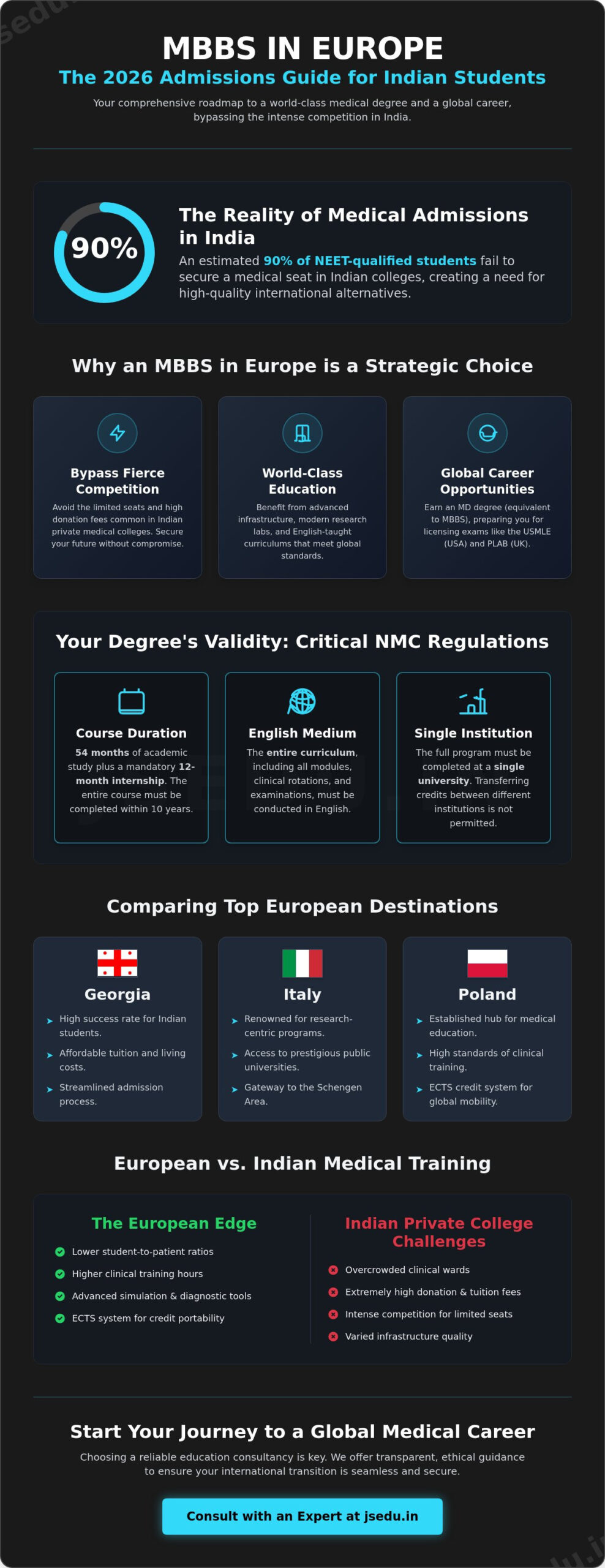
Top European Destinations: Comparing Georgia, Italy, Poland, and Czech Republic
Choosing the right destination for an MBBS in Europe involves balancing academic rigor with financial feasibility. While over 30 countries offer medical programs, most Indian students focus on a select few that consistently deliver high FMGE pass rates and NMC compliance. In 2026, the choice often comes down to the specific professional goals of the student. Are you looking for the most affordable path with a massive peer community, or is a prestigious scholarship in a Schengen nation your priority? Understanding the nuances of each country helps you make a decision that protects both your career and your family’s investment.
Georgia currently leads the preference list for Indian aspirants, hosting over 12,000 Indian students as of June 2026. Italy follows closely for those seeking public university prestige, while Poland and the Czech Republic remain the gold standard for clinical infrastructure. Each of these countries offers English-taught programs, but they differ significantly in their admission hurdles and cost structures. We’ve analyzed these hubs to help you identify which environment best suits your learning style and long-term residency goals.
MBBS in Georgia: The 2026 Hub for Indian Aspirants
Georgia has earned its reputation as the top choice for medical education due to its seamless visa processing and high success rates. For many, MBBS in Georgia for Indian students represents the perfect middle ground between quality and cost. Tuition fees for the 2026 cycle typically range from ₹3.3 lakhs to ₹6.7 lakhs per year. Leading institutions like Tbilisi State Medical University provide a welcoming environment with a curriculum that strictly adheres to the 54-month academic rule. With monthly living expenses as low as $100 to $150, it remains one of the most cost-effective ways to earn a globally recognized MD degree.
Italy and Central Europe: The Schengen Advantage
Italy offers a premium education model where tuition at public universities can be as low as €500 per year, provided you clear the International Medical Admissions Test (IMAT). While the entrance exam is competitive, the potential for world-class scholarships makes it highly attractive. In contrast, Poland and the Czech Republic focus on advanced, simulation-based training. Polish universities often charge between €10,000 and €15,000 annually but provide unmatched clinical exposure within the EU. The Czech Republic maintains a high standard of excellence; graduates from heritage institutions like Charles University boast FMGE pass rates between 40% and 47%. These Schengen countries also offer the advantage of easier travel and potential residency opportunities across Europe after graduation.
The 2026 Admission Roadmap: Eligibility and Documentation
Securing a seat for an MBBS in Europe is a methodical process that rewards those who plan ahead. For the 2026 academic cycle, your journey should ideally begin in February or March. This early start allows you to research specific university curriculums and entrance requirements before the NEET-UG exam in May. Waiting until the last minute often leads to unnecessary stress and limited choices. By following a structured timeline, you can ensure that every document is verified and every deadline is met without the anxiety of a rushed application. Your focus should be on building a solid foundation for your future medical career.
Academic eligibility is the first gate you must pass. Most European medical universities require a minimum of 50% in Physics, Chemistry, and Biology (PCB) for general category students, while reserved categories typically need 40%. Qualifying for the NEET-UG is a non-negotiable requirement for Indian students. Even though you’re studying abroad, a valid NEET score is mandatory for your degree to be recognized by the NMC later. Without it, you won’t be eligible to sit for the NExT exam or practice medicine in India. It’s a critical regulatory bridge that ensures your international education remains a valid asset for your professional life back home.
Financial planning is equally vital. Beyond tuition fees, you need to budget for mandatory health insurance, student visa fees, and monthly accommodation. For countries like Poland or the Czech Republic, universities often require proof of financial stability through specific bank statement standards. Having these funds organized early simplifies the visa process and provides peace of mind for your family. We recommend starting your consultation for the 2026 intake as soon as possible to get a clear breakdown of the specific financial requirements for your chosen destination.
Required Documentation Checklist
Your academic transcripts must undergo an Apostille process by the Ministry of External Affairs (MEA) to be legally recognized in Europe. Many universities also require professional translations of your 10th and 12th-grade mark sheets into the local language or English. Ensure your passport is valid for at least 18 months beyond your departure date. You’ll also need a comprehensive medical fitness certificate, often including specific tests for HIV and Hepatitis, to meet both university and visa standards.
The Visa Interview and Pre-Departure Orientation
The student visa interview is a standard procedure where officials assess your genuine intent to study. Expect questions about why you chose a specific country and how you plan to fund your education. JS Education provides thorough mock interview sessions and pre-departure orientations to ensure you feel confident and prepared. We also help you prepare for the practicalities of living abroad. This includes advice on essential items to pack, such as heavy winter gear for the European climate and familiar spices to help you settle into your new home.
Choosing a Trusted Medical Education Consultancy in India
How do you choose the right partner for such a significant life decision? Selecting a consultancy for your MBBS in Europe shouldn’t feel like a gamble. It requires a partner who prioritizes transparency over aggressive sales tactics. Many agencies promise “guaranteed seats” in top-tier universities, but this is often a red flag. Ethical placement focuses on matching your specific profile with institutions where you genuinely meet the eligibility criteria. You need a trusted advisor who understands that your success in India or the USA depends on the integrity of your initial admission.
JS Education has spent 20 years building a reputation for procedural integrity and reliable guidance. We don’t just process applications; we act as a bridge between your current reality and your future professional goals. Our long-standing presence in the industry means we’ve navigated every regulatory shift, from the early days of foreign medical education to the 2026 NMC guidelines. This experience allows us to offer a seamless transition that protects your investment. We believe the relationship shouldn’t end at the airport. True support includes helping you settle into your new environment and providing a sense of security for your family back home.
A reliable consultancy acts as your strategic partner throughout the entire 5.5-year journey. From the moment you begin your search to the day you start your clinical rotations, you deserve clear, honest communication. We avoid the high-pressure tactics common in the industry, focusing instead on informative, expert-led counseling. This ensures you make decisions based on facts rather than marketing slogans. Our goal is to empower you to reach your full potential as a global medical professional.
Our Specialized Assistance for 2026
We provide personalized university matching that aligns your NEET-UG score and budget with the best possible European institutions. Our team handles the heavy lifting of documentation and visa filing to ensure your application is error-free and compliant with local laws. While we specialize in medical degrees, we also offer guidance for alternative healthcare paths, including Nursing, BDS programs abroad, and Physiotherapy courses in Europe. This comprehensive care ensures every student finds a path that fits their long-term ambition.
Take the First Step Toward Your Global Career
Ready to move from planning to action? You can book a consultation with our senior medical advisors to discuss your specific needs for the 2026 intake. We also provide access to our extensive network of Indian students already studying in Georgia, Italy, and Poland. Hearing about their first-hand experiences can help you feel more prepared and confident about your move. Don’t leave your future to chance when you can partner with seasoned experts who are invested in your success. Start Your Journey with JS Education Today
Start Your Global Medical Career in 2026
Choosing to study an MBBS in Europe is a transformative decision that aligns high-quality training with regulatory safety. By prioritizing NMC-compliant universities and following the 2026 admission roadmap, you’re securing a future that spans across borders. Success in this journey depends on meticulous documentation and a clear understanding of the evolving medical landscape. You’ve seen how critical it’s to choose a destination that meets both your professional goals and your family’s budget while ensuring your degree remains valid for practice in India.
As official representatives of top NMC-recognized universities, JS Education has provided 100% transparency in fee structures and visa processes since 2004. With over 20 years of expertise, we serve as your strategic partner to ensure your transition is seamless and legally sound. You don’t have to navigate these complex international procedures alone. Our team is ready to guide you through every step of the 2026 intake cycle with the authority and care your career deserves.
Secure Your 2026 MBBS Admission – Book a Free Counseling Session Now
Your ambition to become a doctor deserves a path that’s both safe and world-class. We’re here to help you turn that lifelong ambition into a reality.
Frequently Asked Questions
Is an MBBS from Europe valid in India for 2026-27?
Yes, a medical degree from Europe is valid in India as long as it complies with the National Medical Commission’s FMGL regulations. You must ensure the course lasts at least 54 months and includes a 12-month internship at the same institution. Qualifying for the 2026-27 cycle requires strict adherence to these duration rules to ensure you can sit for the National Exit Test (NExT) upon your return.
Which is the cheapest country in Europe for MBBS for Indian students?
Italy and Georgia are currently the most cost-effective options for Indian students. While Italian public universities offer very low tuition fees for those who pass the IMAT, Georgia provides a high standard of education with annual fees starting around ₹3.3 lakhs. Choosing an MBBS in Europe through these countries allows you to manage your budget without compromising on the quality of clinical training or infrastructure.
Is NEET mandatory for studying MBBS in Europe?
Yes, qualifying for the NEET-UG is a mandatory requirement for any Indian student planning to study medicine abroad. The NMC uses your NEET score as a baseline for eligibility. Without a qualified score from the year of admission or the two preceding years, you won’t be allowed to register as a doctor in India, regardless of how well you perform in your European university.
Can I practice in the UK or USA after completing my MBBS in Europe?
You can certainly practice in the UK or USA after graduating, provided you clear the respective licensing exams. Graduates from European universities are eligible to appear for the USMLE for residency in the United States or the PLAB for the United Kingdom. Many institutions we partner with follow a curriculum that aligns with these global standards, making the transition to international healthcare systems much smoother.
What is the duration of the MBBS course in European countries?
The total duration for a medical degree in Europe is a minimum of 5.5 years. This includes 54 months (4.5 years) of dedicated academic study and a mandatory 12-month internship completed at the same hospital or university. This structure is designed to meet both the European ECTS requirements and the specific guidelines set by the National Medical Commission for Indian graduates.
Are medical universities in Europe recognized by the NMC and WHO?
Most reputable European medical universities are listed in the World Directory of Medical Schools (WDOMS) and recognized by the NMC. It’s vital to verify that your chosen institution appears in this directory before you apply. We exclusively represent universities that maintain these official recognitions, ensuring that your MBBS in Europe remains a globally mobile and legally valid professional credential.
What is the medium of instruction for MBBS in Georgia and Italy?
The medium of instruction for the international programs we represent in Georgia and Italy is strictly English. This covers all lectures, laboratory work, and clinical rotations. It’s essential to ensure the entire 5.5-year course is taught in English to remain compliant with Indian regulations. We vet every program to ensure you won’t face “bilingual” curriculum shifts in later years.
What is the average cost of living for an Indian student in Europe?
The cost of living varies significantly by country, with Georgia being the most affordable at approximately $100 to $150 per month for basic expenses. In Schengen countries like Italy or Poland, you should budget between €300 and €900 per month depending on the city. These estimates include food and local transport but can fluctuate based on your choice of private or university-managed accommodation.