



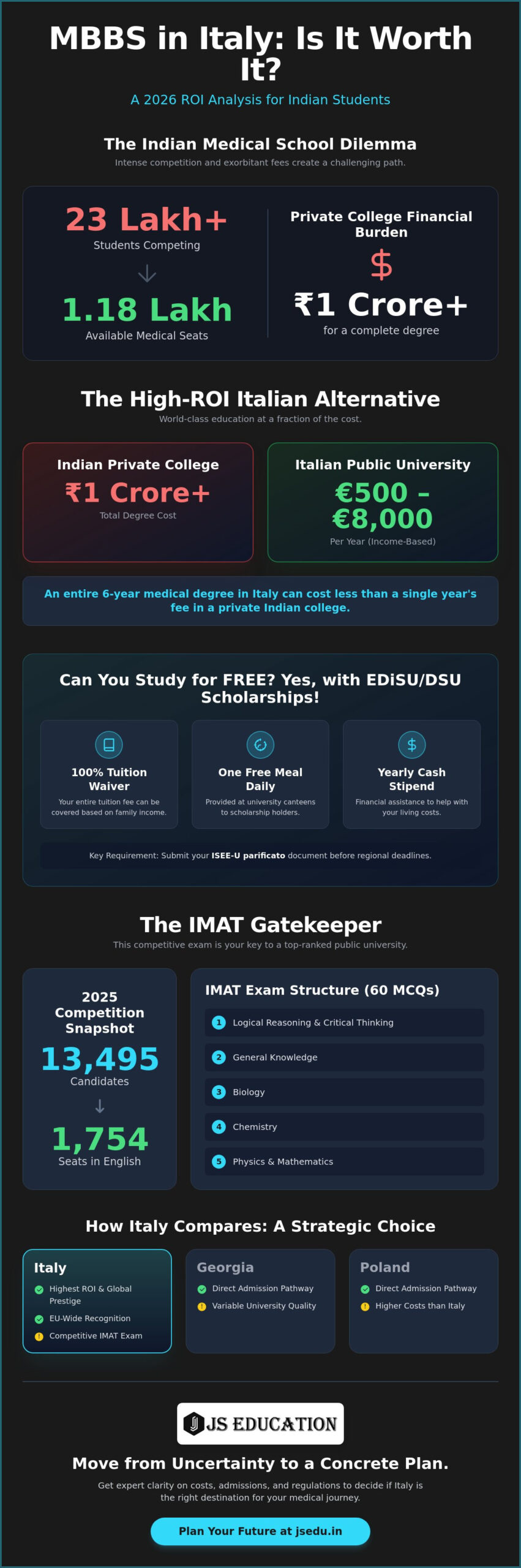
Did you know that in 2025, over 23 lakh Indian students competed for just 1.18 lakh medical seats? This staggering gap leaves thousands of brilliant minds questioning their future. With domestic private college fees reaching exorbitant levels, many families are asking: is MBBS in Italy worth it as a high-ROI alternative for 2026? It’s completely understandable to feel overwhelmed by the intense competition and the financial burden of private education. You want a world-class degree that doesn’t compromise your financial stability or leave you guessing about your career prospects back home.
This analysis provides the expert clarity you need to move from uncertainty to a concrete plan. We’ll break down the actual costs of public versus private Italian universities, explain the IMAT admission hurdle, and confirm exactly how these degrees align with NMC and NExT regulations. You’ll discover the real truth about expenses, quality of education, and long-term career prospects to decide if Italy is the right destination for your medical journey.
Key Takeaways
- Understand how public university tuition ranging from €500 to €8,000 provides a superior financial return compared to the high costs of Indian private medical colleges.
- Evaluate the 2026 IMAT competition trends to determine if your academic profile is suited for this prestigious entrance gateway.
- Confirm how Italy’s 6-year MD program maintains strict alignment with NMC regulations, ensuring a seamless transition to practicing in India.
- Decide if is MBBS in Italy worth it for your goals by comparing Italy’s high-reward structure against the direct admission pathways available in Georgia and Poland.
- Prepare for the practicalities of student life by reviewing updated 2026 living costs and the necessity of Italian language skills for clinical success.
The ROI Equation: Comparing Tuition vs. Quality in Italy
When evaluating whether is MBBS in Italy worth it, the primary factor for most Indian families is the Return on Investment (ROI). Indian private medical colleges often demand upwards of ₹1 crore for a complete degree, a figure that places an immense burden on middle-class households. In contrast, Italy’s public universities offer a world-class alternative where tuition fees are calculated based on your family’s financial standing. These fees typically range from €500 to €8,000 per year, meaning a student could complete their entire medical education for less than the cost of a single year at a private Indian institution. This massive cost difference doesn’t signify a drop in quality; it reflects a European philosophy that high-tier medical training should be accessible to talented individuals regardless of their wealth.
Why do we consider this a high-ROI destination? The value isn’t just in the savings but in the prestige. Italian medical faculties are consistently ranked among the top institutions globally, offering clinical rotations in some of Europe’s most advanced hospitals. By choosing Italy, you aren’t just saving crores of rupees; you’re gaining a degree that carries weight across the European Union and is fully recognized by the National Medical Commission (NMC) in India. This combination of low cost and high global standing is why many top-tier Indian students now prioritize Italy over more expensive English-speaking countries.
Public vs. Private Universities in Italy
Choosing between a public or private institution is a critical decision for your financial roadmap. Public universities are the gold standard for ROI because of their subsidized fees and immense prestige, though they require a competitive score on the International Medical Admissions Test (IMAT). Private universities charge fixed fees, typically between €14,000 and €20,000 annually. While these are more expensive than public options, they often provide luxury infrastructure and a more streamlined admission process. You can explore the List of medical schools in Italy to see the breadth of both public and private options available. For most Indian families, the public route offers the most transformative financial advantage.
The “Free” Education Myth: Understanding EDiSU Scholarships
Is it actually possible to study for free? For many Indian students, the answer is a definitive yes. Through regional scholarships like EDiSU or DSU, students from lower to middle-income backgrounds can secure a 100% tuition waiver. These benefits often include one free meal daily at university canteens and a yearly cash stipend to assist with living costs. The ISEE-U parificato is the essential document that translates your family’s Indian income and assets into an Italian economic indicator, and it must be submitted before the specific regional deadlines in late 2026. This system ensures that financial status is not a barrier to achieving your ambition of becoming a doctor.
The IMAT Gatekeeper: Is the Admission Struggle Worth It?
The International Medical Admissions Test (IMAT) represents the single most significant hurdle for Indian students aiming for public universities. While the competition is real, the reward is an MD degree from an institution ranked among the global elite. When you consider the quality of medical education in Italy, the six to twelve months of intensive preparation become a strategic investment. In 2025, a record 13,495 candidates vied for approximately 1,754 seats. For 2026, we anticipate similar ratios, making a data-driven approach to university selection essential for success.
Many students ask if the stress of this entrance exam is justified, and the answer lies in the career mobility it grants. Ultimately, is MBBS in Italy worth it when you have to clear such a rigorous test? Yes, because unlike the NEET, which often rewards rote memorization, the IMAT values logical reasoning and scientific application. It’s a fairer system for students who excel in critical thinking rather than just volume-based learning. Securing a seat in a top-500 global university through the IMAT validates your academic caliber on an international stage.
IMAT Exam Structure and 2026 Syllabus Updates
The IMAT consists of 60 multiple-choice questions divided into five sections: Logical Reasoning, General Knowledge, Biology, Chemistry, Physics, and Mathematics. The “Critical Thinking” section is often the secret to high scores, as it tests your ability to analyze arguments rather than recall facts. For the September 2026 exam, you should begin your preparation no later than January. This timeline allows you to master the Cambridge-style questioning format while keeping your NEET foundation fresh.
Non-EU Seat Quotas and Strategic University Selection
Italy uses a “First Choice” rule for non-EU students, meaning you can only apply to one public university. This makes your selection high-stakes. While prestigious institutions like Sapienza in Rome offer incredible history, they also attract the highest number of applicants. Smaller, high-quality universities like Messina or Bari may offer better success rates due to different applicant-to-seat ratios. Selecting the right medicine in Italy in English program is about matching your predicted IMAT score to specific seat availability. If you’re unsure which city fits your academic profile, the team at JS Education can help you analyze previous years’ cutoff trends to maximize your chances.
The Hidden Costs: Living Expenses and the Language Barrier
While the low tuition fees at public universities are a major draw, a complete assessment of whether is MBBS in Italy worth it requires looking at the monthly outflows. Living in Italy involves expenses that vary significantly based on your chosen city. For 2026, we estimate that an average student needs between €700 and €1,000 per month to cover accommodation, food, and utilities. Beyond the financial aspect, you must also consider the “administrative cost” of moving to Europe. Navigating Italian bureaucracy, specifically the Permesso di Soggiorno (residency permit) process, requires patience and meticulous documentation within your first eight days of arrival.
Many Indian students hope to offset these costs through part-time work. Italian student visas allow you to work up to 20 hours per week, but you should be realistic about this possibility. Medical school in Italy is academically rigorous, often leaving little time for outside employment. While some students find flexible roles, we advise families to have their primary living budget secured beforehand. This ensures the student can focus entirely on their demanding curriculum without the added stress of financial instability during exam seasons.
Cost of Living Breakdown (North vs. South)
Geographic location is the biggest factor in your budget. In northern hubs like Milan or Rome, high demand for housing means you should expect to spend €800 to €1,200 per month. In contrast, southern cities such as Bari, Naples, or Catania offer a more affordable lifestyle, with monthly budgets ranging from €500 to €700. To save on rent, most students opt for a Posto Letto (a bed in a shared room) which costs between €250 and €400, rather than a Monolocale (studio apartment) which can easily exceed €800 in major cities.
Clinical Years and the Italian Language Requirement
The “Language Wall” is a factor that many students overlook until they reach their fourth year. During the first three years, your education is predominantly theoretical and conducted entirely in English. However, once you enter the clinical years (Years 4 to 6), you’ll be interacting with local patients in Italian hospitals. Most patients, especially the elderly, do not speak English. To succeed in your rotations and gain meaningful clinical experience, achieving at least B2-level proficiency in Italian is essential. This isn’t just a hurdle; it’s a career investment that allows you to integrate into the European medical community and potentially pursue residency in Italy later.
Ultimately, is MBBS in Italy worth it despite these hidden challenges? If you’re willing to embrace the local culture and manage your budget strategically, the answer remains a strong yes. The experience of living in a culturally rich European nation while receiving top-tier medical training provides a level of personal growth that few other destinations can match.
Global Recognition: NMC Compliance and Career Mobility
The validity of a foreign medical degree is often the biggest concern for Indian parents. When considering is MBBS in Italy worth it, the answer depends heavily on whether the degree allows you to practice in India without legal hurdles. Under the National Medical Commission (NMC) Foreign Medical Graduate Licensure (FMGL) Regulations of 2021, a degree must involve at least 54 months of study and a 12-month internship in the same country. Italy’s six-year MD program, which totals 360 ECTS credits, naturally exceeds these requirements, making it one of the most compliant destinations in Europe.
Italian universities aren’t just meeting the minimums; they’re setting global standards. You can find a verified list of NMC recognized universities in Italy to ensure your chosen institution is fully accredited for 2026. This recognition is the foundation of your career, ensuring that your transition back to the Indian healthcare system is based on a solid legal framework. Because the entire course and internship are completed at a single institution in English, you avoid the common pitfalls that affect students in other foreign destinations.
Italy vs. USA/UK for Post-Graduation
For those looking beyond India, an Italian degree serves as a powerful passport. Italian clinical training is highly regarded by the Educational Commission for Foreign Medical Graduates (ECFMG), making it an excellent base for USMLE aspirants aiming for residency in the United States. Additionally, the “Blue Card” EU advantage allows graduates to seek medical roles in countries like Germany or Scandinavia with significantly fewer bureaucratic barriers than non-EU graduates. The Italian MD degree is fully valid under the 2021 NMC FMGL regulations as it encompasses the mandatory 54 months of theoretical training and the subsequent year of clinical internship within the same institution.
The NEXT Exam Transition for 2026 Graduates
The Indian medical landscape is shifting toward the National Exit Test (NEXT). This exam focuses heavily on clinical case studies and practical application rather than rote theory. Because the Italian curriculum integrates clinical rotations early and emphasizes problem-based learning, students often find themselves better prepared for the NEXT format than those in more traditional systems. If you’re concerned about the specifics of the licensing process, JS Education provides personalized roadmaps for returning to India to complete your licensing requirements. Ultimately, the global mobility offered by this pathway confirms that is MBBS in Italy worth it for students who want a career without borders.
Is Italy Right for You? Italy vs. Georgia and Poland
Choosing the right destination is about balancing your academic risk with your long-term professional goals. While we’ve established that the financial return is unmatched, is MBBS in Italy worth it if you don’t secure a public university seat? The answer depends on your personal “risk vs. reward” tolerance. Italy represents a high-reward scenario where the IMAT serves as the ultimate gatekeeper. If you’re a top-tier student with a modest budget but exceptional academic drive, the effort to clear the IMAT is a logical investment. However, for families who prioritize admission certainty and want to avoid the stress of another competitive exam after NEET, looking at alternatives like Georgia or Poland is a strategic move.
We often categorize the decision into a simple matrix. Italy is the choice for those who want the lowest possible tuition and highest university rankings, even if it means a 13% overall admission rate. In contrast, destinations like Georgia offer a more predictable path. By understanding your own strengths and financial boundaries, you can choose a destination that doesn’t just look good on paper but actually fits your reality as a student in 2026.
The Case for Georgia and Poland
Georgia has become a powerhouse for Indian medical students because it effectively removes the entrance exam barrier. A student pursuing MBBS in Georgia benefits from an English-medium environment and a very safe atmosphere for international residents. Tuition there typically ranges from $4,000 to $8,000 per year, which is roughly ₹3.3 Lakhs to ₹6.6 Lakhs. Poland offers a central EU location and high-quality clinical training that is deeply integrated into the European healthcare system. While Polish tuition fees are higher than Italian public universities, ranging between €8,500 and €12,000 annually, the admission process is generally based on your academic record and NEET qualification. The “worth” of these options lies in the peace of mind that comes with a confirmed seat and a straightforward enrollment process.
How JS Education Simplifies Your Italian Journey
We understand that the uncertainty of the IMAT can be daunting for both students and parents. That’s why we implement a “Dual-Track” strategy for our 2026 applicants. This approach allows you to aim for Italy’s prestigious public universities while simultaneously securing a backup seat in Georgia or Poland. Our team provides end-to-end support, covering everything from IMAT registration to the complex Declaration of Value (DoV) and visa documentation. We don’t just process papers; we offer transparent counseling to determine if you’re a fit for Italy’s competitive landscape or if a more direct route is a safer bet for your career timeline. Schedule a free consultation with JS Education to evaluate your 2026 MBBS profile.
Secure Your Medical Future in Italy for 2026
Italy stands as a premier destination for Indian students who refuse to settle for anything less than excellence. By prioritizing public universities, you access a high-quality curriculum that saves your family from the financial strain of Indian private colleges. Whether you’re navigating the IMAT or preparing for future clinical rotations, the pathway is structured to ensure your success on a global scale. Ultimately, deciding if is MBBS in Italy worth it comes down to your willingness to tackle a professional entrance hurdle in exchange for a prestigious, low-cost European degree.
At JS Education, we act as your trusted advisor, bringing over 20 years of experience to your medical journey. We provide expert guidance on NMC and NEXT compliance to ensure your degree remains valid back home. From specialized support for EDiSU scholarship documentation to seamless visa processing, we handle the complexities so you can focus on your studies. Start your 2026 MBBS in Italy application with JS Education and take the first step toward a world-class medical career. Your ambition deserves a partner that values your long-term well-being as much as you do.
Frequently Asked Questions
Is NEET mandatory for studying MBBS in Italy?
Yes, qualifying for the NEET-UG exam is a non-negotiable requirement for any Indian student planning to enroll in a foreign medical university. This regulation ensures that your degree remains valid in the eyes of the National Medical Commission (NMC). Without a valid NEET scorecard from the year of admission, you won’t be eligible to sit for the National Exit Test (NEXT) or practice medicine within India upon your return.
Can I practice in India after completing my MBBS in Italy in 2026?
You can absolutely practice in India, provided you fulfill the requirements of the FMGL 2021 regulations. Italy’s six-year curriculum is specifically designed to meet the 54-month study and 12-month internship criteria mandated by the NMC. After graduation, you’ll need to clear the NEXT exam, which replaces the previous FMGE, to secure your permanent registration and begin your career as a licensed physician in India.
What is the total cost of MBBS in Italy for an Indian student including living expenses?
For an Indian student at a public university, the annual expenditure typically ranges from ₹8 Lakhs to ₹15 Lakhs, covering both tuition and living costs. While public tuition fees range between €500 and €8,000, monthly living expenses in 2026 average between €700 and €1,000. When calculating is MBBS in Italy worth it, remember that need-based scholarships can potentially reduce your tuition to zero and provide a stipend for your stay.
Is the IMAT exam harder than the NEET exam?
The IMAT is not necessarily harder than NEET, but it is fundamentally different. While NEET focuses on a massive volume of NCERT-based biological facts, the IMAT prioritizes logical reasoning and critical thinking. Many students find the IMAT more manageable because it rewards analytical skills over rote memorization. However, the limited number of non-EU seats makes the competition for public universities quite intense each September.
Are there any scholarships for Indian students in Italy for 2026?
Yes, Indian students are eligible for several need-based regional scholarships, such as the DSU and EDiSU programs. These awards are based on your family’s economic situation (ISEE-U) rather than academic merit alone. Successful applicants can receive a full tuition waiver, one free meal per day at the university canteen, and a cash stipend to help cover their accommodation and personal expenses throughout the academic year.
Is it possible to study medicine in Italy in English?
It is entirely possible and common to study medicine in Italy in English. There are currently over 15 public universities and several private institutions offering MD programs taught 100% in English. These programs are specifically designed for international cohorts, ensuring that the curriculum, textbooks, and examinations are accessible to students who don’t yet possess advanced Italian language skills during their initial years of study.
What happens if I fail the IMAT exam?
If you don’t clear the IMAT, you cannot secure a seat in an English-taught public medical school for that academic cycle. In this scenario, you might consider enrolling in a private Italian university or pivot to a “Plan B” destination like Georgia or Poland where admission is more direct. Many students use our “Dual-Track” strategy to ensure they have a confirmed admission elsewhere while they await their competitive IMAT results.
How long is the MBBS course in Italy for international students?
The MBBS (MD) course in Italy lasts for exactly six years, which is divided into twelve semesters. This duration includes both the theoretical pre-clinical phase and the mandatory clinical internship required for graduation. This six-year structure is a significant reason why is MBBS in Italy worth it for Indian students, as it aligns perfectly with the latest NMC requirements for foreign medical graduates seeking licensure in India.