



What if the list of NMC recognized universities in Georgia you’re looking at is already dangerously outdated? Many students don’t realize that the National Medical Commission no longer issues a simple “approved” list; instead, they’ve shifted to a complex, regulations-based system. It’s completely understandable if you feel anxious about these changes. You’ve worked hard for your NEET qualification, and the last thing you want is to be misled by agents or outdated MCI lists. You deserve a clear, transparent path to your medical career.
This guide provides a definitive compliance checklist to ensure your chosen institution meets every current FMGL regulation. You’ll learn exactly how to verify a university’s status and ensure your degree remains valid for the NExT exam in India. We’ll walk you through the essential 54-month training requirement, the mandatory 12-month internship in Georgia, and the latest June 2026 updates regarding the 10-year completion timeline. By the end of this article, you’ll have the expert knowledge needed to choose a compliant path with absolute certainty through JS Education.
Key Takeaways
- Understand why the FMGL Regulations 2021 are now the only valid metric for identifying NMC recognized universities in Georgia and how to avoid relying on obsolete MCI lists.
- Learn to identify the specific clinical rotation standards and hospital affiliations that ensure your Georgian medical degree is fully valid for practice in India.
- Gain a clear, step-by-step action plan for manually verifying university credentials through the World Directory of Medical Schools and global accreditation bodies like FAIMER.
- Evaluate the strategic differences between government-funded and top-tier private medical universities to make an informed choice for your international education.
- Discover how a professional “Compliance Audit” can eliminate the risks of misleading information and provide a secure, expert-led pathway to your medical career.
Understanding NMC Recognition for Georgia in 2026
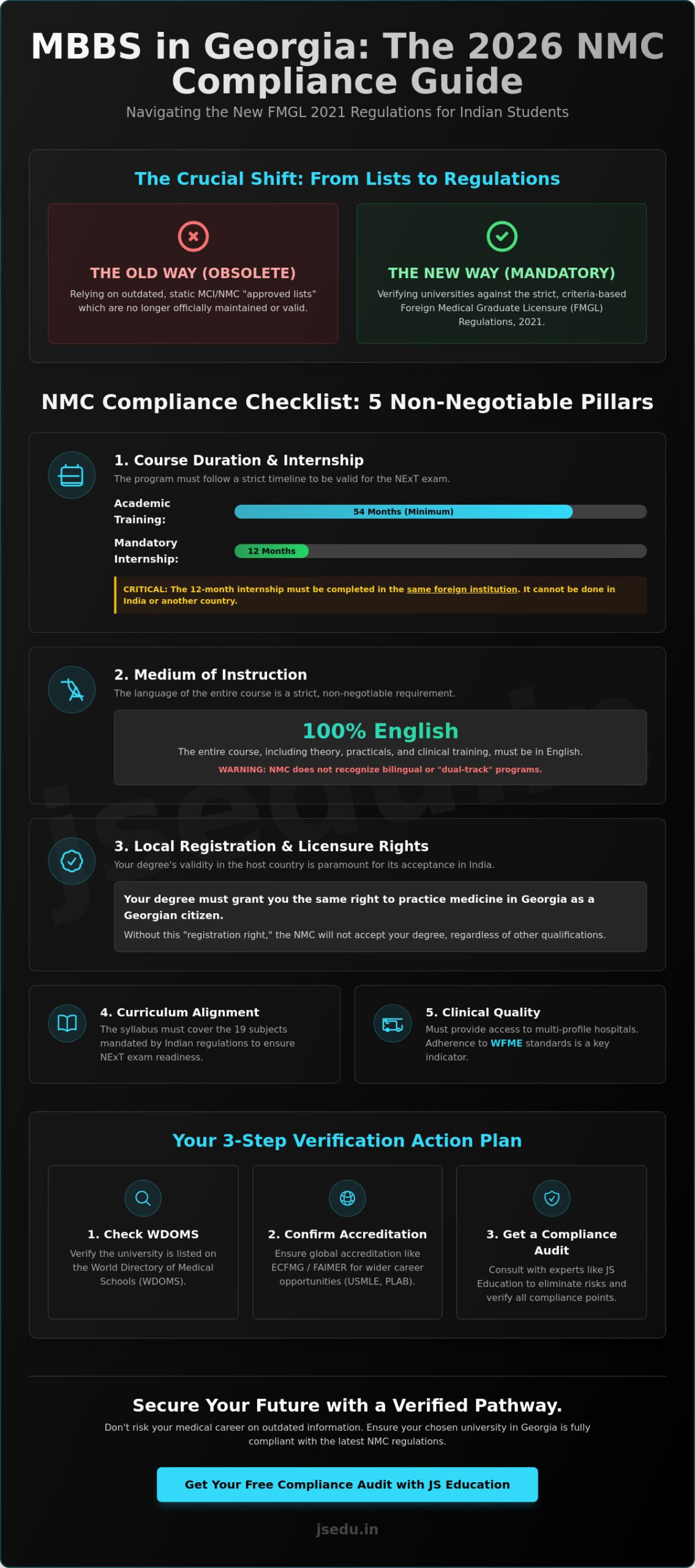
Many students still search for a downloadable PDF list of NMC recognized universities in Georgia. However, that static list no longer exists in the way it once did. The National Medical Commission (NMC) fundamentally changed its approach with the introduction of the Foreign Medical Graduate Licensure (FMGL) Regulations in 2021. Instead of maintaining a fixed directory of names, the NMC now enforces a strict, regulations-based system. This means a university isn’t “recognized” simply because of its history; it’s considered compliant only if its current curriculum and operational standards mirror Indian medical education requirements.
This shift places a greater responsibility on you and your family. You aren’t just choosing a campus; you’re verifying a legal framework. Georgia has remained a top-tier destination because its leading medical institutions were among the first to proactively align their MD programs with these new Indian standards. By choosing a compliant path, you ensure that your hard work leads to a valid license rather than a dead-end degree. The link between your university’s daily operations and your future eligibility for the National Exit Test (NExT) is absolute. If the university fails even one regulatory pillar, you won’t be allowed to practice in India.
The Core Principles of FMGL Regulations 2021
To be considered one of the NMC recognized universities in Georgia, an institution must satisfy three non-negotiable criteria. First, the academic course duration must be at least 54 months of theoretical and practical training. This must be followed by a mandatory 12-month internship completed at the same foreign medical institution. You cannot split your clinical training between different countries. Second, the entire program, including every lecture and clinical rotation, must be conducted 100% in English. The NMC does not recognize bilingual or “dual-track” programs. Finally, the degree must grant you the same rights to practice medicine in Georgia that a local citizen would have. Without this “registration right” in the host country, your degree won’t be accepted by the NMC upon your return.
Why ‘Recognition’ Matters for Your Medical Career
Falling into the “invalid degree” trap is a nightmare no student should face. Some non-compliant institutions might offer lower fees or shorter durations, but these shortcuts come at a massive professional cost. Proper recognition is the only way to ensure seamless eligibility for the NExT exam, which is now the mandatory gateway for licensing in India. Furthermore, compliant Georgian universities often hold ECFMG and FAIMER certifications, which open doors to the USMLE in the USA or the PLAB in the UK. Before making your final decision, it’s worth reading an in-depth analysis of whether MBBS in Georgia is good for Indian students, which separates common myths from the regulatory reality of practicing in India after graduation. For a deeper look at the admission landscape, you can explore our guide on MBBS in Georgia for Indian students. Staying informed about these nuances is the best way to protect your long-term investment and career ambitions.
The 2026 NMC Compliance Checklist for Georgian Universities
Selecting the right path requires more than just looking at a brochure. To identify genuine NMC recognized universities in Georgia, you must evaluate them against a specific set of legal benchmarks. The primary requirement is a total duration of at least 5.5 years. This includes 54 months of academic study followed by a full year of clinical internship. Beyond duration, the syllabus must align with the 19 subjects mandated by Indian regulations. This ensures that your education in Georgia prepares you directly for the NExT exam.
Clinical quality is equally vital. A compliant university must demonstrate that students have access to multi-profile hospitals for real-world experience. It isn’t enough to study in a classroom; you need hands-on exposure to diverse patient cases. High-performing institutions often adhere to World Federation for Medical Education (WFME) standards, which provide a global benchmark for medical teaching quality. Finally, verify that your degree grants you the legal right to practice in Georgia. This “licensure eligibility” is a cornerstone of the FMGL 2021 rules. Verifying these details is the only way to confirm you’re attending one of the NMC recognized universities in Georgia that will actually lead to a license.
Medium of Instruction and Language Requirements
The NMC is very clear: the entire course must be taught in English. Any university offering “bilingual” or “dual-medium” tracks is a red flag for Indian students. While your exams and lectures are in English, you’ll still learn basic Georgian. Why? Because you’ll need it to communicate with local patients during your clinical years. This practical skill is essential for a rich learning experience, but it never replaces English as the official medium of instruction.
Internship Validity and Practical Exposure
Your 12-month internship must happen within the same institution where you completed your MD. The NMC doesn’t allow you to do part of your internship in Georgia and part in India. Real hands-on training is what separates a world-class doctor from the rest. We recommend looking for universities that prioritize bedside teaching over simulation-only labs. If you’re feeling overwhelmed by these technicalities, you can speak with our advisors to see how we audit these clinical facilities firsthand. We ensure that every university we represent meets these rigorous practical standards before you even apply.
Top NMC-Compliant Medical Universities in Georgia: 2026 Review
Choosing between a government-funded institution and a high-ranking private university is one of the most significant decisions you’ll make. Both paths offer NMC recognized universities in Georgia that fully comply with the FMGL 2021 regulations, but they cater to different priorities. Government universities often carry a legacy of decades, while premier private institutions frequently invest more heavily in modern simulation technology and student-centric infrastructure. Most students gravitate toward Tbilisi, the vibrant capital, but cities like Batumi and Kutaisi are gaining traction for their specialized clinical facilities and calmer environments. For a comprehensive comparison of current performance, check out our top medical universities in Georgia rankings for the 2026 session.
Leading Government Universities
Tbilisi State Medical University (TSMU) remains the most recognized legacy institution in the region. With a tuition fee of approximately USD 8,000 per year, it hosts the largest Indian student community in Georgia. Its strength lies in its massive network of affiliated clinics. Batumi Shota Rustaveli State University offers a unique advantage for those who prefer the coastal region, providing excellent clinical exposure in multi-profile hospitals. Meanwhile, Ivane Javakhishvili Tbilisi State University is highly regarded for its research-oriented curriculum, making it ideal for students who aim for academic excellence beyond clinical practice.
Premier Private Medical Institutions
The University of Georgia (UG) has emerged as a leader among private institutions, boasting modern infrastructure and impressive passing ratios for the FMGE and NExT exams. David Tvildiani Medical University (DTMU) is another top-tier choice, specifically known for integrating USMLE preparation into its core MD program while maintaining strict NMC compliance. If you’re looking for advanced simulation labs at a more competitive price point, Caucasus International University (CIU) provides a high-tech learning environment that doesn’t compromise on the quality of faculty expertise.
Budget-Friendly Compliant Options
It’s entirely possible to find NMC recognized universities in Georgia that offer high-quality education at a lower tuition fee, often around USD 6,500 per year for the MD program. When evaluating these options, it’s vital to balance the lower cost of tuition with the overall quality of living. You should consider factors like hostel availability and proximity to clinical sites. To help you plan your finances accurately, we’ve prepared a detailed cost of living in Georgia for Indian students guide. This resource breaks down monthly expenses so you can ensure your medical journey remains sustainable from your first year through your final internship.
How to Manually Verify University Recognition: A Student’s Action Plan
Empowerment is your best defense against misinformation. While many agents claim to have “exclusive” lists, you can actually verify NMC recognized universities in Georgia yourself using public, authoritative databases. This transparency ensures that your high-stakes decision is based on facts rather than sales pitches. By following a structured verification process, you’ll gain the confidence needed to pursue your medical degree without the fear of it being invalid in India. If you’re still weighing whether this path is right for you, our detailed breakdown of whether MBBS in Georgia is good for Indian students addresses the most common concerns families raise before beginning the verification process.
The verification process involves four critical steps:
- Step 1: Search the World Directory of Medical Schools (WDOMS).
- Step 2: Check for ECFMG and FAIMER accreditation to ensure global mobility.
- Step 3: Visit the National Center for Educational Quality Enhancement (NCEQE) website to confirm Georgian local accreditation.
- Step 4: Review the latest advisories from the Indian Embassy in Tbilisi.
Each of these steps acts as a safety net. If a university fails to appear in any of these official records, it’s a major red flag. Taking the time to do this research now saves you from potential legal hurdles after you’ve already invested years into your education. It’s about protecting your future as a licensed physician. Once you’ve confirmed your chosen university meets all compliance criteria, understanding the MBBS in Georgia admission process is your next critical step to avoid documentation errors that delay hundreds of applications every year.
Deciphering the WDOMS Sponsor Notes
The World Directory of Medical Schools (WDOMS) serves as the primary global database for medical school verification. When you find a university profile, click on the “Sponsor Notes” tab. Look specifically for the “India” section. This note confirms whether the institution is recognized by the National Medical Commission. If the note is missing or mentions the old MCI rules without updating to the FMGL 2021 standards, you’ll need to seek further clarification. Many NMC recognized universities in Georgia are proactive about keeping these notes current to reassure international applicants.
Contacting Official Bodies
Don’t be afraid to ask for proof. We recommend drafting a formal email to the university registrar asking for a written statement on their FMGL 2021 compliance. Specifically, ask them to confirm the 54-month course duration and the availability of a 12-month on-site internship. You should also check the NMC’s official website regularly for new public notices. These updates often clarify which institutions meet the latest criteria for the NExT exam. If you want to skip the guesswork and see a pre-verified list of institutions, book a session with our advisors. We perform these audits regularly so our students can focus on their studies instead of regulatory paperwork.
Securing Your Admission with JS Education’s Verified Pathway
Making the decision to study medicine abroad is a high-stakes move that impacts your entire professional future. It’s not just about finding a seat in a classroom; it’s about ensuring that every legal and academic requirement is met long before you arrive on campus. With over 20 years of experience in international medical education, JS Education has built a reputation as a trusted advisor for Indian families. We understand the anxiety caused by shifting regulations, which is why we’ve developed a rigorous “Compliance Audit” for every institution we represent. We don’t just take a university’s word for it; we verify their adherence to FMGL 2021 standards ourselves.
Our audit process is exhaustive. We confirm that the NMC recognized universities in Georgia we partner with provide the full 54-month academic course and the mandatory 12-month on-site internship. We also verify that the curriculum covers all 19 essential subjects required for NExT eligibility. This level of transparency is why hundreds of students choose us as their strategic partner. You aren’t just getting an admission letter; you’re getting a verified pathway to a global medical career.
The JS Education Admission Process
We start with personalized counseling that respects your specific needs. By matching your NEET score and budget with the right institution, we ensure you don’t overstretch your resources or settle for a non-compliant school. The technical side of admission can be overwhelming, but we manage the heavy lifting. Our team handles the document apostille and translation services required by Georgian authorities, ensuring your transcripts are accepted without delay. To understand exactly what documentation and timelines are involved, our comprehensive guide on the MBBS in Georgia admission process for the 2026 session provides a month-by-month roadmap that helps you avoid the common errors that delay hundreds of applications each year. Before you leave, we provide comprehensive pre-departure briefings. These sessions cover everything from academic expectations to safety and culture in Georgia, so you feel prepared from day one.
Beyond Admission: Support Until Graduation
Our commitment doesn’t end when you receive your visa. We stay by your side to assist with local registration and residency permits once you land in Tbilisi or Batumi. These administrative tasks are crucial for your legal stay and future practice rights. As you move into your final years of the MD program, we provide guidance on NExT exam preparation. We want you to return to India not just with a degree, but with the confidence to pass your licensing exams on the first attempt. Join the hundreds of successful doctors who started their journey with JS Education and experience a seamless, expert-led transition into the medical profession. We provide the stability and expertise you need to turn your ambition into a reality among the top NMC recognized universities in Georgia.
Your Future in Medicine Starts with a Secure Choice
Success in international medical education depends on more than just academic talent; it requires a foundation of legal compliance. You now have the tools to distinguish between outdated information and the current FMGL 2021 regulations. Remember that verifying the 54-month course duration and the mandatory 12-month Georgian internship is the only way to safeguard your eligibility for the NExT exam. By focusing on NMC recognized universities in Georgia that prioritize these rigorous standards, you’re investing in a degree that holds genuine global value.
JS Education has served as a trusted bridge for Indian students since 2004. With over 20 years of expertise, we offer 100% transparency in regulatory auditing and provide dedicated on-ground support in Tbilisi to assist you throughout your journey. You don’t have to navigate these complex legal waters alone. Our team is here to ensure your transition is seamless and your career path is protected from the day you apply until the day you graduate.
Book a Free Consultation with JS Education Experts Today
Your ambition to become a doctor is a noble pursuit. We look forward to helping you turn that dream into a world-class reality with confidence and peace of mind.
Frequently Asked Questions
Is the NMC list for Georgia still active in 2026?
No, the National Medical Commission no longer maintains a static list of “approved” colleges. Instead, any institution that fulfills the FMGL Regulations 2021 is considered part of the NMC recognized universities in Georgia. You must ensure the specific program you choose meets the 54-month study and 12-month internship requirements. This shift requires students to verify the university’s curriculum and local registration rights rather than searching for a simple name on a list.
Does the NMC recognize private medical universities in Georgia?
Yes, the NMC recognizes both government and private medical universities in Georgia provided they adhere to the 2021 regulatory framework. Many private institutions are popular because they’ve specifically aligned their MD programs with Indian requirements. As long as the private university is listed in the World Directory of Medical Schools (WDOMS) and offers a 5.5-year program in English, it remains a valid choice for your medical career.
What happens if a university doesn’t follow the 54-month duration rule?
If a university’s MD program is shorter than 54 months of academic study, your degree won’t be valid for practice in India. The NMC strictly enforces this duration to ensure that foreign medical education is equivalent to the Indian MBBS standard. Choosing a non-compliant program means you’ll be ineligible to appear for the National Exit Test (NExT) and will be unable to obtain a license to practice medicine in your home country.
Can I do my internship in India after completing my MBBS in Georgia?
No, you cannot substitute your Georgian internship with one in India to meet NMC requirements. The FMGL Regulations 2021 mandate that the 12-month clinical internship must be completed in the same foreign institution where you finished your theoretical studies. An internship done in India after graduation won’t be recognized for licensing purposes, making it essential to complete the full six-year cycle in Georgia before returning home.
Is the NExT exam mandatory for students returning from Georgia?
Yes, the National Exit Test (NExT) is the mandatory qualifying examination for all students returning with a medical degree from Georgia. This exam replaces the previous FMGE and serves as both a licensing test and a gateway for postgraduate medical entrance in India. Every student graduating from NMC recognized universities in Georgia must pass this assessment to register with the State Medical Council and legally practice as a doctor.
How can I check if a Georgian university is English medium?
You can verify the medium of instruction by checking the “Sponsor Notes” section of the university’s profile in the World Directory of Medical Schools (WDOMS). It’s also vital to review the official accreditation from the National Center for Educational Quality Enhancement (NCEQE) in Georgia. The NMC strictly prohibits bilingual or dual-medium programs, so ensure your admission letter explicitly states that the entire course duration is conducted 100% in English.
Are there any Georgian universities that the NMC has blacklisted?
The NMC doesn’t typically publish a “blacklist” of specific Georgian universities. Instead, it issues public notices advising against programs that fail to meet the FMGL 2021 criteria, such as those with insufficient duration or lack of local registration rights. It’s your responsibility to audit each university against the compliance checklist. Staying updated with the latest Indian Embassy advisories in Tbilisi is the best way to avoid non-compliant institutions.
Will JS Education help me verify the NMC compliance of my chosen college?
Yes, JS Education provides a thorough “Compliance Audit” for every university we represent. Our experts verify the curriculum duration, internship validity, and English-medium status to ensure your degree meets all current NMC standards. We’ve navigated international medical laws for over 20 years, so we understand how to protect your academic investment. Our team ensures that you only apply to institutions where your future eligibility for the NExT exam is fully secured.