



Did you know that over 8,000 Indian students are currently studying medicine in Georgia, yet hundreds of applications face delays every year due to simple documentation errors? It’s understandable if you’re feeling anxious about the evolving NMC 2026 regulations or the high stakes of a Georgian student visa interview. You’ve dedicated years to your medical dream, and the complexity of the MBBS in Georgia admission process shouldn’t be the barrier that stops you. We’re here to act as your expert guide, ensuring every step is handled with precision and care.
This article provides the complete roadmap you need to master the journey from university selection to final visa approval. You’ll find a detailed month-by-month timeline, a foolproof document checklist, and the specific insights required to ensure your application meets every legal requirement for the 2026 session. By the end of this guide, you’ll have the confidence to secure your future in Georgian medical education without the stress of the unknown.
Key Takeaways
- Understand how the 2026 multi-tier verification system aligns with the latest NMC guidelines to ensure your medical degree remains fully recognized in India.
- Master the 5-stage MBBS in Georgia admission process, including how to successfully prepare for mandatory university video interviews and assessments.
- Access a comprehensive checklist for the document apostille process, ensuring your NEET scorecard and academic certificates meet Georgian Ministry standards.
- Navigate the D3 Category Student Visa application with confidence by learning the precise steps for VFS Global appointments and embassy requirements.
- Learn how to identify and avoid “direct admission” scams by partnering with experts who provide transparent, local Georgian expertise throughout your journey.
Understanding the MBBS in Georgia Admission Landscape for 2026
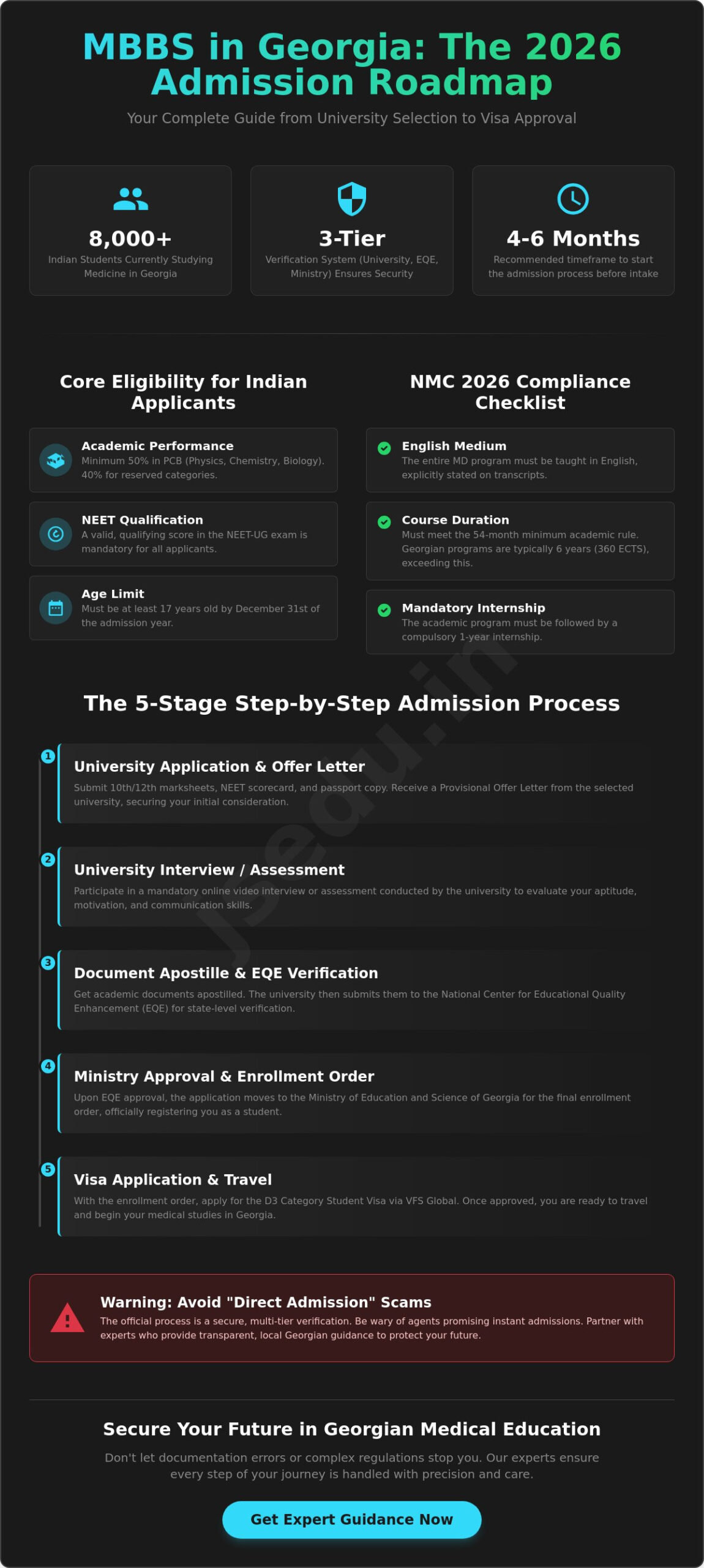
The 2026 MBBS in Georgia admission process has evolved into a rigorous, multi-tier verification system designed to ensure academic integrity and legal transparency. It isn’t just a matter of submitting a form to a college. Your application travels through three distinct levels of scrutiny: the chosen university’s admissions board, the National Center for Educational Quality Enhancement (EQE), and finally, the Ministry of Education and Science of Georgia. This structured approach protects international students by guaranteeing that every enrolled candidate is officially registered in the state database. It’s a system that prioritizes your security as much as your education.
Georgia remains a premier destination for Indian students, especially as the 2026 NMC guidelines demand stricter compliance for foreign medical graduates. Georgian universities have proactively aligned their curricula with global standards. Many of these institutions are featured on the list of recognized medical universities in Georgia, offering a curriculum that mirrors the depth required for the NExT exam in India. Most universities operate on a dual intake system with sessions beginning in the Fall (September/October) and Spring (February). For most Indian applicants, the Fall intake is the ideal choice. It aligns perfectly with the timing of 12th-standard results and NEET score declarations, allowing for a smooth transition without a gap year.
Timing is the most critical factor in your success. You should ideally begin the MBBS in Georgia admission process at least 4-6 months before your intended start date. This window allows ample time for document apostille, university interviews, and the detailed student visa application. Starting early isn’t just a suggestion; it’s a strategy to avoid the seasonal rush and ensure your seat in top-tier institutions.
Basic Eligibility Criteria for Indian Applicants
To qualify for a medical seat in Georgia, you must meet specific academic and legal benchmarks. These requirements are non-negotiable and include:
- Academic Performance: You need a minimum of 50% aggregate in Physics, Chemistry, and Biology (PCB) in your 12th-standard examinations. For students in reserved categories, this requirement is typically 40%.
- NEET Qualification: A qualifying score in the NEET-UG exam is mandatory for all Indian students planning to practice in India later. Without a valid NEET scorecard, you cannot obtain the necessary eligibility certificates.
- Age Limit: You must be at least 17 years old by December 31st of the year you are seeking admission.
NMC 2026 Compliance: What You Must Know
The National Medical Commission has set clear parameters for students studying abroad. First, the entire MD program (the Georgian equivalent of MBBS) must be conducted in English. You must ensure this “English Medium” status is explicitly mentioned in your official university transcripts. Second, the course duration must meet the 54-month minimum academic rule, followed by a mandatory internship. Georgian MD programs typically span six years (360 ECTS credits), which comfortably exceeds these requirements. To ensure you choose the right path, always consult the list of NMC recognized universities in Georgia before finalizing your application. This step is vital to ensure your degree is valid for the NExT exam and future practice in India.
The 5-Stage Step-by-Step Admission Process for Georgian Medical Universities
The MBBS in Georgia admission process is a structured journey that transforms an aspiring student into a legally enrolled medical candidate. For the 2026 intake, this process has become more transparent, ensuring that every seat is backed by state-level verification. You shouldn’t expect a “quick fix” admission. Instead, you’ll progress through five distinct phases designed to protect your academic future. Each stage requires specific actions and precise timing to ensure you don’t miss the enrollment deadlines.
Phase 1 begins with your initial application to the university. You’ll submit your 10th and 12th-standard marksheets along with a valid passport copy to receive a Provisional Offer Letter. Phase 2 moves into the interactive stage: the mandatory video interview. Once you pass this, Phase 3 involves the National Center for Educational Quality Enhancement (EQE) verification and the subsequent Ministry Decree. This is followed by Phase 4, where the university issues your final Enrollment Letter and the official Invitation Letter. Finally, Phase 5 concludes the MBBS in Georgia admission process with your tuition fee payment, which formalizes your seat and clears the path for your Georgian D3 Category Student Visa application.
Acing the University Skype/Zoom Interview
Expect questions about your motivation for pursuing medicine and why you’ve specifically chosen Georgia. Faculty members often test basic biological concepts or chemistry fundamentals to ensure you’re prepared for the MD program’s rigors. You’ll need a stable internet connection and a quiet environment to maintain professional conduct throughout the call. The university interview is a mandatory quality-control measure for 2026 admissions to ensure every student possesses the language proficiency and academic intent required for success.
The EQE and Ministry Approval Process
The EQE acts as the gatekeeper for Georgian higher education. They meticulously verify your Indian marksheets to ensure they match Georgian equivalency standards. This stage involves professional translation and notarization of your documents within Georgia, a process that typically takes 15 to 20 business days. Once the EQE gives the green light, the Ministry of Education issues a Decree. This Decree is your “Golden Ticket” because it’s the specific legal document the embassy requires to prove your admission is state-sanctioned. If you find these legal steps overwhelming, you can consult with our experts to manage the documentation on your behalf.
By following this methodical approach, you eliminate the risk of last-minute rejections. It’s about building a solid foundation for your medical career from day one.
Essential Documentation and Apostille Checklist for 2026
A single missing stamp or an expired document can stall your medical career before it even begins. While the MBBS in Georgia admission process is transparent, it demands meticulous attention to detail. You’ll need to gather a specific set of academic, identity, and medical documents to satisfy both the university and the Georgian Ministry of Education. Having this checklist ready early prevents the panic of last-minute document procurement. It’s your first step toward procedural integrity.
- Primary Academic Records: Your 10th and 12th-standard marksheets and passing certificates are the foundation of your file. You must also provide your NEET-UG scorecard showing a qualifying rank for the current or previous two years.
- Identity Proof: A valid passport is essential. Ensure it has at least 18 months of validity remaining from the date of your intended arrival. You’ll also need 10 to 12 recent passport-sized photographs with a white background.
- Medical Clearances: Georgian authorities require an HIV/AIDS negative report and a general certificate of physical fitness from a registered medical practitioner.
- Financial Evidence: For the visa stage, you’ll need bank statements from the last six months showing sufficient funds to cover tuition and living costs. If a parent is sponsoring you, a notarized sponsorship affidavit is mandatory.
The MEA Apostille and Document Legalisation
Because Georgia is a member of the Hague Convention, your Indian documents must be apostilled by the Ministry of External Affairs (MEA). This isn’t a standard notary stamp. It’s a specialized sticker that validates your documents for international use. Once apostilled, your papers must undergo “Georgia-specific” translation into the Georgian (Kartuli) language. These translations must be notarized by a certified translator in Georgia to be accepted by the EQE. A common mistake that leads to 2026 application rejections is attempting to use standard English translations without the official Kartuli notarization. You can find more details on current requirements through the Embassy of Georgia in India Visa Information portal.
Verifying Your Chosen Institution
Before you commit, you must verify that your university is listed in the World Directory of Medical Schools (WDOMS). This ensures your degree is recognized by global bodies and allows you to sit for international licensing exams like the NExT or USMLE. It’s wise to review the top medical universities in Georgia to ensure your choice offers the full six-year MD program, including the mandatory clinical internship. For Indian students specifically seeking a high-performing institution with a verified FMGE pass rate, the detailed European University Georgia for Indian students 2026 admission guide offers a comprehensive breakdown of NMC compliance, clinical training standards, and the complete application process. This verification step is your safeguard against unaccredited institutions that don’t meet NMC standards. Does your university appear on the official NMC list? Always double-check this before starting the MBBS in Georgia admission process to protect your future license.
Navigating the Georgian Student Visa (D3 Category) and Travel
Securing your Ministry Decree marks the end of the academic verification stage, but your journey is only half-complete. You now enter the immigration phase, specifically applying for the D3 Category Student Visa. This transition is a pivotal moment in the MBBS in Georgia admission process. You’ll need to book an appointment at the VFS Global center or the Georgian Embassy in New Delhi, depending on current jurisdictional rules. It’s not a mere formality; it’s a legal review of your intent and financial capability.
Preparation is your best defense against visa delays. You must present your original apostilled documents alongside the university’s invitation letter. The visa officer’s goal is to ensure you’re a genuine student with the means to support yourself throughout your six-year degree. Once your visa is stamped, travel logistics become the priority. Most students fly into Tbilisi International Airport or Batumi, where an initial airport pick-up is usually arranged to ensure a safe transition to your new home. If you’re feeling uncertain about the interview stage, you can start your visa application today with our expert support team.
Visa Interview Preparation Tips
The most important distinction to make during your interview is the “Intent to Study” versus the “Intent to Immigrate.” Visa officers look for students who have a clear plan to return to India or pursue global medical careers after graduation. You’ll likely be asked about the cost of living in Georgia for Indian students to verify that your budget is realistic. Be prepared to explain the source of your family’s funds clearly. Use bank statements that show a consistent history rather than sudden, large deposits, as this builds trust in your financial stability.
Post-Arrival Formalities in Georgia
Your arrival in Georgia is just the beginning of your local legal requirements. You must apply for a Temporary Residence Permit (TRC) within 30 days of landing. This card serves as your official ID while you’re in the country. During your first week, you’ll also need to handle several functional tasks:
- Local Banking: Open a Georgian bank account to pay for utilities and receive funds from home.
- Connectivity: Purchase a local SIM card for affordable data and communication.
- University Registration: Complete your final on-campus registration and submit your original documents to the Dean’s office.
- Hostel Check-in: Finalize your accommodation and complete the mandatory police registration for your place of residence.
Following these steps ensures your stay remains legal and your focus stays on your medical studies. The MBBS in Georgia admission process concludes only when your TRC is in hand and your university enrollment is finalized.
Securing Your Future: Why Professional Guidance Matters for Georgia
The road to becoming a doctor is paved with ambition, but it’s also fraught with procedural complexities. While the MBBS in Georgia admission process is designed to be fair, navigating the legal nuances of two different countries requires more than just a search engine. You’re making a high-stakes life decision for your child, and the margin for error is slim. Professional guidance doesn’t just simplify the paperwork; it provides a safety net against the unpredictable hurdles of international education. It’s about ensuring that every step you take is backed by experience and local knowledge.
A “trusted advisor” approach transforms a stressful transaction into a manageable journey. You need a partner who understands the rhythm of Georgian ministry decrees and the specific expectations of the Indian National Medical Commission. This isn’t just about getting an admission letter. It’s about securing a future where your degree is legally valid, your stay is safe, and your academic environment is world-class. When you have an expert guiding the MBBS in Georgia admission process, you can focus on what truly matters: preparing for the rigors of medical school.
Avoiding Admission Fraud in 2026
The rising popularity of Georgian medical degrees has unfortunately attracted “Solar Cowboy” consultants. These are unverified agents who promise “Direct Admission” without interviews or documentation, only to disappear once the first fee payment is made. You should be wary of any agent who isn’t transparent about the fee structure or who mentions hidden “donations” to secure a seat. True admission in Georgia is a multi-tier verification process that cannot be bypassed. For an honest take on the current environment, check our guide on is MBBS in Georgia good for Indian students to separate myth from reality. Many families also wonder is Georgia a safe country for Indian students before committing to this destination, and our 2026 safety and security analysis provides a fact-based breakdown of the current environment.
The JS Education Advantage
With over 20 years of experience in facilitating international medical admissions, JS Education acts as a bridge between your current reality and your future professional goals. We don’t just provide a service; we take responsibility for your child’s career path. Our “Bridge-Builder” persona means we maintain strong, local connections in Georgia to ensure a seamless transition. From our comprehensive pre-departure briefings to our continuous support through the final MD degree, we’re with you every step of the way. We help with residence permit renewals, local banking, and even guidance for the NExT exam. Ready to start? Contact JS Education for a personalized 2026 admission roadmap.
Your Future in Global Medicine Starts Today
Mastering the MBBS in Georgia admission process is about more than just filling out forms; it’s about synchronizing your academic goals with international legal standards. By following the 5-stage roadmap we’ve outlined, from the initial EQE verification to securing your D3 student visa, you’re building a foundation that meets the strict 2026 NMC guidelines. You now have the checklist and the timeline needed to avoid common rejections and navigate the journey with clarity. Success in international education requires a partner who understands the local landscape and the high stakes of your medical career.
JS Education brings over 20 years of expertise as NMC and WHO compliance specialists to your side. We don’t just facilitate admissions; we provide comprehensive post-arrival support in Tbilisi to ensure your transition is seamless and safe. Don’t leave your medical dream to chance or unverified agents. Secure your 2026 MBBS seat in Georgia with JS Education today and take the first step toward a world-class medical career. You have the talent and the ambition; we have the bridge to get you there.
Frequently Asked Questions
How long does the entire MBBS in Georgia admission process take?
The entire MBBS in Georgia admission process typically takes between 8 to 12 weeks from your initial application to the final visa approval. This timeline includes approximately 15 to 20 business days for the EQE and Ministry verification and another 15 to 30 days for the D3 student visa processing at the embassy. Starting your application 4 to 6 months before the intake ensures you have a cushion for document apostille and translation.
Is NEET mandatory for MBBS in Georgia in 2026?
Yes, a qualifying NEET-UG score is mandatory for all Indian students who wish to pursue a medical degree in Georgia. While Georgian universities themselves may not require NEET for their internal records, the National Medical Commission (NMC) in India requires it for the degree to be valid for practice in India. Without a qualifying NEET scorecard, you won’t be eligible to sit for the NExT exam or obtain a license to practice medicine back home.
Can I apply for the Georgia MBBS admission process before my 12th results are out?
You can certainly begin the initial stages of the MBBS in Georgia admission process using your 10th-standard marksheet and a valid passport. Most universities will issue a conditional offer letter based on these documents, which allows you to reserve your seat early. However, you must submit your final 12th-standard PCB marksheet and NEET qualification certificate to complete the EQE verification and receive the final Ministry Decree.
What is the “Ministry Decree” and why is it essential for my admission?
The Ministry Decree is the official state-level approval issued by the Ministry of Education and Science of Georgia that confirms your legal enrollment in a specific university. It’s the most critical document in your file because the Georgian Embassy will not process a D3 student visa without it. This decree proves that your academic background has been verified by the state and that the university is authorized to admit you as an international student.
Are there any entrance exams for Georgian medical universities?
Most Georgian medical universities don’t require a traditional competitive entrance exam like NEET or the MCAT. Instead, they conduct a mandatory video interview via Skype or Zoom to assess your basic knowledge of Biology and Chemistry along with your English language proficiency. Passing this interview is a prerequisite for receiving your provisional offer letter and moving forward with the National Center for Educational Quality Enhancement (EQE) verification.
What happens if my visa is rejected after I pay the university fees?
If your visa is rejected, most Georgian universities provide a refund of the tuition fees paid, though they may retain a small administrative or registration charge. You must carefully review the refund policy stated in your offer letter before making any payments. We recommend working with experienced consultants to ensure your visa documentation is flawless, as this significantly reduces the risk of rejection and financial complications.
Do I need to provide IELTS or TOEFL scores for Georgia?
No, Georgian medical universities generally don’t require IELTS or TOEFL scores from Indian students. Since the medium of instruction is English, the universities use the mandatory video interview to evaluate your ability to understand and communicate in the language. As long as you can demonstrate a clear understanding of medical concepts and basic English fluency during the interview, you don’t need to sit for additional standardized English tests.
What is the deadline for the September 2026 intake in Georgia?
The primary deadline for the September intake is usually in late July or early August, but seats in top-tier universities often fill up much earlier. Because the document apostille and Ministry approval stages can be time-consuming, it’s best to finalize your university choice by May or June. Applying early gives you the best chance of securing a seat in your preferred institution and completing the visa process without last-minute stress.