



Did you know that Georgia currently ranks 21st globally for safety according to the 2026 Numbeo Crime Index, outperforming many major Western European nations? For many Indian families, the decision to send a child abroad for medical studies is a high-stakes life choice often clouded by headlines of regional tension. You might find yourself asking: is georgia a safe country for a student traveling thousands of miles from home? It’s completely natural to worry about political stability in Tbilisi or how regional conflicts might impact daily life.
We understand that your peace of mind is just as important as the academic curriculum. This comprehensive analysis moves past the rumors to provide a fact-based breakdown of the current security environment in 2026. You’ll gain a clear understanding of the low crime rates, the reality of local safe zones, and why the Georgian culture remains one of the most welcoming for Indian medical students. We will explore the specific measures that protect the 20,319 Indian students currently enrolled, helping you move from a place of anxiety to a plan for success.
Key Takeaways
- Review current global safety data that places Georgia among the top 25 most secure nations for international residents in 2026.
- Find out why the question “is georgia a safe country” is met with high scores in law and order, specifically regarding campus security and student hostels.
- Clarify misconceptions about regional politics by understanding the significant distance between medical universities and restricted border zones.
- Learn the practical steps for a secure lifestyle, including the use of verified transit apps and the “112” emergency response network.
- Discover how a structured transition process and local community support can empower Indian students to focus entirely on their medical ambitions.
Is Georgia a Safe Country? Understanding Global Safety Rankings in 2026
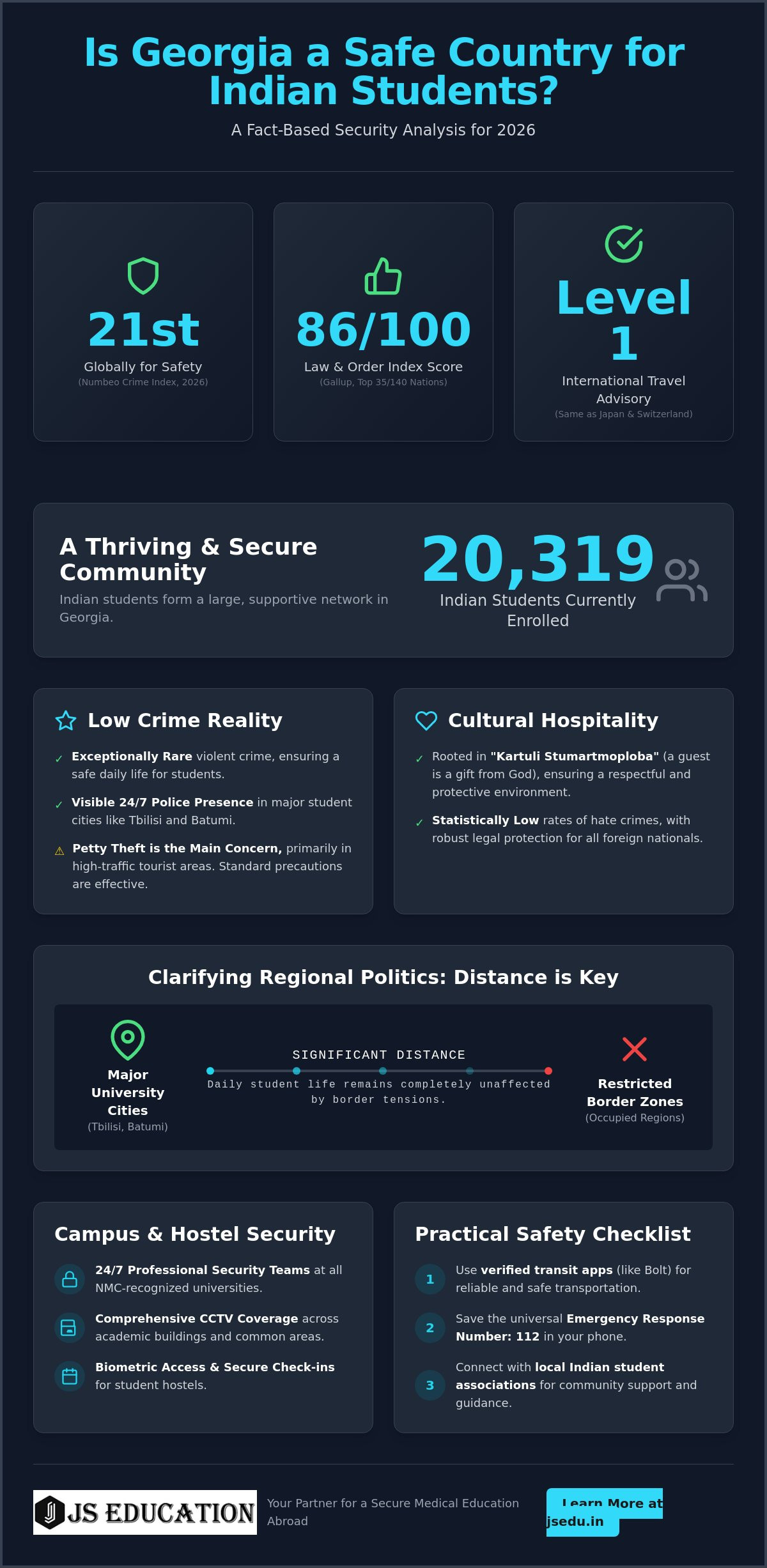
Georgia’s reputation for safety isn’t just anecdotal; it’s backed by rigorous global data. As of June 2026, the Numbeo Crime Index ranks Georgia 21st globally for safety. This puts the nation well ahead of many traditional educational destinations. When parents ask, “is georgia a safe country,” they are often looking for objective proof. The Gallup Law and Order Index provides this, scoring Georgia an 86 out of 100. This places it among the top 35 safest countries out of 140 surveyed. These rankings reflect a consistent trend of stability that has made the country a preferred hub for international medical education.
International travel advisories consistently classify Georgia as a “Level 1” destination. This means the country requires only standard precautions, the same level assigned to nations like Japan or Switzerland. This stability is maintained by the Georgian Ministry of Internal Affairs, which has implemented modernized policing strategies to keep the national crime index at a low 26.2 points. For a long-term resident, this translates to a daily life where safety is a background reality rather than a constant concern. Whether you’re walking to a late-night library session or exploring a new neighborhood, the environment is designed to be secure.
Comparing Crime Rates: Georgia vs. Major Educational Hubs
While major Western hubs like the UK or USA often struggle with rising urban crime, Georgia’s student cities offer a different reality. Statistics show that violent crime is exceptionally rare. Most incidents are limited to petty theft in high-traffic tourist areas. This controlled environment is largely due to the visible, 24/7 police presence in Tbilisi and Batumi. You can read more about the historical decline of Crime in Georgia to understand how the nation transformed into one of Europe’s most secure regions. This proactive approach to law enforcement ensures that students can focus on their studies without the anxiety common in larger global metropolises.
The Cultural Factor: Georgian Hospitality (Kartuli Stumartmoploba)
Safety in Georgia is also deeply rooted in the local philosophy of “Kartuli Stumartmoploba,” which suggests that a guest is a gift from God. This cultural pillar ensures that international students are generally treated with high levels of respect and protection by the local community. With over 20,000 Indian students currently in the country, a strong support network exists. It’s a place where neighbors look out for one another. Hate crimes are statistically low, and the legal framework provides robust protection for foreign nationals, ensuring that the environment remains inclusive and secure for everyone pursuing their professional goals.
Safety for Indian Students: Crime, Community, and Campus Security
For an Indian parent, the question “is georgia a safe country” often boils down to the daily reality of their child’s life. It is about the walk from the library to the hostel at midnight or the security of their living quarters. In 2026, the answer is found in the robust infrastructure built specifically to protect the growing international student population. With 20,319 Indian students currently residing in Georgia, the local environment has adapted to provide a secure, home-like atmosphere that prioritizes student well-being above all else.
The sense of security is palpable in the streets of Tbilisi. Unlike many major cities where certain areas are avoided after dark, students here frequently walk to 24/7 pharmacies or convenience stores at 2 AM without hesitation. This level of comfort is supported by the U.S. State Department travel advisory, which maintains a Level 1 status for the country. This rating confirms that Georgia remains one of the most stable environments for foreigners in the region, allowing students to focus entirely on their rigorous medical curriculum.
University Campus and Hostel Security
NMC-recognized institutions, such as Tbilisi State Medical University, have set high standards for campus safety. These universities employ 24/7 professional security teams and comprehensive CCTV coverage across all academic buildings. Hostels are particularly well-guarded, often featuring biometric access points and mandatory check-in procedures. Most international wings provide separate floors for female students and have dedicated hostel wardens who act as local guardians. This structured environment ensures that help is always seconds away if a student feels uneasy or faces a minor emergency.
Social Integration and the Indian Diaspora
The sheer size of the Indian community in Georgia acts as a natural safety net. In neighborhoods like Saburtalo, which is a hub for medical students, Indian grocery stores and restaurants are common sights. This concentration of the diaspora means that new arrivals are never truly alone. Indian student associations play a vital role here, organizing cultural events and providing a peer-to-peer support network for navigating local laws. While isolated reports of racial profiling exist, the reality for the vast majority of students is one of acceptance and mutual respect. To ensure you are fully prepared for this transition, it is helpful to consult with a trusted advisor who understands the local landscape and can guide you toward the safest residential zones.
Navigating Political Stability and the “Occupied Regions” Misconception
Geopolitical headlines often create a distorted image of reality for those looking at Georgia from a distance. When parents research “is georgia a safe country,” they frequently encounter mentions of the “occupied regions” of Abkhazia and South Ossetia. It’s vital to distinguish between these localized border disputes and the daily life of the rest of the nation. These regions are restricted zones under separate administration; they are not part of the tourist or academic landscape. For an Indian student, these areas are essentially invisible in day-to-day life, as they’re strictly cordoned off and have no impact on the functionality of major cities.
The political climate in Georgia is currently defined by a strong drive toward European Union integration. This trajectory has acted as a powerful stabilizer, encouraging the government to maintain high standards of law and order. In fact, recent data suggests that Georgia is one of the safest countries in Europe for individuals walking alone at night. This sense of security remains consistent even as the country navigates its internal political evolution.
The Geography of Safety
Understanding the physical distance between conflict zones and student hubs is the best way to alleviate anxiety. Major medical universities are located in Tbilisi, Kutaisi, and Batumi. These cities are hundreds of kilometers away from the Administrative Boundary Lines (ABL). While international advisories correctly warn against traveling to the border regions, the heart of the country remains entirely peaceful. The Georgian government maintains a heavy focus on ensuring that urban centers and transport corridors are secure, allowing the academic ecosystem to thrive without interruption from regional border issues.
Understanding Local Demonstrations
You may occasionally see news reports of political demonstrations in Tbilisi, particularly around the Parliament building on Rustaveli Avenue. It’s important to understand that these events are typically localized and peaceful in nature. They represent a vibrant democratic culture rather than civil unrest. Universities are proactive in their communication, often sending alerts to students to avoid specific squares during scheduled rallies. By simply choosing an alternative route or staying away from the immediate vicinity of Parliament House for a few hours, students can go about their classes and social lives without any disruption. The reality of student life is far removed from the sensationalized snippets often seen on global news cycles.
Practical Safety Tips for Living and Studying in Georgia
While global indices provide a macro view of security, your daily experience depends on practical habits and local awareness. Moving beyond the general question of whether is georgia a safe country, you need to understand the systems designed to protect you. Georgia operates a highly efficient, unified emergency service known as “112.” This single number connects you to the police, fire department, and medical emergency services. Operators often speak English, ensuring that international students can communicate clearly during urgent situations. It’s a reliable safety net that functions with the same precision as emergency services in Western Europe.
Legal compliance is another pillar of personal security. As a student, your Temporary Residence Card (TRC) is your most important document. You should carry it at all times. It serves as your official identification and proof of legal status. Georgian police are generally helpful and professional toward foreigners, but they do expect residents to have their documentation in order. Maintaining this legal clarity prevents unnecessary misunderstandings and ensures that you can access all state protections without friction.
Daily Commute and Public Transport Safety
Navigating cities like Tbilisi is remarkably safe, provided you use the right tools. For personal transport, we strongly advise using ride-hailing apps like Bolt or Yandex instead of street hailing. These apps provide a digital trail, fixed pricing, and GPS tracking for every journey. If you prefer public transit, the Tbilisi Metro and the fleet of modern yellow buses are excellent options. You should register for a “student card” immediately upon arrival. This card doesn’t just offer discounted travel; it creates a traceable record of your commutes, adding an extra layer of security to your daily routine.
Cultural Etiquette to Avoid Misunderstandings
Safety is often linked to mutual respect. Georgia is a deeply traditional country with a strong Orthodox Church influence. Respecting local customs, especially when visiting religious sites, builds goodwill with the community. While many young Georgians speak English, learning basic phrases like “Gamarjoba” (Hello) and “Madloba” (Thank you) can bridge the language gap and foster positive local interactions. Financial security is equally vital. Understanding the cost of living in Georgia for Indian students helps you manage your budget effectively and avoid the stress of financial vulnerability. If you’re ready to begin this journey with the support of experts who prioritize your well-being, you can apply for MBBS in Georgia through our verified admission channel.
How JS Education Ensures a Secure Transition for Medical Students
Transitioning to a new country involves more than just securing an admission letter. While the statistical evidence confirms that is georgia a safe country, the actual move requires a strategic partner to manage the logistics of a student’s arrival. We act as a trusted advisor, bridging the gap between Indian expectations and the local Georgian reality. Our support begins long before the flight takes off. Through intensive pre-departure briefings, we empower students with the local knowledge they need to navigate their new home with confidence. We cover everything from setting up local SIM cards to understanding the 112 emergency system and the legal nuances of the student residence permit.
On-ground support is where our commitment to student well-being becomes a tangible reality. We maintain a dedicated team of local representatives in major university cities who are available for emergency assistance and day-to-day guidance. One of our primary tasks is helping students secure vetted, safe accommodation. We prioritize housing located in secure neighborhoods with 24/7 surveillance and proximity to university campuses. This ensures that the student’s living environment is as secure as the academic facilities they attend, providing a seamless transition into their new life as medical professionals in training.
Comprehensive Support from Admission to Graduation
Ensuring legal and academic compliance is the first step toward a secure future. We provide expert guidance to help students and their families verify NMC recognized universities in Georgia. This verification process is crucial for ensuring that the degree remains valid for practice in India. Our oversight of the MBBS in Georgia admission process involves meticulous document handling and adherence to all 2026 regulatory requirements. We don’t stop once the student is enrolled. We conduct regular well-being check-ins throughout the duration of the course to monitor security and academic progress, ensuring that any challenges are addressed immediately by our local team. For Indian students specifically evaluating their institutional options, our detailed breakdown of European University Georgia for Indian students outlines how this institution’s verified FMGE pass rates and NMC compliance make it one of the most secure academic choices available in 2026.
A Message to Parents: Your Child’s Safety is Our Priority
We recognize the high stakes involved when sending a child thousands of miles away for their education. Our role as a “bridge-builder” is to provide absolute transparency. We maintain open communication channels with families back in India, providing accurate updates on the local situation in Georgia. Is georgia a safe country for your child’s medical career? With our structured support system and local expertise, the answer is a confident yes. We take the guesswork out of international education, allowing your child to focus on their studies while we handle the complexities of their security and integration.
Consult with JS Education for a safe and secure MBBS journey in Georgia and take the first step toward a global medical career with total peace of mind.
Secure Your Future in One of the World’s Safest Student Hubs
The data for 2026 is clear: Georgia remains a premier destination for Indian students seeking a secure and supportive environment. From its high global safety rankings to the robust security measures found on medical campuses, the country prioritizes the well-being of its international residents. When you look at the objective facts, the answer to the question “is georgia a safe country” is a resounding yes. By following simple practical tips and staying within verified university networks, you can focus entirely on your professional ambitions without the burden of security concerns.
Navigating this transition is easier when you have a seasoned partner by your side. JS Education brings over 20 years of experience in international medical admissions, having successfully placed more than 1,000 students in top Georgian universities. With our dedicated on-ground support team based in Tbilisi, we ensure that you are never alone on this journey. We handle the complexities of legal compliance and safe housing so you can focus on your medical training with total confidence.
Start your safe and successful medical career in Georgia with JS Education today. Your path to becoming a world-class doctor is waiting, and we are here to make that dream a seamless reality.
Frequently Asked Questions
Is Georgia safer than other MBBS destinations like Russia or Ukraine?
Georgia is much more secure than Russia or Ukraine in 2026. While those regions face active conflict and high-level travel warnings, Georgia maintains a Level 1 travel advisory status. This ranking reflects a stable democracy and a low crime index. For parents wondering if is georgia a safe country compared to other options, the global peace indices provide clear proof of its superior security for international students.
Can Indian students walk safely at night in Tbilisi?
Indian students can walk safely at night in Tbilisi without fear. The city’s student neighborhoods are well-lit and feature a high density of 24/7 convenience stores. Local police patrols are frequent and approachable. This secure environment allows students to manage their study schedules flexibly, knowing that the streets remain peaceful even in the early morning hours. It’s one of the few global capitals where night-time safety is a standard reality.
Are there any specific areas in Georgia that Indian students should avoid?
You must strictly avoid traveling to the Russian-occupied regions of Abkhazia and South Ossetia. These areas are restricted zones and are illegal to enter without official authorization. Outside of these specific border regions, Georgia is exceptionally safe. In urban centers, simply use common sense by avoiding deserted industrial areas or unlit parks after dark, just as you would in any major city across the world.
What should I do in case of a medical or legal emergency in Georgia?
Dial 112 for any medical or legal emergency. This is Georgia’s unified emergency number, and it provides access to English-speaking operators who can dispatch police or ambulances. You should also notify your university’s international student department immediately. Having the Indian Embassy’s contact details stored in your phone is a vital precaution for any long-term resident, ensuring you have official support whenever it’s needed.
Is there racial discrimination against Indian students in Georgia?
Georgia has a deeply rooted culture of hospitality that generally protects international students from discrimination. While isolated misunderstandings can happen in any country, systemic racial issues aren’t a characteristic of Georgian society. The large Indian diaspora and the university legal frameworks ensure that students are treated with respect. There are clear, official channels available to report any grievances, and the local community is largely accustomed to international residents.
How has the Russia-Ukraine conflict affected safety in Georgia in 2026?
The conflict hasn’t impacted the domestic safety of Georgia in 2026. The country continues to operate as a stable, sovereign nation focused on European integration. Daily life in Tbilisi and other university cities remains peaceful. The government’s proactive security measures ensure that regional politics don’t disrupt the academic environment or the safety of the international student community. Students continue to attend classes and travel without any conflict-related interruptions.
Do Georgian universities have separate hostels for girls with high security?
Most medical institutions offer dedicated hostel facilities for female students with enhanced security protocols. These hostels often include separate floors, 24/7 warden assistance, and biometric entry systems to prevent unauthorized access. CCTV monitoring in common areas provides an additional layer of protection. This structured living environment gives parents peace of mind regarding their child’s daily safety and privacy while they pursue their medical degree.
Is it safe for Indian students to travel alone across Georgia during holidays?
Traveling alone across Georgia is safe for Indian students during their holidays. The country is a globally recognized destination for safe travel with a reliable network of buses and trains. When considering if is georgia a safe country for solo exploration, remember that local hospitality extends to all regions. we recommend using verified transport apps and staying in reputable guesthouses while keeping your residence card handy at all times.